About this topic
A small number of leading cases supply many of the rules of Public International Law. Each of them began as a real dispute, and each produced a rule that is needed for examinations and for understanding how States deal with one another. The topic covers 21 leading cases.
Five real disputes show the kind of rules these cases produce:
- A ship's officer sails into a foreign port after an accident on the open sea, and he is arrested and put on trial by a country whose flag he never served under.
- A foreign minister gives a polite one-line answer to a visiting diplomat, and fourteen years later that single sentence helps his country lose its claim to a huge stretch of Arctic coast.
- A country receives a map, says nothing about it for half a century, and then learns that its silence has cost it an ancient temple.
- A businessman acquires a new nationality in a matter of days, only to find that the International Court of Justice will not let that nationality work against the country where he actually lived.
- A powerful country says it is defending its friends, and the same Court tells it that it is breaking the law.
Instead of a loose list, the cases are arranged around five big questions:
- Who can bring a claim in international law?
- Which government speaks for a State?
- Where do the binding rules come from?
- How far does a State's power reach, over land and over sea?
- What happens when a State breaks the rules or uses force?
For every case, keep three things ready: the quarrel, the question and the rule. A student who can state these three things knows the case.
Question 1: Who can bring a claim in international law?
International law was built mainly for States. When an ordinary person is harmed by a foreign government, a practical problem arises: that person usually cannot take a foreign State before an international court in his own name. The first four cases explain how such a complaint reaches the international level, which State may carry it, what power the court needs to hear it, and when a treaty can give rights directly to individuals.
1. Mavrommatis Palestine Concessions case (Greece v. United Kingdom), 1924
This case was decided by the Permanent Court of International Justice (PCIJ), the world court of the League of Nations period, which the International Court of Justice (ICJ) later replaced.
Concession: a contract by which a government gives a private party the right to run a project or business, such as supplying electricity or water, usually in return for payment.
Mandate: after the First World War, Britain administered Palestine under a Mandate from the League of Nations, which means it governed the territory under League supervision.
Mavrommatis Palestine Concessions case, Greece v. United Kingdom (PCIJ, 1924)
Facts (the quarrel): Before the First World War, the Ottoman authorities gave Mr. Mavrommatis, a Greek national, concessions in Palestine. They covered works in Jerusalem, such as electricity and water supply, and also works in Jaffa. After the war, Britain administered Palestine under the Mandate. The British administration gave Mr. Rutenberg a concession that clashed with what Mavrommatis claimed in Jerusalem. Greece took up his complaint and filed a case against the United Kingdom, relying on a clause in the Mandate that allowed disputes between Britain and another League member about the Mandate to be sent to the Court.
Question: Was this a dispute between States at all? Britain said no: in its view, the quarrel was between a private businessman and the British administration.
Held: The Court disagreed and laid down the rule of diplomatic protection. It accepted jurisdiction over the Jerusalem concessions, but not over the Jaffa concessions.
Principle: When a State takes up its national's case, the dispute becomes one between two States.
The rule of diplomatic protection, as stated by the Court:
- A State is entitled to protect its nationals when another State injures them by acts contrary to international law, and
- they have not been able to get satisfaction through the ordinary channels.
- When a State takes up its national's case, it is really asserting its own right, the right to have international law respected in the person of its nationals.
- From that point, the dispute is between two States.
Meaning of "dispute" (Mavrommatis): a disagreement on a point of law or fact, a conflict of legal views or of interests between two persons.
Memory line: in Mavrommatis, the individual's injury becomes the State's own claim.
2. Nottebohm case (Liechtenstein v. Guatemala), 1955
Mavrommatis raises a second question: which State is entitled to adopt a person's claim? Is any passport enough? The ICJ answered this in Nottebohm.
Naturalisation: the process by which a foreigner becomes a national of a State.
Inadmissible claim: a claim that the Court should refuse to hear.
Nottebohm case, Liechtenstein v. Guatemala (ICJ, 1955)
Facts (the quarrel):
- Friedrich Nottebohm was born in Germany in 1881 and was a German national.
- In 1905 he moved to Guatemala, built a large business there and lived there for about 34 years, without becoming a Guatemalan citizen.
- His brother lived in Liechtenstein, a small neutral country in Europe, and he visited it from time to time.
- In October 1939, a few weeks after the Second World War began, he applied for naturalisation in Liechtenstein during one such visit. Liechtenstein granted it within days and excused its normal residence requirement. Under German law, he lost his German nationality.
- He went back to Guatemala on a Liechtenstein passport.
- In 1943, Guatemala, which was at war with Germany, arrested him as an enemy national, handed him over to the United States for internment, and later confiscated his property.
- Liechtenstein sued Guatemala, asking for restitution and compensation on his behalf.
Question: Guatemala argued that the claim was inadmissible because the nationality had no real substance. Did Guatemala have to accept Liechtenstein's nationality for the purpose of diplomatic protection?
Held: No. Nottebohm's life, his home and his business were in Guatemala, and his ties with Liechtenstein were thin. The naturalisation had been sought mainly to replace the status of a national of a country at war with that of a national of a neutral country. Liechtenstein's claim was rejected.
Principle: the genuine link doctrine.
Nationality (Nottebohm): a legal bond having as its basis a social fact of attachment, a genuine connection of existence, interests and sentiments.
Limit of the decision: the Court did not declare the naturalisation invalid under Liechtenstein's own law. It only held that Liechtenstein could not use it against Guatemala on the international plane.
Memory line: a passport opens the door to diplomatic protection only if a real life stands behind it.
3. Anglo-Iranian Oil Company case (United Kingdom v. Iran), 1952
Even when the right State brings a claim, one more hurdle remains. The court must have power to hear it, and that power comes only from the consent of the States involved. This case, decided by the ICJ, shows that hurdle at work.
Nationalisation: the State takes a private business into its own ownership and control.
Anglo-Iranian Oil Company case, United Kingdom v. Iran (ICJ, 1952)
Facts (the quarrel): In 1933, Iran granted an oil concession to a British company that later became the Anglo-Iranian Oil Company. That concession had come about after a quarrel over an earlier concession was taken to the League of Nations. In 1951, Iran nationalised its oil industry, and the company lost its Iranian operations. The United Kingdom brought a case against Iran, asking the Court to order restoration of the company's position or payment of compensation.
Question (jurisdiction): Iran had accepted the Court's compulsory jurisdiction only for disputes about treaties or conventions accepted by Iran after its declaration. The United Kingdom tried to bring the case within that limit in two ways:
- It argued that the 1933 concession was also a treaty between the two governments, because of the League's role in producing it.
- It relied on older treaties with Iran.
Held: The Court accepted neither argument.
- The concession was a contract between a government and a foreign company, and the United Kingdom was not a party to it. A contract with a foreign company does not turn into a treaty just because the company's home State takes an interest in it.
- The older treaties came before Iran's declaration, so they fell outside Iran's consent.
The Court found that it had no jurisdiction, and the case never reached the merits.
Principle: the jurisdiction of an international court rests on the consent of States and goes no further than that consent.
Memory line: a State's contract with a foreign company is not a treaty, and a court's power stops where consent stops.
4. Danzig Railway Officials case (Advisory Opinion), 1928
In the first three cases, the individual needed a State to speak for him. This case shows that a treaty can sometimes hand rights straight to individuals. It is an advisory opinion of the PCIJ.
Advisory opinion: a legal opinion given at the request of an authorised body, not a judgment in a contested case between States.
Danzig Railway Officials case (PCIJ, Advisory Opinion, 1928)
Facts (the quarrel): After the First World War, Danzig became a Free City under the protection of the League of Nations, and Poland took control of its railways. Many Danzig railway officials moved into Polish service. A 1921 agreement between Danzig and Poland set their service conditions, including pay and pensions. Some of these officials sued the Polish railway administration in the Danzig courts for money due under that agreement.
Poland's objection: the agreement was an international agreement between two parties, which could give no direct rights to private persons. At most, Poland might owe something to Danzig, not to the officials. The dispute reached the League of Nations, and its Council asked the PCIJ for an advisory opinion.
Question: Could the officials rely directly on the agreement in the Danzig courts?
Held: Yes. The agreement was meant to form part of the officials' contract of service. So the officials could rely on it, and the Danzig courts had jurisdiction.
Principle: a treaty can create rights directly enforceable by individuals if that is what the parties intended.
The Court's reasoning had two steps:
- General rule: an international agreement does not, by itself, create direct rights and obligations for private individuals.
- Exception: the very object of an agreement, according to the intention of the parties, may be to adopt definite rules creating individual rights and obligations that national courts can enforce. That intention is read from the content of the agreement.
Memory line: if the parties intend it, a treaty can speak directly to individuals. This idea later became one of the foundations of human rights law.
Question 1 at a glance
| Case | Court and year | Hurdle | Rule |
|---|---|---|---|
| Mavrommatis Palestine Concessions | PCIJ, 1924 | How does an individual's complaint reach the international level? | Diplomatic protection: the State asserts its own right, and the dispute becomes one between States |
| Nottebohm | ICJ, 1955 | Which State may adopt the claim? | Genuine link: nationality without a real connection cannot be used against another State |
| Anglo-Iranian Oil Company | ICJ, 1952 | Does the court have power to hear it? | Jurisdiction rests on consent; a concession contract is not a treaty |
| Danzig Railway Officials | PCIJ, Advisory Opinion, 1928 | Can a treaty give rights directly to individuals? | Yes, where the parties so intend, as read from the content of the agreement |
Question 2: Which government speaks for a State? (Recognition)
When a government comes to power by revolution, conquest or civil war, foreign courts must decide whether to treat its laws as real laws. This is where recognition matters.
Recognition is the act by which one State accepts that another entity is a State, or that a group is the government of a State.
- De jure recognition is full recognition of a government as the lawful government.
- De facto recognition is more careful. It accepts that a government actually controls territory, without yet fully accepting its legal title.
| Point | De jure recognition | De facto recognition |
|---|---|---|
| Nature | Full recognition | Careful, limited recognition |
| What is accepted | The government is the lawful government | The government actually controls territory |
| Legal title | Fully accepted | Not yet fully accepted |
English courts decided four leading cases on these ideas. In each of them, the court followed the official statement of the British Foreign Office about recognition.
Think of recognition as a letter appointing a new manager. A de jure letter says, "You are the rightful manager." A de facto letter says, "We accept that you are actually running the office." And very often the letter is backdated. This picture holds all four recognition cases together.
5. Luther v. Sagor, 1921
Luther v. Sagor (English Court of Appeal, 1921)
Facts (the quarrel): A. M. Luther was a company incorporated in Russia, which owned a factory producing wood products. After the Russian Revolution, the Soviet Government nationalised the factory in 1919 and seized its wood. In 1920, it sold some of that wood to James Sagor and Company, an English firm, which shipped it to England. The Luther company sued in England, saying that the wood was still its own. Its argument was that Britain had not recognised the Soviet Government, so an English court should ignore that government's decrees. At first instance, the company won on exactly this point.
Question: Before the appeal was heard, Britain recognised the Soviet Government as the de facto government of Russia. Could the English courts still ignore the nationalisation?
Held: No. Recognition is retroactive. The English courts could no longer question the nationalisation. The wood had become the property of the Soviet Government and then passed to Sagor by the sale. The company lost.
Principle: recognition reaches back in time and validates the acts of the government from the date it actually took power.
Retroactive means reaching back in time. Retroactive recognition validates the acts of the government from the date it actually took power.
Memory line: recognition, like a backdated letter, covers what the government did before the letter arrived.
6. Civil Air Transport Incorporated v. Central Air Transport Corporation, 1952
This case answers how far the backdating of recognition reaches, and over what.
Civil Air Transport Incorporated v. Central Air Transport Corporation (Privy Council, 1952)
Facts (the quarrel):
- During the Chinese civil war in 1949, aircraft of the Central Air Transport Corporation, an airline belonging to the Nationalist Government of China, were flown to Hong Kong, which was then a British colony.
- The People's Republic of China was proclaimed on 1 October 1949.
- In December 1949, the Nationalist Government, which Britain still recognised as the government of China, sold the aircraft to American buyers, whose rights passed to Civil Air Transport Incorporated.
- In January 1950, Britain withdrew recognition from the Nationalist Government and recognised the Communist Government as the de jure government of China.
- The airline corporation, now under the new government's control, claimed the aircraft. The Hong Kong courts agreed with it, relying on retroactivity.
Question: Did retroactive recognition of the new government cancel the sale made by the earlier recognised government?
Held: The Privy Council reversed the Hong Kong decision. The aircraft were in Hong Kong, never under the new government's control, and the sale was made while the Nationalist Government was still recognised. So the sale stood, and Civil Air Transport kept the aircraft.
Principle: retroactive recognition validates the acts of the new government in the territory that it actually controlled. It does not cancel the acts of the previously recognised government in territory that remained under that earlier government's control.
In the manager picture, the backdated letter covers only the rooms the new manager was really running. It cannot reach into the rooms that the old manager still held and undo what he did there.
| Point | Luther v. Sagor | Civil Air Transport v. Central Air Transport |
|---|---|---|
| Court and year | English Court of Appeal, 1921 | Privy Council, 1952 |
| Recognition given | De facto recognition of the Soviet Government | De jure recognition of the Communist Government of China |
| Act in question | The new government's own nationalisation of the factory and seizure of the wood | A sale by the earlier recognised government of aircraft in Hong Kong, never under the new government's control |
| Result | Retroactivity validated the nationalisation; Sagor won | Retroactivity did not undo the earlier government's sale; Civil Air Transport won |
| Lesson | Recognition is retroactive | Retroactivity is limited to territory the new government actually controlled |
7. Bank of Ethiopia v. National Bank of Egypt and Liguori, 1937
This case shows the practical effect of de facto recognition on a government's decrees.
Bank of Ethiopia v. National Bank of Egypt and Liguori (English court, 1937)
Facts (the quarrel): In the war between Italy and Ethiopia, Italian forces captured Addis Ababa, the Ethiopian capital, in 1936. The Italian authorities issued a decree dissolving the Bank of Ethiopia and appointing Mr. Liguori as its liquidator, the person who winds up a company and collects its assets. The National Bank of Egypt held money belonging to the Bank of Ethiopia. The bank, through its former management, sued in England for that money and challenged the Italian decree.
Question: Must an English court give effect to the decree of a government recognised only de facto?
Held: The Foreign Office informed the court that Britain recognised the Italian Government as the de facto government of the parts of Ethiopia under Italian control. The court held that it therefore had to give effect to the decree, and the bank's claim failed.
Principle: the decrees of a government recognised de facto are given effect in the territory it actually controls.
In the manager picture, even a de facto letter is enough to make the manager's orders count inside the office he actually runs.
8. The Arantzazu Mendi, 1939
This case asks what happens when two rival governments of the same State both come to court. It was decided during the Spanish Civil War.
The Arantzazu Mendi (House of Lords, 1939)
Facts (the quarrel): Britain recognised the Republican Government as the de jure government of Spain, and the Nationalist Government as the government exercising de facto administrative control over the larger part of Spain. The dispute was over a merchant vessel registered at Bilbao, the Arantzazu Mendi. After the Nationalists captured Bilbao, both governments issued decrees requisitioning ships registered there, that is, taking them over for State use. The ship's owners and master accepted the Nationalist Government's authority. While the ship was in London, the Republican Government began an action in an English court to take possession of her.
Question: The Nationalist Government objected that, as a foreign sovereign, it could not be sued in an English court without its consent. Was it entitled to that immunity?
Held: Yes. Because Britain recognised it as the de facto government of the territory it controlled, the Nationalist Government was treated as a foreign sovereign entitled to immunity. An English court could not decide a claim that would interfere with property in the possession and control of such a sovereign. The Republican Government's action was set aside.
Principle: a government recognised de facto is treated as a foreign sovereign and enjoys immunity, even against a claim by the rival government recognised de jure.
In the manager picture, even a manager holding only a de facto letter is treated as master of his own office. A foreign court will not drag him into a lawsuit without his consent, even at the request of the rival who holds the de jure letter.
Question 2 at a glance
| Case | Court and year | Rule |
|---|---|---|
| Luther v. Sagor | English Court of Appeal, 1921 | Recognition is retroactive and validates the government's acts from the date it actually took power |
| Civil Air Transport v. Central Air Transport | Privy Council, 1952 | Retroactivity covers only territory the new government actually controlled; it does not undo the earlier recognised government's acts elsewhere |
| Bank of Ethiopia v. National Bank of Egypt and Liguori | English court, 1937 | De facto recognition is enough to give effect to a government's decrees in territory it controls |
| The Arantzazu Mendi | House of Lords, 1939 | A de facto government is a foreign sovereign entitled to immunity, even against the de jure government |
Question 3: Where do the binding rules come from? (Custom and treaties)
The two main sources of binding rules are treaties and custom. Article 38 of the Statute of the ICJ tells the Court to apply, among other things:
"international custom, as evidence of a general practice accepted as law"
Custom has two parts:
- a practice of States; and
- a belief that the practice is legally required. This belief is called opinio juris.
Custom can be studied in three sizes: a custom for the whole world, a custom for one region, and a custom between just two neighbours. After that comes the question of when a State can walk away from a treaty.
| Size of custom | Leading case | Rule |
|---|---|---|
| General (whole world) | North Sea Continental Shelf cases, 1969 | A treaty rule becomes general custom only through very widespread and representative participation, extensive and virtually uniform practice, and opinio juris |
| Regional | Asylum case, 1950 | The party relying on it must prove constant and uniform usage; it does not bind a State that has kept away from it |
| Local (two States) | Right of Passage over Indian Territory case, 1960 | Two States are enough to make a custom, but it covers only what the practice actually covered |
9. North Sea Continental Shelf cases, 1969 (world-sized custom)
- Continental shelf: the seabed that slopes out from a coast under the sea; it can hold oil and gas.
- Delimit: to divide by drawing boundaries.
- Equidistance: a method in which every point of the boundary is the same distance from the nearest points on each coast.
- Concave coast: a coast that bends inward.
North Sea Continental Shelf cases, Federal Republic of Germany v. Denmark and Federal Republic of Germany v. the Netherlands (ICJ, 1969)
Facts (the quarrel): The three States had to delimit their areas of the North Sea continental shelf. Denmark and the Netherlands wanted equidistance, the method found in Article 6 of the Geneva Convention on the Continental Shelf, 1958. Germany's coast is concave, lying between two neighbours whose coasts bend outward. Equidistance lines drawn from both sides would close in front of Germany and leave it a small area, out of proportion to its long coastline. Germany had signed the Convention but never ratified it. Denmark and the Netherlands therefore argued that equidistance had become customary law, binding on Germany anyway.
Question: Had the equidistance rule in the treaty become customary law binding on a non-party?
Held: The Court decided in favour of Germany. A treaty rule can grow into general customary law and bind even States that are not parties, but only under demanding conditions, and equidistance failed them. Germany was not bound by it.
Principle: the conditions for a treaty rule to become general custom (below), and delimitation by agreement in accordance with equitable principles.
Conditions for a treaty rule to become general customary law
- Participation must be very widespread and representative, and it must include the States whose interests are specially affected.
- State practice must be extensive and virtually uniform.
- The practice must show opinio juris, a sense that it is required by law.
Why equidistance failed these tests
- It had been proposed with hesitation.
- The Convention permitted reservations to it.
- Later practice was too thin.
How the boundary was to be drawn
- The boundary must be settled by agreement in accordance with equitable principles, taking account of all relevant circumstances.
- Each State should receive, as far as possible, the parts of the shelf that are the natural prolongation of its land territory.
- There should be a reasonable degree of proportionality between the shelf area and the length of coast.
- The parties later negotiated new boundaries, and Germany received a larger share.
Because the Court filled the gap with equitable principles where no fixed rule bound the parties, this case is commonly given as an illustration of equity praeter legem.
Praeter legem means "alongside the law". The judge does not act against the law; the judge supplies a fair rule where the law is silent, so that the dispute can still be decided.
Memory line: a treaty rule becomes world custom only through wide, uniform practice backed by a sense of legal duty.
10. Asylum case (Colombia v. Peru), 1950 (regional custom)
The Asylum case, decided by the ICJ, is the leading case on regional custom.
Diplomatic asylum is protection given inside an embassy. Territorial asylum is protection that a State gives within its own territory.
Safe conduct: a guarantee that a person can leave the country without arrest.
Asylum case, Colombia v. Peru (ICJ, 1950)
Facts (the quarrel): In October 1948, an armed rebellion broke out in Peru and was crushed. The Peruvian Government blamed Victor Raul Haya de la Torre, the leader of a political party. In January 1949, he entered the Colombian Embassy in Lima, the Peruvian capital, and the Colombian Ambassador granted him diplomatic asylum. Colombia classified him as a political offender and asked Peru for a safe conduct. Peru refused, saying that he faced charges for common crimes.
Colombia's claim: the State granting asylum could decide, alone and with binding effect, whether the offence was political. It relied on:
- the Bolivarian Agreement on Extradition, 1911;
- the Havana Convention on Asylum, 1928;
- the Montevideo Convention on Political Asylum, 1933; and
- a regional custom said to exist among Latin American States.
Question: Did any treaty or regional custom give Colombia a one-sided right to classify the offence, binding on Peru?
Held: The Court rejected Colombia's claim (details below).
Principle: a regional custom must be proved by constant and uniform usage, and cannot be invoked against a State that has kept away from it.
Why diplomatic asylum is a sensitive matter
- An embassy is not a piece of the sending State's territory. It stands on the territory of the receiving State.
- What the law gives the embassy is inviolability.
- When an embassy shelters a person wanted by the local authorities, it blocks the normal legal process of the territorial State on that State's own soil. Such a step needs a firm legal basis.
Vienna Convention on Diplomatic Relations, 1961, Article 22, paragraph 1: "The premises of the mission shall be inviolable. The agents of the receiving State may not enter them, except with the consent of the head of the mission."
What the Court held
- Treaties: none of the treaties gave such a one-sided right, and Peru had not ratified the Montevideo Convention.
- Burden of proving custom: the party relying on a custom must prove a constant and uniform usage.
- No such custom proved: the practice shown was full of uncertainty and contradiction, and was shaped largely by political convenience.
- Not binding on Peru anyway: even if such a custom had existed, it could not be invoked against Peru, which had kept away from it by refusing to ratify the Montevideo Convention.
- Safe conduct: Peru was not obliged to issue a safe conduct.
- Colombia's own grant: Colombia's grant of asylum was itself not in line with the Havana Convention, because there was no urgency when Haya de la Torre arrived at the embassy three months after the rebellion.
Memory line: a regional custom must be proved by constant and uniform practice, and it does not bind a State that has kept away from it.
11. Right of Passage over Indian Territory case (Portugal v. India), 1960 (custom between two States)
Can a custom exist between only two States? India itself was a party to the case, decided by the ICJ, that answered this question.
Enclave: territory completely surrounded by another State's territory.
Right of Passage over Indian Territory case, Portugal v. India (ICJ, 1960)
Facts (the quarrel): Portugal held the coastal district of Daman and two small inland enclaves, Dadra and Nagar Haveli. To reach these enclaves from Daman, Portuguese officials had to cross Indian land. In 1954, groups supporting India took control of Dadra and Nagar Haveli, and India refused to let Portuguese officials and armed forces pass through its territory to reach them.
Portugal's claim: a right of passage between Daman and the enclaves, and between the enclaves, as far as needed to exercise its sovereignty there. It relied on the Treaty of Poona of 1779 with the Maratha rulers, on later grants, and on a long practice of passage, which it called a local custom.
India's reply:
- A local custom could not arise between only two States.
- The Maratha grants had given Portugal only revenue rights, not sovereignty.
Question: Did Portugal have a right of passage through Indian territory based on local custom, and had India breached it?
Held: The Court gave a layered answer (below). Portugal had a right of passage for private persons, civil officials and goods in general, but not for armed forces, armed police, arms and ammunition; and India had not breached its obligations.
Principle: a local custom can arise between two States, but it extends only as far as the practice accepted as law.
The Court's layered answer
- Two States can make a custom: the Court saw no reason why a long practice between two States, accepted by them as governing their relations, could not create a local custom binding on them.
- Private persons, civil officials and goods in general: there was a constant and uniform practice of free passage lasting beyond a century and a quarter, through the British period and after it. That practice was accepted as law, so Portugal had a right of passage for them.
- Armed forces, armed police, arms and ammunition: these had always needed British and later Indian permission, so there was no such right for them.
- No breach by India: in the tense situation after 1954, India's refusal fell within its power to regulate and control passage.
| Category | Past practice | Right of passage? |
|---|---|---|
| Private persons, civil officials and goods in general | Constant and uniform free passage for more than a century and a quarter, accepted as law | Yes |
| Armed forces, armed police, arms and ammunition | Always needed British and later Indian permission | No |
These territories were formally made part of India in 1961, the year after the judgment.
Updated from the lecture: the lecture said these territories became part of India a few years later. The correct position is that Dadra and Nagar Haveli, out of Portuguese control since 1954, were formally integrated into India as a Union territory by the Constitution (Tenth Amendment) Act, 1961, with effect from 11 August 1961, a little over a year after the 1960 judgment. Source: The Constitution (Tenth Amendment) Act, 1961 (legislative.gov.in).
Memory line: two States are enough to make a custom, but the custom covers only what the practice actually covered.
12. Fisheries Jurisdiction case (United Kingdom v. Iceland), 1973 and 1974 (escaping a treaty)
Custom grows slowly out of practice. A treaty, by contrast, is a deliberate promise. The question here is when a State can escape that promise because the world has changed. The leading case was decided by the ICJ in 1973 and 1974.
Exchange of notes: a simple form of treaty made through diplomatic letters.
Rebus sic stantibus (roughly, "things remaining as they are"): the doctrine of fundamental change of circumstances.
Fisheries Jurisdiction case, United Kingdom v. Iceland (ICJ, 1973 and 1974)
Facts (the quarrel): In 1961, the two States resolved a fishing dispute by an exchange of notes. The United Kingdom accepted Iceland's 12 nautical mile fishery zone. Iceland, in turn, agreed that any dispute about a further extension of its fishery jurisdiction would go to the ICJ at the request of either side. In 1972, Iceland extended its exclusive fishery zone to 50 nautical miles and declared that the 1961 agreement no longer bound it. Iceland did not appear in Court, but it argued in letters that circumstances had changed fundamentally, pointing to new fishing technology and its heavy dependence on fish.
Question: Could Iceland escape the 1961 agreement on the ground of a fundamental change of circumstances?
Held: No. The obligation still to be performed was simply to let the Court decide a dispute. Better fishing technology did not radically transform that duty.
- 1973: the Court upheld its jurisdiction.
- 1974: Iceland's 50 mile regulations could not be enforced against the United Kingdom. Iceland, as a coastal State specially dependent on fishing, had preferential rights, but British vessels had established rights too, and the two States had to negotiate an equitable settlement.
Principle: a change of circumstances ends a treaty obligation only on the strict conditions of Article 62 of the Vienna Convention on the Law of Treaties, 1969, which the Court treated as reflecting customary law.
Article 62 of the Vienna Convention on the Law of Treaties, 1969
The Court treated Article 62 as reflecting customary law on the doctrine of fundamental change of circumstances.
Article 62, paragraph 1: "A fundamental change of circumstances which has occurred with regard to those existing at the time of the conclusion of a treaty, and which was not foreseen by the parties, may not be invoked as a ground for terminating or withdrawing from the treaty unless:
(a) the existence of those circumstances constituted an essential basis of the consent of the parties to be bound by the treaty; and
(b) the effect of the change is radically to transform the extent of obligations still to be performed under the treaty."
The rule is written in the negative. The starting point is that a change may not be invoked. Escape is the exception.
Article 62, paragraph 2: "A fundamental change of circumstances may not be invoked as a ground for terminating or withdrawing from a treaty:
(a) if the treaty establishes a boundary; or
(b) if the fundamental change is the result of a breach by the party invoking it either of an obligation under the treaty or of any other international obligation owed to any other party to the treaty."
Paragraph 3 adds that where a party may invoke such a change to terminate or withdraw, it may also invoke it as a ground for suspending the operation of the treaty.
| Article 62 | Content |
|---|---|
| Paragraph 1: conditions for invoking the change | (a) The circumstances were an essential basis of the parties' consent; and (b) the change radically transforms the extent of obligations still to be performed |
| Paragraph 2: plea never available | (a) The treaty establishes a boundary; or (b) the change results from a breach by the party invoking it |
| Paragraph 3: suspension | Where termination or withdrawal may be claimed, suspension may also be claimed |
Memory line: changed times do not cancel a treaty unless the change strikes at the very basis of consent and radically transforms what remains to be done.
Question 4: How far does a State's power reach? (Territory and the sea)
A boundary treaty cannot be escaped through a change of circumstances. Boundaries lead to the fourth question: how does a State gain land, and how far does its power reach? Four cases answer it: a State bound by its silence, a State bound by its words, a title won by long deeds, and a State acting on the open sea.
13. Temple of Preah Vihear case (Cambodia v. Thailand), 1962 (silence)
This ICJ case is the leading case on acquiescence.
Acquiescence: accepting something by staying silent when one was expected to object.
Watershed line: the line along which rainwater divides and runs in opposite directions.
Temple of Preah Vihear case, Cambodia v. Thailand (ICJ, 1962)
Facts (the quarrel):
- The temple stands on a cliff in the Dangrek mountains, on the border between Cambodia and Thailand, which was then called Siam.
- In 1904, France, which then controlled Cambodia, agreed with Siam that in this sector the boundary would follow the watershed line. A mixed commission was to work out the details.
- French experts later prepared maps, partly at Siam's request, and published them in 1908. One of them showed the temple on the Cambodian side.
- Siam received the map, used it and raised no objection.
- In 1930, Prince Damrong of Siam made an official visit to the temple and was received by the French official of the neighbouring Cambodian province, under a French flag. Siam still made no protest.
- After Cambodia became independent, Thai forces were stationed at the temple, and Cambodia brought the case.
Thailand's argument: the map was wrong, because the real watershed line placed the temple in Thailand, and Thailand had never accepted the map.
Question: Was Thailand bound by the map despite the alleged error?
Held: Yes. Even if the map contained an error, Thailand's conduct over many years amounted to acceptance. Thailand had also enjoyed the benefit of a stable boundary for some fifty years. The temple was in territory under Cambodian sovereignty. Thailand had to withdraw its military and police forces and return objects removed from the temple.
Principle: where a State ought to have reacted and could have reacted, its silence is taken as consent.
Later developments: after the temple was listed as a UNESCO World Heritage Site in 2008, tension returned. In 2013 the Court, interpreting its earlier judgment, held that Cambodia had sovereignty over the whole promontory of Preah Vihear.
Memory line: in boundary matters, silence can speak, and it can speak against you.
14. Legal Status of Eastern Greenland case (Denmark v. Norway), 1933 (words)
This PCIJ case shows how a single sentence can bind a State.
Terra nullius: land belonging to no State, and so open to occupation.
Critical date: the date at which the legal position is judged.
Legal Status of Eastern Greenland case, Denmark v. Norway (PCIJ, 1933)
Facts (the quarrel): In 1919, the Danish Minister in Norway asked the Norwegian Foreign Minister, Mr. Ihlen, whether Norway would make difficulties if Denmark extended its sovereignty over all of Greenland, while Denmark would raise no objection to Norway's claims over Spitsbergen. Mr. Ihlen replied orally that Norway would not make any difficulties in settling this question. Twelve years later, on 10 July 1931, Norway proclaimed that it had occupied part of Eastern Greenland. Denmark claimed sovereignty over the whole island and went to the PCIJ.
Norway's arguments:
- Danish sovereignty covered only the colonised areas on the west coast; the east was terra nullius.
- Mr. Ihlen had no constitutional power to make such a commitment.
Question: Did Denmark have sovereignty over the area on the critical date, and was Norway bound by Mr. Ihlen's reply?
Held: Denmark had sovereignty. Norway was obliged not to dispute Danish sovereignty over Greenland. The Court declared Norway's occupation unlawful and invalid.
Principle: sovereignty based on a continued display of authority needs intention plus actual exercise; and a Foreign Minister's reply on a matter within his province binds his State.
Step 1: The critical date
The critical date was 10 July 1931, the day of Norway's proclamation. The question was whether Denmark had sovereignty over the area on that day.
Step 2: Two elements of a claim based on a continued display of authority
- Animus occupandi: the intention and will to act as sovereign.
- Corpus possessionis: some actual exercise or display of that authority, meaning actual possession and control.
Remember the two elements as mind and hand: the mind that wants to rule (animus occupandi) and the hand that actually rules (corpus possessionis).
- In a remote and thinly populated region, very little actual exercise of authority is needed, so long as no other State can show a better claim.
- Denmark satisfied both elements through its legislation, its concessions, and treaties that dealt with Greenland as a whole.
Step 3: Mr. Ihlen's reply
A reply given by a Foreign Minister on behalf of his government, in answer to a request from a foreign diplomatic representative, on a matter within his province, binds his country. Norway's argument that Mr. Ihlen lacked constitutional power did not succeed.
Memory line: the critical date fixes the moment, mind and hand prove the occupation, and a Foreign Minister's word can bind his State.
15. Island of Palmas arbitration (Netherlands and United States of America), 1928 (deeds)
This case shows a title won by deeds over centuries. It was decided by the sole arbitrator, Max Huber, in 1928, after the parties had agreed to arbitrate in 1925.
Island of Palmas arbitration, the Netherlands and the United States of America (sole arbitrator Max Huber, 1928)
Facts (the quarrel): Palmas is a small island between the southern Philippines and what were then the Dutch East Indies.
- United States: claimed it as part of the Philippines, which Spain had ceded to it by the Treaty of Paris of 1898. This claim rested on Spain's title, which came mainly from discovery in the sixteenth century, and also on the island's nearness to the Philippines.
- Netherlands: relied on a long and peaceful exercise of authority, through arrangements with local rulers going back to the seventeenth century.
Question: Did discovery and nearness, or long and peaceful display of authority, give title to the island?
Held: The island went to the Netherlands. Spain's inchoate title from discovery could not prevail over the continuous and peaceful display of authority by the Netherlands, and nearness alone did not create title.
Principle: continuous and peaceful display of State authority prevails over an incomplete title based on discovery.
Sovereignty over territory (Huber): the right to exercise the functions of a State there, to the exclusion of all other States.
Intertemporal law: an act is judged by the law in force when it happened, but a right, to continue, must also satisfy the law as it develops later.
Huber's reasoning
- Discovery may once have counted for something. But by the nineteenth century, discovery alone gave only an inchoate title, meaning an incomplete title, which had to be completed within a reasonable time by effective occupation.
- An inchoate title cannot prevail over a continuous and peaceful display of authority by another State.
- Spain could hand over to the United States only what it actually had.
- The Netherlands had displayed sovereignty continuously and peacefully, probably from before 1700. The position was unchanged in 1906, when an American official visited the island and found the Dutch flag flying.
- The argument of nearness also failed, because geographical closeness does not, by itself, create title.
Memory line: discovery is only a first step, while long, peaceful and actual government wins the land.
| Case | How the State was bound or gained title | Rule |
|---|---|---|
| Temple of Preah Vihear (ICJ, 1962) | Silence | Where a State ought to have reacted and could have reacted, its silence is taken as consent (acquiescence) |
| Eastern Greenland (PCIJ, 1933) | Words | A Foreign Minister's reply on a matter within his province binds his State; occupation needs animus occupandi and corpus possessionis |
| Island of Palmas (Max Huber, 1928) | Deeds | Continuous and peaceful display of authority prevails over an inchoate title from discovery; nearness alone gives no title |
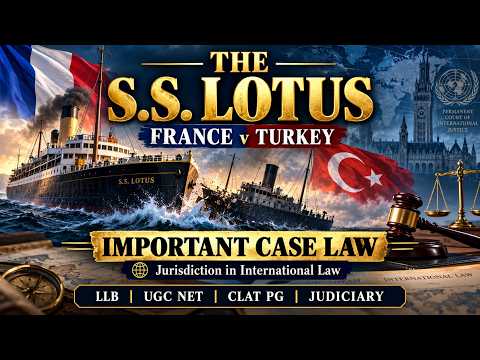
16. S. S. Lotus case (France v. Turkey), 1927 (the open sea)
On the open sea, no State owns the water. Does a State's criminal law stop at its shore? The PCIJ gave a famous answer.
S. S. Lotus case, France v. Turkey (PCIJ, 1927)
Facts (the quarrel): On 2 August 1926, on the high seas near the Greek island of Lesbos, the French mail steamer Lotus collided with the Turkish ship Boz Kourt. The Turkish ship sank and eight Turkish nationals died. The Lotus picked up survivors and sailed on to Constantinople, today's Istanbul. There, Turkish authorities arrested Lieutenant Demons, the French officer of the watch on the Lotus at the time of the collision. He was tried together with the Turkish captain for involuntary manslaughter and was convicted. France protested, and the two States took the matter to the PCIJ by agreement.
Question: Did Turkey's prosecution of a French officer for a collision on the high seas violate international law?
Held: No. The judges were equally divided, and the President's casting vote decided the case for Turkey.
Principle: the Lotus principle: a State is free to act unless a rule of international law forbids it.
| France's argument | Turkey's argument |
|---|---|
| Turkey needed a permissive rule of international law to justify its jurisdiction; on the high seas, the flag State alone has jurisdiction over what happens on board its ship | No rule of international law prohibited the prosecution |
The Court's reasoning
- Restrictions on the independence of States cannot be presumed. A State has wide freedom to act, limited only by prohibitive rules. So France had to point to a rule forbidding Turkey's jurisdiction, and it found none.
- Concurrent jurisdiction: the effects of the offence were felt on the Turkish ship, which is treated like Turkish territory. So both States had concurrent jurisdiction, each with a valid claim to try the case.
- Abstention is not custom: the fact that States had usually not prosecuted in such cases did not prove a customary prohibition, because there was no evidence that they had abstained out of a sense of legal duty.
Lotus principle: a State is free to act unless a rule forbids it. Restrictions on the independence of States cannot be presumed.
The collision rule reversed by treaty
The specific collision rule of Lotus was later reversed by treaty.
United Nations Convention on the Law of the Sea, 1982, Article 97, paragraph 1: "In the event of a collision or any other incident of navigation concerning a ship on the high seas, involving the penal or disciplinary responsibility of the master or of any other person in the service of the ship, no penal or disciplinary proceedings may be instituted against such person except before the judicial or administrative authorities either of the flag State or of the State of which such person is a national."
- Paragraph 2: in disciplinary matters, only the State that issued a master's certificate, or a certificate of competence or licence, may withdraw it, after due legal process, even if the holder is not its national.
- Paragraph 3: no authority other than the flag State may order the arrest or detention of the ship, even as a measure of investigation.
| Point | Lotus case (1927) | Article 97, Law of the Sea Convention (1982) |
|---|---|---|
| Who may prosecute after a collision on the high seas | Concurrent jurisdiction: Turkey, whose ship felt the effects, could try the French officer | Only the flag State or the State of which the accused person is a national |
| Basis | No prohibitive rule forbade Turkey's jurisdiction; the Turkish ship is treated like Turkish territory | Express treaty rule |
Memory line: Lotus gave a broad principle of State freedom, but for collisions at sea, the treaty now gives jurisdiction only to the flag State and the State of the accused person's nationality.
Question 5: What happens when a State breaks the rules or uses force?
The sea also supplies the first case on this question. Corfu Channel shows when responsibility arises; Chorzow Factory shows what the responsible State must then do; Caroline and Nicaragua set the limits of force in self-defence.
17. Corfu Channel case (United Kingdom v. Albania), 1949
This was the first contentious case, that is, the first dispute between States, to come before the ICJ.
Corfu Channel case, United Kingdom v. Albania (ICJ, 1949)
Facts (the quarrel): The North Corfu Channel is a narrow strait between the coast of Albania and the Greek island of Corfu, and it is used for international navigation. On 22 October 1946, a squadron of British warships sailed through it. Two destroyers struck mines in Albanian waters, both were badly damaged, and 44 British sailors were killed. A few weeks later, the Royal Navy swept the channel for mines inside Albanian waters without Albania's consent.
Questions and answers:
- Was Albania responsible for the explosions? Yes. The minefield could not have been laid without Albania's knowledge, and Albania was bound to notify shipping of the minefield and to warn the approaching warships.
- Had Britain violated Albanian sovereignty by sending warships through the strait? No. In peacetime, States have a right to send warships through straits used for international navigation between two parts of the high seas, without prior permission, provided the passage is innocent.
- Was the later minesweeping lawful? No. It violated Albanian sovereignty, and the Court's declaration of that violation was itself appropriate satisfaction.
The Court later fixed the compensation that Albania had to pay Britain.
Principle: a State must warn others of dangers it knows of in its waters, and an injured State may not enforce its rights by force on another State's territory.
Albania's duty to warn rested on three foundations:
- elementary considerations of humanity;
- the principle of freedom of maritime communication; and
- every State's obligation not to allow knowingly its territory to be used for acts contrary to the rights of other States.
Memory line: a State must warn others about dangers it knows of in its waters, and an injured State still may not enforce its rights by force on another State's territory.
18. Factory at Chorzow case (Germany v. Poland), 1927 and 1928
Corfu Channel shows when responsibility arises. This PCIJ case shows what the responsible State must then do.
Factory at Chorzow case, Germany v. Poland (PCIJ, 1927 and 1928)
Facts (the quarrel): After the First World War, part of Upper Silesia passed from Germany to Poland. A Geneva Convention of 1922 between the two States protected German property rights there, and allowed Poland to take over certain property only on the terms it laid down. Poland nevertheless took over a nitrate factory at Chorzow owned by two German companies. In 1926, the PCIJ had already found this contrary to the Convention. Germany then claimed reparation, that is, repair of the harm, for the companies' losses.
Question: What must a State that has breached an international obligation do?
Held: The Court stated two principles of reparation (below).
Principle: breach creates a duty to make reparation, and reparation must, as far as possible, wipe out all the consequences of the illegal act.
The two Chorzow principles:
- It is a principle of international law that the breach of an engagement involves an obligation to make reparation in an adequate form.
- Reparation must, as far as possible, wipe out all the consequences of the illegal act and re-establish the situation which would, in all probability, have existed if that act had not been committed.
Forms of reparation in order
- Restitution in kind, putting things back as they were, comes first.
- If that is impossible, the State must pay a sum corresponding to the value of restitution,
- plus damages for any loss not covered by it.
The International Law Commission's Articles on Responsibility of States for Internationally Wrongful Acts, 2001, carry this idea forward.
Article 31, paragraph 1: "The responsible State is under an obligation to make full reparation for the injury caused by the internationally wrongful act."
Paragraph 2 adds that injury includes any damage, whether material or moral.
Memory line: breach creates a duty to repair, and repair means rebuilding the situation as it would have been.
Use of force and self-defence under the UN Charter
Repairing harm is one response to a wrong. Using force is another, and international law treats it far more strictly.
United Nations Charter, Article 2, paragraph 4: "All Members shall refrain in their international relations from the threat or use of force against the territorial integrity or political independence of any state, or in any other manner inconsistent with the Purposes of the United Nations."
The main exception is self-defence, recognised in Article 51, which begins:
Article 51: "Nothing in the present Charter shall impair the inherent right of individual or collective self-defence if an armed attack occurs against a Member of the United Nations, until the Security Council has taken measures necessary to maintain international peace and security."
- Measures taken in self-defence must be immediately reported to the Security Council.
- The Article preserves the Council's authority to act at any time.
Yet the limits of self-defence were first stated in a dispute much older than the Charter.
19. The Caroline case, 1837
The Caroline case (1837; dispute closed by diplomatic correspondence in 1841 and 1842)
Facts (the quarrel): Canada was then under British rule, and a rebellion broke out in Upper Canada. The defeated rebels took refuge on Navy Island, on the Canadian side of the Niagara River, and received men and supplies from sympathisers in the United States. A small American steamboat, the Caroline, carried supplies to them. On the night of 29 December 1837, British forces crossed to the American side, where the Caroline was moored, seized her, set her on fire and sent her drifting towards Niagara Falls. An American citizen was killed.
Question: The United States protested the invasion of its territory, and Britain pleaded self-defence. When can such action be justified as self-defence?
Outcome: The American Secretary of State, Daniel Webster, said that such action could be justified only by a necessity of self-defence that is instant, overwhelming, leaving no choice of means and no moment for deliberation. Even then, the action must involve nothing unreasonable or excessive. The British envoy, Lord Ashburton, accepted these principles and expressed regret.
Principle: the Caroline test, the source of the conditions of necessity and proportionality.
The Caroline test is the source of two conditions that still govern self-defence:
- Necessity; and
- Proportionality.
It remains the classic reference point for anticipatory self-defence, that is, force used against an attack that is imminent but has not yet begun.
Necessity: was there any other way? A State receives firm evidence that a hostile group will launch rockets from a boat within the hour, and the coastal State concerned cannot be reached in time to stop it. Disabling that boat may pass the necessity test. If the group was only raising funds, there was time for other means, and the test fails.
Proportionality: did the response stop where the danger stopped? Disabling the boat is one thing. Occupying a neighbouring port for a year in reply would be excessive, and the proportionality test would fail.
20. Military and Paramilitary Activities in and against Nicaragua (Nicaragua v. United States of America), 1986
Necessity and proportionality were tested again, nearly 150 years after the Caroline, in this ICJ case.
Military and Paramilitary Activities in and against Nicaragua, Nicaragua v. United States of America (ICJ, 1986)
Facts (the quarrel): After a revolution in 1979, a new government took power in Nicaragua. The United States alleged that Nicaragua was supplying arms to rebels fighting the government of El Salvador. The United States, for its part, backed the contras, armed groups fighting the Nicaraguan Government, by financing, training, arming and supplying them. It also laid mines in Nicaraguan ports and attacked Nicaraguan oil installations. Nicaragua sued. The United States justified its conduct as collective self-defence of El Salvador and other neighbours.
Procedure: After the Court upheld its jurisdiction, the United States stopped taking part in the case. Because of a reservation in the American acceptance of the Court's jurisdiction, the Court decided the case mainly on customary international law.
Question: Was the United States' conduct justified as collective self-defence?
Held: No. The self-defence plea was rejected at several levels. The United States had breached its obligations not to use force against another State, not to intervene in its affairs and not to violate its sovereignty. It was ordered to stop and to make reparation.
Principle: self-defence requires an armed attack, a request by the victim State in collective self-defence, and necessity and proportionality; customary rules exist side by side with the Charter.
Customary rules continue to exist side by side with the Charter, even where their content is similar.
Why the self-defence plea failed
- No armed attack: self-defence requires an armed attack. Supplying weapons or logistical support to rebels in another State is not an armed attack, though it may be unlawful intervention.
- No request: collective self-defence requires the victim State to declare that it has been attacked and to ask for help. El Salvador had not done so in time.
- No report: the United States had not reported its measures to the Security Council. The Court treated this as one indication that it did not itself believe it was acting in self-defence.
- No necessity or proportionality: some measures were taken months after the danger had passed, and their scale went far beyond any need.
Breaches found
By training, arming and supporting the contras, and by laying mines and attacking Nicaraguan targets, the United States had breached its obligations:
- not to use force against another State;
- not to intervene in its affairs; and
- not to violate its sovereignty.
| Conduct | Legal character (Nicaragua) |
|---|---|
| Supplying weapons or logistical support to rebels in another State | Not an armed attack, though it may be unlawful intervention |
| Arming and training the contras | Use of force |
| Financing the contras alone | Unlawful intervention |
Effective control: the United States was not held responsible for every act committed by the contras, because it was not proved that it had effective control over the particular operations in which those acts occurred.
Memory line: no armed attack, no request, no report and no proportion, so no self-defence.
Lawless v. Ireland: Derogation from Human Rights in a Public Emergency
This case moves the focus from force between States to violence inside a State.
Issue: When a government faces an internal armed campaign, may it set aside human rights?
Lawless v. Ireland was the very first case heard by the European Court of Human Rights. Its final judgment came in 1961.
Facts
- Gerard Richard Lawless was suspected of membership of the Irish Republican Army (IRA), an unlawful armed organisation.
- In 1957, as violence increased, the Irish Government brought into operation a special power of detention without trial under the Offences against the State (Amendment) Act, 1940.
- Lawless was held in a military camp for about five months without being brought before a judge.
- He complained that this violated his rights to liberty and to a fair trial under the European Convention on Human Rights.
Ireland's defence: Article 15 of the Convention
Ireland relied on Article 15 of the European Convention on Human Rights, which permits derogation in an emergency.
To derogate means to depart temporarily from an obligation.
Article 15(1): the power to derogate
"In time of war or other public emergency threatening the life of the nation any High Contracting Party may take measures derogating from its obligations under this Convention to the extent strictly required by the exigencies of the situation, provided that such measures are not inconsistent with its other obligations under international law."
Conditions drawn from Article 15(1):
- There must be a war or other public emergency threatening the life of the nation.
- The measures may go only to the extent strictly required by the exigencies of the situation.
- The measures must not be inconsistent with the State's other obligations under international law.
Article 15(2): rights that can never be suspended
"No derogation from Article 2, except in respect of deaths resulting from lawful acts of war, or from Articles 3, 4, paragraph 1, and 7 shall be made under this provision."
| Provision | Right protected (non-derogable) |
|---|---|
| Article 2 | Right to life (except for deaths resulting from lawful acts of war) |
| Article 3 | Ban on torture |
| Article 4(1) | Ban on slavery and servitude |
| Article 7 | Rule against punishment without law |
Article 15(3): duty to inform
The derogating State must:
- keep the Secretary General of the Council of Europe fully informed of the measures it has taken and the reasons for them; and
- inform the Secretary General when the measures have ended.
Ireland had notified its derogation.
Decision of the Court
- The detention could not be justified under the ordinary rules on liberty.
- However, the Court upheld the derogation.
Meaning of "public emergency threatening the life of the nation"
A public emergency threatening the life of the nation is an exceptional situation of crisis or emergency which affects the whole population and constitutes a threat to the organised life of the community. (Definition laid down in Lawless v. Ireland.)
Why an emergency existed
- A secret army was operating within the State.
- It was also acting across the border.
- Its violence was growing steadily.
Why the detention was "strictly required"
- The ordinary law had not been able to check the danger.
- The detention came with safeguards:
- a commission reviewed each detention; and
- a detainee could secure release by undertaking to respect the law.
- Lawless was in fact released after giving such an undertaking.
Result: The Court found no violation.
Lawless v. Ireland (1961): Lawless, a suspected IRA member, was detained without trial for about five months in a military camp under the Offences against the State (Amendment) Act, 1940, and claimed violation of his rights to liberty and fair trial; Ireland relied on its notified derogation under Article 15 of the European Convention on Human Rights. Held: Although the detention could not be justified under the ordinary rules on liberty, the derogation was valid, since a genuine public emergency existed and the detention was strictly required and subject to safeguards; there was no violation. Principle: In a public emergency threatening the life of the nation, a State may derogate from Convention obligations only to the extent strictly required, never from the non-derogable rights, and subject to notification and review.
Memory line: An emergency can justify departing from some rights, but only a real emergency, only as far as strictly required, never for the core rights, and always under review.
Five Fact Patterns and Their Cases
Each of the following fact patterns identifies a leading case:
| Fact pattern | Who / what it was | Case |
|---|---|---|
| A ship's officer arrested after an accident at sea | Lieutenant Demons | Lotus case |
| A minister's one-line answer | The Ihlen Declaration | Eastern Greenland case |
| The silent country | Siam (later Thailand) | Temple of Preah Vihear case |
| The businessman with the quick new nationality | Friedrich Nottebohm | Nottebohm case |
| The powerful country claiming to defend its friends | The United States | Nicaragua case |
Quick revision
The cases fall under five big questions:
- Who can bring a claim: Mavrommatis, Nottebohm, Anglo-Iranian and Danzig Railway Officials.
- Which government speaks for a State: Luther v. Sagor, Civil Air Transport, Bank of Ethiopia and The Arantzazu Mendi.
- Where the rules come from: North Sea Continental Shelf, Asylum, Right of Passage and Fisheries Jurisdiction.
- How far a State's power reaches: Preah Vihear, Eastern Greenland, Island of Palmas and Lotus.
- What follows a wrong: Corfu Channel, Chorzow Factory, Caroline, Nicaragua and Lawless.
Lawless v. Ireland in one line: derogation only for a real emergency, only as far as strictly required, never for the core rights (Articles 2, 3, 4(1) and 7), and always under review.
Exam tip: For each case, remember three things: the quarrel (facts), the question (issue) and the rule (principle laid down).