About this subject
▶ Watch this part of the lecture (00:00)
Public International Law is studied in seven units: from how a law between nations was born to how a new State or government is accepted by other States. Rules made between States work quietly in daily life, when a parcel is sent abroad, a flight goes to Singapore, or fish is caught in the Indian Ocean. Linking each rule to daily life makes it easy to understand and remember.
For every important case, learn the facts, the question before the court, the decision and, above all, the principle: that is what is applied in examination answers.
Unit 1: History, Nature and Development of International Law
The law between nations
▶ Watch this part of the lecture (01:25)
Inside India, Parliament and the State legislatures make the law, courts apply it and police enforce it. Between States there is no world parliament, no world police and no court that can summon a State against its will. Yet States sign treaties, exchange ambassadors, share rivers and fish in the same seas. The rules governing these dealings form public international law, also called the law of nations.
| Point | Public international law | Private international law |
|---|---|---|
| Other name | Law of nations | Conflict of laws |
| Nature | Law between States | Really a part of each country's own law |
| Deals with | Mainly the rights and duties of States and international organisations | Which country's law applies, and which court may hear a private dispute that crosses borders |
Prince in Pune buys a laptop online from a seller in Singapore, and it never arrives. Private international law tells us which court and which law will decide his claim.
Early origins
▶ Watch this part of the lecture (02:15)
The modern system is about four hundred years old, but its seeds are much older.
- Lagash and Umma (ancient Mesopotamia, over four thousand years ago) fixed their boundary by a treaty inscribed on stone, calling on their gods to punish any breach.
- After the battle of Kadesh (over three thousand years ago), Ramesses II of Egypt and the Hittite king Hattusili III made a treaty of peace and alliance that even provided for the return of fugitives.
- Ancient India: the Arthashastra of Kautilya describes the mandala, a circle of kingdoms in which your neighbour is your natural rival and your neighbour's neighbour your natural friend; envoys must not be killed. The Mahabharata and Manusmriti lay down rules of righteous war, dharmayuddha: no striking an enemy who has surrendered, is unarmed or is fleeing, and no poisoned weapons. These ideas are close to today's international humanitarian law.
- Greece: city-states often settled quarrels by arbitration and respected heralds and ambassadors.
- Rome: the jus fetiale was a set of religious rules, applied by priests called fetials, for declaring war and making treaties. The jus gentium (law of peoples) was the law Roman courts applied to foreigners, since Rome's civil law applied only to citizens. It was not international law in the modern sense, but later writers borrowed from it the idea of a law common to all peoples.
These early rules were not universal. Each civilisation had its own rules, usually binding only within its own cultural or religious world.
The Middle Ages
- The Pope and the Holy Roman Emperor both claimed authority over all Christian rulers.
- The Church developed the idea of a just war and limited fighting through rules such as the Truce of God, which banned fighting on certain days.
- The lex mercatoria (law merchant) governed trade between merchants of different lands; sea codes like the Consolato del Mare governed shipping.
- In the Islamic world, jurists such as al-Shaybani (eighth century) set out the siyar: rules on war, treaties, envoys and the treatment of foreigners.
One essential condition was missing: independent and equal sovereign States. Power was shared among the Pope, the Emperor, kings and feudal lords, and modern international law could arise only when this structure broke down.
The birth of modern international law
From the sixteenth century, strong national States emerged in Europe and the Reformation broke the Pope's authority. The voyages of discovery asked whether Europeans could simply take the lands of the peoples of the Americas; the Spanish theologian Francisco de Vitoria, in his lectures of 1539, argued that the native peoples had real rights.
Hugo Grotius and the Peace of Westphalia
▶ Watch this part of the lecture (05:25)
- Mare Liberum (1609), "the free sea": no nation can own the open sea.
- De Jure Belli ac Pacis (1625), on the law of war and peace: law binds nations even in war, and natural law, based on human reason, would bind people even if one wickedly supposed that there is no God.
- Grotius brought natural law, Roman law, history and the practice of nations into one system, and is called the father of international law.
The Peace of Westphalia (1648) ended the Thirty Years' War. It is treated as the starting point of the Westphalian system of sovereign States, each supreme over its own territory and dealing with others as equals.
| School after Grotius | Writers | International law comes from |
|---|---|---|
| Naturalists | Samuel Pufendorf | Natural law: reason and justice |
| Positivists | Richard Zouche, Cornelius van Bynkershoek | What States actually do and agree to, through custom and treaties |
Emer de Vattel (Swiss, 1758) wrote a handbook diplomats used for a century, stressing the equality and independence of States. Jeremy Bentham gave us the word international.
Hague Conferences, the League and the UN Charter
▶ Watch this part of the lecture (06:55)
- 1815, Congress of Vienna: fixed the ranks of diplomats and condemned the slave trade.
- 1899 and 1907, Hague Peace Conferences: codified the laws of war and created the Permanent Court of Arbitration.
- 1920, League of Nations; 1922, Permanent Court of International Justice, the first standing world court.
- 1928, Kellogg-Briand Pact: renounced war as an instrument of national policy.
- The League could not prevent the Second World War, so the United Nations was born. Its Charter (signed 26 June 1945, in force 24 October 1945) banned the threat or use of force and created the International Court of Justice.
India was a founding member of both the League and the United Nations, even before independence. Decolonisation brought dozens of new States into the system, and the law spread to human rights, the environment, trade, the sea and outer space.
The chain: ancient seeds, medieval customs, Grotius and Westphalia, the League, then the United Nations.
Definition of international law
▶ Watch this part of the lecture (08:05)
- Oppenheim (1st edition, 1905): the body of customary and conventional rules which are considered legally binding by civilised States in their intercourse with each other. Three features: the rules come from custom and treaties; they are legally binding; only States are its subjects. The 9th edition (1992) still speaks of rules legally binding on States, but adds that international organisations and, to some extent, individuals may also have rights and duties. The word civilised is gone.
- J. G. Starke (wider): that body of law composed for its greater part of the principles and rules of conduct which States feel themselves bound to observe, and therefore do commonly observe, in their relations with each other. It also includes rules on the functioning of international institutions, and certain rules relating to individuals and non-State entities so far as their rights or duties concern the international community. Feel themselves bound is the psychological element of custom (Unit 2).
- Philip Jessup (American jurist, later a judge of the International Court), 1948: law applicable to States in their mutual relations and to individuals in their relations with States. He later spoke of transnational law, covering all law regulating events that cross national frontiers.
- Marjorie Whiteman (Digest of International Law for the US Department of State): the standard of conduct, at a given time, for States and other entities subject thereto. International law is not frozen; it changes as State practice changes.
The consent-based view and the Lotus principle
▶ Watch this part of the lecture (10:22)
The Permanent Court of International Justice gave the classic consent-based statement: international law governs relations between independent States; the rules binding upon States emanate from their own free will, as expressed in conventions or by usages generally accepted as expressing principles of law; and restrictions upon the independence of States cannot be presumed.
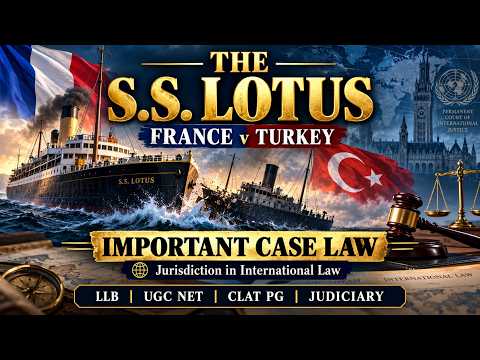
The Case of the S.S. Lotus, France v. Turkey: in 1926 the French mail steamer Lotus collided on the high seas with a Turkish ship, which sank; eight Turkish nationals died. When the Lotus reached Constantinople (now Istanbul), Turkey prosecuted the French officer on watch. France denied Turkey's jurisdiction. Held: for Turkey, by the casting vote of the Court's President, Max Huber. Principle (Lotus principle): a State is free to act unless a rule forbids it. (Studied further under custom in Unit 2; its rule on collisions belongs to Unit 5.)
Combined definition: international law is the body of rules made mainly by the consent of States, through treaties and custom, governing the relations of States with one another, the working of international organisations and, in some matters, the rights and duties of individuals.
Classical law meant States only; modern law means States, organisations and individuals. In the examination, give one classical definition (Oppenheim) and one modern definition (Starke), and explain how the change happened.
Is international law really law?
▶ Watch this part of the lecture (12:05)
When a powerful State breaks a treaty, often nothing seems to happen, so critics call international law weak law or no law at all.
The critics
- John Austin: law properly so called is a command of a sovereign backed by a sanction (threat of punishment). A sovereign is one whom the bulk of society habitually obeys and who habitually obeys no one else. No such sovereign stands over States and no organised sanction exists, so the law of nations is only positive morality, rules backed by general opinion.
- Thomas Erskine Holland: the vanishing point of jurisprudence, since there is no judge over nations except public opinion.
- Law without sanction: there is no world police, and the International Court can hear a case only with the consent of the States concerned.
Why it is true law, though a weaker kind
- Austin's test is too narrow. It does not explain much domestic law either: a constitution binds the sovereign itself, and a custom recognised by courts is nobody's command, yet both are law.
- H. L. A. Hart: a mature system combines primary rules (imposing duties) and secondary rules (how rules are recognised, changed and applied). International law has plenty of primary rules but lacks secondary rules: no legislature, no court with compulsory jurisdiction, no organised sanctions. Hart compared it to a simple, less developed system: law, but not yet a complete legal system.
- Sanctions exist, mostly decentralised. Under Chapter VII of the Charter, the Security Council can impose economic sanctions and even authorise force, as against Iraq in 1990. Under Article 94, if a State ignores a judgment of the International Court, the other party may go to the Security Council. States also use self-defence, lawful countermeasures and world opinion.
- States obey it most of the time (the most important reason). Louis Henkin: almost all nations observe almost all principles of international law and almost all of their obligations almost all of the time. A State breaking a rule rarely denies that the law binds it; it argues that its conduct is lawful or that an exception applies, which itself shows States treat it as law.
- Constitutional recognition. Article 51 of the Indian Constitution directs the State to foster respect for international law and treaty obligations, and Indian courts apply it (Unit 4).
It is weak in one sense: enforcement depends on the will of States, and the powerful can sometimes escape it, for example through the veto. But weak enforcement does not deny the existence of law; an unpunished murder does not abolish the law of murder.
International law is true law, with weak enforcement.
The communist (Soviet) approach
▶ Watch this part of the lecture (15:35)
Karl Marx taught that law serves the ruling class. After the Russian Revolution of 1917, Soviet jurists asked whether a socialist State could accept a law made by capitalist States. Their answers changed over time:
- Evgeny Korovin: an international law of the transition period, a temporary compromise between the socialist and capitalist worlds.
- Evgeny Pashukanis: all law would wither away under communism.
- Grigory Tunkin (leading Soviet scholar): international law is created by agreement, a concordance of the wills of States with different social systems, for the purpose of peaceful coexistence.
The Soviet school therefore preferred treaties (express consent) and distrusted custom, much of which Western powers had made. Its darker side: in 1968 the Soviet Union and its allies invaded Czechoslovakia under the Brezhnev Doctrine, a claimed right to intervene to protect socialism in any socialist country, which most States saw as a plain breach of sovereignty. With the end of the Cold War, the class-based view largely faded.
China at first followed the Soviet view and moved closer to generally accepted international law only after its economic reforms of the late 1970s. It stresses sovereignty, non-interference and consent, and often prefers negotiation to courts. A key statement is the Five Principles of Peaceful Coexistence, known in India as Panchsheel, first set out in the India–China agreement of 29 April 1954 on trade with the Tibet region:
- mutual respect for each other's territorial integrity and sovereignty;
- mutual non-aggression;
- mutual non-interference in each other's internal affairs;
- equality and mutual benefit;
- peaceful coexistence.
The Third World approach (TWAIL)
This approach of Asia, Africa and Latin America starts from history. Modern international law grew up in Europe in the age of colonialism and divided the world into civilised nations, full members of the law, and the rest. Doctrines like terra nullius (land belonging to no one) let European powers take inhabited lands, and the Berlin Conference of 1884–1885 set the rules for dividing Africa.
After independence, new States did not reject international law but tried to reshape it. R. P. Anand (India), Georges Abi-Saab (Egypt) and Mohammed Bedjaoui (Algeria) argued that new States must be equal makers of the law, not mere receivers. From this movement came the Bandung Conference (1955), General Assembly resolutions on decolonisation (1960) and permanent sovereignty over natural resources (1962), and the call for a New International Economic Order (1974).
A second generation in the 1990s gave the movement its present name: Antony Anghie, Makau Mutua and the Indian scholar B. S. Chimni. Chimni's manifesto argues that recolonisation is under way: international law is being reshaped to weaken the autonomy of Third World States and protect international property rights, and economic power is shifting to international financial and trade institutions. He calls for a theory of resistance and for making international institutions and transnational corporations accountable to the poor and marginalised peoples of the world.
TWAIL asks three questions of every rule: Who made it? Whose interests does it serve? How can it be made fairer for the weaker peoples of the world?
The New Haven School
Also called policy-oriented jurisprudence, it comes from Yale Law School, New Haven. Its founders, the lawyer Myres McDougal and the political scientist Harold Lasswell, began writing together in 1943. Law is not just rules in books but a continuing process of authoritative decision by people with both authority and effective control, whose choices should serve a world order based on human dignity. A lawyer must ask what the rule says, and also who decides, for what purposes and with what results.
Criticism: it makes law too flexible, since a powerful State can justify almost anything in the name of human dignity, and during the Cold War it was sometimes used to support American policy. Strength: realism; rules live through the decisions of real people.
| Approach | Sees international law through | Stresses |
|---|---|---|
| Communist (Soviet) | Class struggle | Peaceful coexistence |
| Third World (TWAIL) | The history of colonialism | Justice for weaker peoples |
| New Haven School | A process of decision-making | Policy goals like human dignity |
All three reject the idea that international law is neutral and timeless. In the examination, write that each approach shows a different face of the same law.
Unit 2: The Sources of International Law
The meaning of a source
▶ Watch this part of the lecture (21:35)
With no world parliament, the question of sources is: how do we know that a rule of international law exists?
| Formal source | Material source |
|---|---|
| The method by which a rule becomes law, like a treaty or a custom | Where evidence of the rule's content is found, like a diplomatic letter, a court decision or a scholar's book |
Nineteenth-century positivists said the basis of the law of nations is the consent of States: a sovereign State can limit its freedom only by agreeing to do so, and once it agrees it must keep its word. This is pacta sunt servanda, agreements must be kept.
Article 38 of the ICJ Statute
Article 38 is the most authoritative list of sources. It first appeared in the Statute of the Permanent Court of International Justice (1920) and was carried almost word for word into the Statute of the present Court, signed with the UN Charter in 1945. Under Article 38(1), the Court, whose function is to decide in accordance with international law such disputes as are submitted to it, shall apply:
- (a) international conventions, whether general or particular, establishing rules expressly recognised by the contesting States;
- (b) international custom, as evidence of a general practice accepted as law;
- (c) the general principles of law recognised by civilised nations;
- (d) subject to Article 59, judicial decisions and the teachings of the most highly qualified publicists of the various nations, as subsidiary means for the determination of rules of law.
Order of priority? Not formally. Treaties, custom and general principles are the three main sources; decisions and writings are only subsidiary means, aids for finding the law. In practice, the Court looks first for a treaty binding the parties (the most specific proof of consent), then custom, then general principles. But a later custom can modify a treaty, and a treaty can codify a custom. Mario Prost argues that this lack of formal order hides real, unspoken hierarchies among sources and law-makers. The only formal hierarchy comes from jus cogens and Article 103 of the Charter.
Three main sources (treaty, custom, general principles) and two helpers (judges and writers).
International conventions
Treaties, whatever their name (charter, covenant, protocol, pact). Under the words establishing rules expressly recognised by the contesting States, a treaty binds only States that consented to it, so the Court first checks that both parties are bound. Today treaties are the most frequent and most precise source (Unit 3).
| Point | Law-making treaty | Treaty contract |
|---|---|---|
| Nature | General rules of conduct for many States, like a statute | Made for a particular purpose, like a contract |
| Examples | UN Charter; the four Geneva Conventions of 1949 on the laws of war; UN Convention on the Law of the Sea | A trade agreement, an extradition treaty, a boundary treaty |
| Parties | Usually many | Two or a few |
| Obligations | General and lasting rules | Specific obligations, often ending once performed |
| Link with custom | May codify an existing custom or generate a new one binding even non-parties | A long series of similar treaty contracts may be evidence of custom |
Strictly, every treaty binds only its parties, so the distinction is useful but not rigid.
A rent agreement signed by Prince and Farhan is like a treaty contract. Common bylaws adopted by a whole housing society for every member are like a law-making treaty.
International custom
▶ Watch this part of the lecture (26:35)
Custom is the oldest source; the immunity of ambassadors and the freedom of the high seas began as custom. Article 38 calls it international custom, as evidence of a general practice accepted as law. It has two elements: a general practice and its acceptance as law.
| Usage | Custom |
|---|---|
| Habitual practice without any sense of legal duty | Practice followed because States feel legally bound |
| First stage | Mature stage |
The International Law Commission's conclusions of 2018 on identifying customary international law confirm that both elements are needed and each must be separately proved.
State practice: the material element
The material (objective) element is almost anything a State does or says officially: diplomatic letters and protests, official statements, laws, national court decisions, military manuals, conduct of armed forces, votes on resolutions and treaties. Even inaction counts, but only if the State deliberately chose not to act. Three tests:
- Duration: no fixed period. Continental shelf rules grew within little more than a decade of the Truman Proclamation of 1945.
- Consistency: substantially uniform, not perfect. In the Nicaragua case, the Court said conduct inconsistent with a rule should generally be treated as a breach of it, not as the start of a new rule.
- Generality: widespread and representative, not universal; the practice of specially affected States carries special weight (for a fishing rule, the great fishing States).
Writers debate how much to rely on what States do and how much on what they say. The traditional approach builds custom from actual practice, from the ground up; the modern approach relies more on statements, declarations and resolutions, top down. Anthea Roberts argues they can be reconciled by weighing practice and statements together in the light of the values a rule protects.
The persistent objector
▶ Watch this part of the lecture (29:15)
A new custom generally binds every State, even one that never took part in forming it, such as a new State. The exception: a State that clearly and consistently objects to a rule while it is being formed is not bound.
Fisheries case, United Kingdom v. Norway: Britain argued that a ten-mile rule for closing bays was custom. Held: rejected; and in any event the rule would not apply against Norway, which had always opposed any attempt to apply it to the Norwegian coast. Principle: a persistent objector is not bound.
Strict conditions: the objection must be clearly expressed, made known to other States and maintained persistently. A subsequent objector (objecting only after the rule is formed) remains bound. No State can be a persistent objector to jus cogens; no State can exempt itself from the ban on genocide.
Opinio juris: the psychological element
Opinio juris sive necessitatis is the belief that a practice is required by law or by necessity. This psychological (subjective) element separates custom from mere habit or courtesy. In the North Sea cases, the Court said the States concerned must feel that they are conforming to what amounts to a legal obligation. Evidence: official statements that something is legally required, protests against a breach, views of government legal advisers, national court decisions, and State attitudes to General Assembly resolutions.
How can a custom begin if States must already believe it is law? Practice and belief grow together: an early practice is often a claim of right, and when other States accept it, the belief in law develops.
Local and regional custom: custom need not be universal. A regional custom may bind a group of States (for example Latin America); a local custom may bind only two States.
Leading cases on custom
North Sea Continental Shelf cases
▶ Watch this part of the lecture (31:15)
North Sea Continental Shelf cases, Federal Republic of Germany v. Denmark and Federal Republic of Germany v. the Netherlands (1969), the leading case on how custom is formed. Germany's coast curves inwards between Denmark and the Netherlands. Article 6 of the Geneva Convention on the Continental Shelf, 1958, made the boundary the equidistance line (every point equally distant from the two coasts) unless the parties agreed otherwise or special circumstances justified another line. On Germany's concave coast, the two equidistance lines would meet a short distance out and squeeze Germany into a small triangle of the rich seabed. Germany had signed but never ratified the Convention, so Denmark and the Netherlands argued the rule had become custom binding Germany anyway.
Held (11 votes to 6): the equidistance rule was not custom when the Convention was drafted and had not become custom since. Boundaries must be settled by agreement in accordance with equitable principles, each party keeping as far as possible the areas forming the natural prolongation of its land territory under the sea. The parties later agreed boundaries giving Germany a larger share.
Principle: a treaty rule becomes custom only through widespread, representative and virtually uniform practice, backed by opinio juris.
When a treaty rule passes into general law, according to the Court:
- the provision must be of a fundamentally norm-creating character;
- very widespread and representative participation in the convention might suffice, if it includes specially affected States;
- even a short time may be enough, but within it practice, including that of specially affected States, must be extensive and virtually uniform;
- the practice must show a general recognition that a rule of law is involved.
Article 6 failed: it was subject to agreement and special circumstances, and reservations to it were allowed, casting doubt on its norm-creating character. Above all, the acts must show a belief that the practice is rendered obligatory by a rule of law. Frequency or even habitual character is not enough, since acts like ceremonial and protocol are done only out of courtesy, convenience or tradition.
Asylum case
▶ Watch this part of the lecture (34:15)
Asylum case, Colombia v. Peru (1950), the leading case on regional custom. After a military rebellion in Peru in October 1948, Peru charged Victor Raul Haya de la Torre, a political party leader, with military rebellion. In January 1949 he took refuge in the Colombian embassy in Lima. Colombia granted diplomatic asylum, declared him a political offender and asked for a safe-conduct to let him leave; Peru refused. Colombia claimed it alone could decide whether his offence was political, binding Peru, relying on Latin American treaties and a regional custom of the American States.
Held: claim rejected. The party relying on such a custom must prove it has become binding on the other party: a constant and uniform usage practised by the States in question, expressing a right of the asylum State and a duty of the territorial State. The practice showed so much uncertainty and contradiction, fluctuation and discrepancy, and political expediency that no such usage was proved. Even if the custom existed, Peru had repudiated it by refusing to ratify the Montevideo Conventions of 1933 and 1939, which first contained such a rule. Nor was Peru bound to give a safe-conduct, since it had not asked him to leave.
Principle: a regional custom must be proved strictly against the very State it is meant to bind. In a later judgment (1951) the Court said Colombia need not hand him over, but the asylum ought to end. He left the embassy in 1954.
Right of Passage case
▶ Watch this part of the lecture (36:05)
Case concerning Right of Passage over Indian Territory, Portugal v. India (merits, 1960): Portugal held Daman on India's west coast and two inland enclaves, Dadra and Nagar Haveli, entirely surrounded by Indian territory. For well over a century, under the British and then independent India, Portuguese officials and goods crossed Indian territory to reach them. In July and August 1954, supporters of union with India overthrew Portuguese rule in the enclaves, and India refused passage to Portuguese officials and forces. Portugal claimed a right of passage.
Held:
- Portugal had a right of passage for private persons, civil officials and goods in general, to the extent necessary for its sovereignty over the enclaves, subject to India's regulation and control. The basis was a local custom between just two States; the Court saw no reason why a local custom based on long practice must involve more than two States.
- No such right existed for armed forces, armed police, arms and ammunition: their passage had needed permission, and a practice of asking permission shows no right.
- India had not acted contrary to its obligations, given the tension in 1954.
A clearly established particular practice between two States prevails over general rules. Principle: a local custom can bind even two States.
In 1961 Dadra and Nagar Haveli became part of India by a constitutional amendment; today they form part of the Union territory of Dadra and Nagar Haveli and Daman and Diu.
The Lotus case on custom
The Case of the S.S. Lotus, France v. Turkey (1927): after the collision of 2 August 1926, Turkey tried the French officer of the watch, Lieutenant Demons, and sentenced him to a short imprisonment and a fine. France argued that only the flag State could try him, since such prosecutions had almost never been brought except by the flag State.
Held (by the President's casting vote after a 6–6 split): Turkey had not broken international law. (1) Restrictions on States cannot be presumed, so France had to prove a rule forbidding Turkey to act. (2) Rarity of prosecutions did not prove a legal duty: only if such abstention were based on States being conscious of having a duty to abstain could one speak of an international custom. (3) The effects of the offence were felt on the Turkish ship, treated like Turkish territory.
Principle: mere abstention is not custom; only practice followed out of a sense of legal duty counts.
If Prince fires across a border and kills a person on the other side, the State where the victim fell may try him.
Custom needs both practice and the belief that it is legally required. North Sea: the general test. Asylum: regional custom must be proved strictly. Right of Passage: even two States can form a local custom. Lotus: mere abstention is not enough.
Treaty and custom compared
| Point | Treaty | General custom |
|---|---|---|
| Form | Written | Unwritten |
| Binds | Only its parties | All States except persistent objectors |
| Formation | Quickly, by express consent | Usually slowly |
They constantly interact: a treaty may codify, crystallise or generate a custom, and both may exist side by side with the same content. In the Nicaragua case (Unit 6), the Court could not apply the Charter, so it applied the customary rule against force existing alongside it.
General principles of law
▶ Watch this part of the lecture (40:35)
Treaties and custom cannot cover everything. Facing a gap, a court should not declare non liquet (the law is not clear) and refuse to decide; it may borrow principles common to the main legal systems:
- good faith and estoppel;
- res judicata: a matter finally decided cannot be reopened;
- no one may be a judge in his own cause;
- reparation: in the Chorzow Factory case, the Permanent Court said any breach of an engagement involves an obligation to make reparation, calling it a principle of international law and even a general conception of law.
Some principles arise within international law itself, such as elementary considerations of humanity. The words civilised nations are now seen as a colonial relic; every State counts. The International Law Commission's recent work speaks of principles recognised by the community of nations. A general principle is not copied from domestic law wholesale but adapted to relations between States.
Corfu Channel case
▶ Watch this part of the lecture (41:45)
Corfu Channel case, United Kingdom v. Albania (merits, April 1949): the Corfu Channel is a narrow strait between the Greek island of Corfu and Albania, partly in Albanian waters and used for international navigation. On 22 October 1946 four British warships passed through; the destroyers Saumarez and Volage struck mines, and 45 British sailors died and 42 were injured. In November the British navy swept the channel for mines inside Albanian waters without Albania's consent. Britain sued for the damage.
Held: (1) Albania responsible (11 votes to 5). There was no direct proof that Albania laid the mines, but it kept close watch over the channel, so minelaying could not have happened without its knowledge. Circumstantial evidence is admitted in all systems of law, especially where the other State has exclusive control of the territory. The duty to warn came not from a treaty but from general and well-recognised principles: elementary considerations of humanity, even more exacting in peace than in war; freedom of maritime communication; and every State's obligation not to allow knowingly its territory to be used for acts contrary to the rights of other States. (2) The passage of 22 October did not violate Albanian sovereignty (14 votes to 2): in peacetime warships have a right of innocent passage through straits used for international navigation. (3) The minesweeping did violate Albanian sovereignty (unanimously): the claimed right of intervention was rejected as the manifestation of a policy of force, and the Court's declaration was enough satisfaction. Later that year Albania was ordered to pay 843,947 pounds.
Principle: general principles, like elementary considerations of humanity and proof by circumstantial evidence, are real sources of law.
Temple of Preah Vihear: acquiescence and estoppel
▶ Watch this part of the lecture (44:05)
Case concerning the Temple of Preah Vihear, Cambodia v. Thailand (1962): Preah Vihear is an ancient temple of Lord Shiva on a cliff top on the Cambodia–Thailand border. In 1904 France (then controlling Cambodia) and Siam (now Thailand) agreed the boundary would follow the watershed line. French officers later prepared a map placing the temple on the Cambodian side. Siam received and used the map and raised no objection for about fifty years; in 1930 a Siamese prince even visited the temple and was received by the French provincial official. After Cambodia's independence, Thailand occupied the temple, arguing that the true watershed placed it in Thailand and the map was wrong.
Held (9 votes to 3): the temple was in Cambodian territory and Thailand must withdraw its forces. Even if the map departed from the watershed, Thailand had accepted it by conduct. The Court applied qui tacet consentire videtur si loqui debuisset ac potuisset: he who keeps silent is taken to consent, if he ought to have spoken and was able to. Having enjoyed a stable frontier for fifty years, Thailand could not deny the map. Nor could it plead error, since such a plea fails if the party contributed to the error by its own conduct, could have avoided it, or was put on notice. By 7 votes to 5, Thailand was ordered to return objects taken from the temple. In 2013, interpreting this judgment, the Court held that Cambodia has sovereignty over the whole promontory of Preah Vihear.
Principle: a State which stays silent when it should protest, and accepts benefits, cannot later change its position: estoppel or preclusion.
Farhan watches Prince build a wall along a line on their shared map and says nothing for years. Farhan will find it very hard to claim later that the wall stands on his land.
Judicial decisions and teachings of publicists
- Under Article 38(1)(d) they are only subsidiary means: they do not create law but help find it.
- Under Article 59, the Court's decision has no binding force except between the parties and in respect of that particular case. There is no binding precedent (stare decisis) in the International Court, though in practice it follows earlier decisions for consistency; decisions of other tribunals and national courts also help identify the law.
- Teachings of publicists are writings of leading scholars, like Grotius, Vattel and Oppenheim earlier. Today the work of expert bodies, especially the International Law Commission, carries great weight.
Emerging sources
1. Soft law: instruments not legally binding but guiding State conduct, such as declarations, guidelines and codes of conduct; for example, the Universal Declaration of Human Rights (1948). States accept it more easily, and over time it can harden into custom or be written into treaties. The Indian jurist P. Sreenivasa Rao wrote on this role of soft law.
2. Unilateral acts
▶ Watch this part of the lecture (47:55)
A State may bind itself by a public declaration, without any treaty.
Nuclear Tests cases: Australia and New Zealand challenged French atmospheric nuclear tests over the Pacific. The French President and ministers publicly announced that the tests would stop. Held: statements made publicly and with the intention to be bound created a legal obligation. Principle: one of the basic principles governing the creation and performance of legal obligations, whatever their source, is good faith.
3. Equity: under Article 38(2), the Court may decide ex aequo et bono (according to what is fair and good) only if the parties agree; no case has yet been decided this way. Equity within the law is common, as in the North Sea cases, where boundaries had to follow equitable principles.
Jus cogens and obligations erga omnes
▶ Watch this part of the lecture (49:05)
These two ideas give international law a kind of hierarchy.
Jus cogens (compelling law)
- Article 53, Vienna Convention on the Law of Treaties, 1969: a treaty is void if, at the time of its conclusion, it conflicts with a peremptory norm of general international law, that is, a norm accepted and recognised by the international community of States as a whole as one from which no derogation is permitted, and which can be modified only by a subsequent norm of general international law having the same character.
- Article 64: if a new peremptory norm emerges, any existing conflicting treaty becomes void and terminates.
- Example: a treaty between two States to trade in slaves would be void.
- The International Law Commission (2022) listed prohibitions of aggression, genocide, crimes against humanity, racial discrimination and apartheid, slavery and torture; the basic rules of international humanitarian law; and the right of self-determination.
Obligations erga omnes (owed towards all)
In the Barcelona Traction case (Unit 6), the Court distinguished obligations owed to a particular State from obligations towards the international community as a whole, in whose protection all States have a legal interest. Examples: outlawing acts of aggression and genocide, and the basic rights of the human person, including protection from slavery and racial discrimination. The East Timor case added the right of peoples to self-determination.
| Point | Jus cogens | Erga omnes |
|---|---|---|
| Concerns | Rank of a norm | Standing |
| Question | Can States contract out of this rule? No. | Who may complain of a breach? Every State. |
Every jus cogens norm creates obligations erga omnes, but not every obligation erga omnes is jus cogens. Jus cogens: no State can escape the rule. Erga omnes: every State can raise its breach.
International comity
Comity (comitas gentium) means rules of goodwill and courtesy between States followed without any sense of legal duty, like the salute exchanged between warships at sea. Breaking it is not a wrongful act, though it may invite an unfriendly but lawful response called retorsion. Comity can grow into law: exemption of diplomats' belongings from customs duties was once a courtesy, and the Vienna Convention on Diplomatic Relations, 1961, made it a legal rule.
| Comity | Custom |
|---|---|
| Repeated practice | Repeated practice |
| Rests only on courtesy | Carries opinio juris, a sense of legal duty |
Prince greeting his neighbour Farhan on Diwali is courtesy, like comity. Prince stopping at a red light is a legal duty, like custom.
Resolutions of international organisations
▶ Watch this part of the lecture (52:35)
- The UN General Assembly is not a world legislature: under Articles 10 to 14 of the Charter it can only make recommendations to States. Under Article 17, its decisions on internal matters, like the budget, bind members.
- Under Article 25, members agree to accept and carry out Security Council decisions, so a Chapter VII decision, like sanctions, binds every member.
- Under Article 103, if Charter obligations conflict with obligations under any other international agreement, the Charter prevails.
General Assembly Resolutions and the Making of Law
General Assembly resolutions can still shape the law in two ways.
- Evidence of opinio juris. In the Nicaragua case, the Court found opinio juris for the rule against force partly in the attitude of States towards the Friendly Relations Declaration of 1970. In the Nuclear Weapons opinion, it said resolutions, even if not binding, may sometimes have normative value, depending on their content and the conditions of their adoption. A series of resolutions may show the gradual evolution of the opinio juris required for a new rule.
- Hardening into custom. Some declarations were so widely accepted that their principles became custom, as with much of the Universal Declaration of Human Rights.
The International Law Commission said in 2018 that a resolution cannot of itself create a rule of custom, though it may provide evidence of one.
The International Law Commission and Codification
Article 13 of the UN Charter asks the General Assembly to initiate studies and make recommendations for encouraging the progressive development of international law and its codification. So in 1947 it set up the International Law Commission (ILC): now 34 members, elected for five years, serving as independent experts.
| Codification | Progressive development |
|---|---|
| More precise formulation and systematisation of rules in fields where there already has been extensive State practice, precedent and doctrine. | Preparing draft conventions on subjects not yet regulated, or where the law is not yet sufficiently developed. |
| Writes down old law. | Builds new law. |
Both definitions come from the ILC Statute; in reality most of its work mixes both.
Treaties produced from ILC drafts: the Geneva Conventions on the Law of the Sea, 1958; the Vienna Convention on Diplomatic Relations, 1961; the Vienna Convention on the Law of Treaties, 1969. Other texts, such as the Articles on State Responsibility, 2001, are not treaties, yet courts cite them as reflecting custom.
Northland and Southland quarrel over fishing near their border. First look for a treaty between them; if none, a general custom (proved by practice and opinio juris) or a local custom between the two, as in the Right of Passage case; if neither answers, general principles such as good faith and estoppel, as in the Preah Vihear case. Judicial decisions and learned writings help identify these rules, and no rule found can override jus cogens.
Unit 3: Law of Treaties
▶ Watch this part of the lecture (56:30)
Treaties are the most frequent and most precise source of international law today. This unit covers how a treaty is born, lives and ends.
Meaning of a treaty
The main law is the Vienna Convention on the Law of Treaties, 1969 (VCLT), in force from 27 January 1980. Much of it codifies customary law. India is not a party, but Indian courts treat its main rules as customary law, so in practice they guide India too.
Article 2(1)(a): a treaty is an international agreement concluded between States in written form and governed by international law, whether embodied in a single instrument or in two or more related instruments and whatever its particular designation.
Five elements:
- an international agreement;
- between States;
- in writing;
- governed by international law;
- under any name: treaty, convention, covenant, charter, protocol or exchange of notes.
Not treaties: a contract between the Government of India and a foreign oil company; a joint statement that the parties never intended to be legally binding.
Must a treaty be written?
▶ Watch this part of the lecture (57:55)
For the VCLT, yes. But Article 3 preserves the legal force of other agreements, so an oral promise can still bind a State under customary law.
Eastern Greenland case: Norway's foreign minister, Nils Ihlen, said orally that Norway would not make difficulties over the Danish claim to Greenland. Held: the Permanent Court held Norway bound by this oral assurance. Principle: an oral promise can bind a State.
Treaties made by international organisations are covered by a separate Vienna Convention of 1986. It closely follows the 1969 Convention but is not yet in force, for lack of enough ratifications.
Content of a Treaty
- Title.
- Preamble: names the parties and states the aims. It creates no obligations but helps find the object and purpose.
- Operative articles: the rights and duties.
- Final clauses: signature, ratification, entry into force, reservations, amendment, withdrawal and authentic languages.
- Annexes or schedules: part of the treaty, e.g. the Schedule to the Whaling Convention.
Conclusion of Treaties
Article 6: every State possesses capacity to conclude treaties. A person binds the State if he produces full powers, a document from the competent authority authorising him to negotiate or sign. Article 7: heads of State, heads of government and ministers for foreign affairs need no full powers, because of their office.
Stages
- Negotiation.
- Adoption of the text (Article 9): consent of all States taking part; at an international conference, a two-thirds majority of States present and voting, unless they decide otherwise.
- Authentication (Article 10): fixes the text as final, usually by signature or initialling.
- Expression of consent to be bound: the most important stage.
Consent to be bound (Article 11)
By signature, exchange of instruments, ratification, acceptance, approval, accession, or any other agreed means.
- Signature alone binds only if the treaty says so or the parties so intended.
- Ratification: the international act by which a State, after signing, establishes its consent to be bound. It gives the government time to study the treaty, consult its legislature where required, and pass any laws needed.
- Accession: how a State that did not sign joins later, e.g. India acceded to the International Covenant on Civil and Political Rights in 1979.
Treaty-making in India
Treaty-making is an executive function: the Union Government signs and ratifies without a vote in Parliament. Where a treaty changes the law or affects citizens' rights, Parliament must legislate under Article 253 (Unit 4).
Between signature and ratification (Article 18)
A signatory must refrain from acts which would defeat the object and purpose of the treaty, until it makes clear that it will not become a party.
Two States sign a treaty to protect an ancient temple on their border. Neither should demolish it while ratification is pending.
Entry into Force and Registration
▶ Watch this part of the lecture (1:01:45)
- Article 24: a treaty enters into force as it provides or as the negotiating States agree. Multilateral treaties usually need a fixed number of ratifications; the Convention on the Law of the Sea came into force twelve months after the sixtieth ratification.
- Article 25: a treaty may be applied provisionally before that.
- Article 102, UN Charter: every treaty entered into by a member must be registered with the Secretariat and published, to end the secret treaties blamed for the First World War.
An unregistered treaty is not void, but no party may invoke it before any UN organ, including the International Court.
Observance and Application of Treaties
- Article 26 (pacta sunt servanda): every treaty in force is binding upon the parties and must be performed by them in good faith. This is the foundation of the law of treaties.
- Article 27: a party may not invoke its internal law as justification for failure to perform a treaty. A State cannot say its Parliament has not passed the law. Narrow exception, Article 46: consent given in manifest violation of a fundamental internal rule on the power to make treaties.
- Article 28 (non-retroactivity): unless a different intention appears, a treaty does not bind a party in relation to any act or fact which took place before its entry into force for that party.
- Article 29: a treaty binds each party in respect of its entire territory.
Belgium v. Senegal
▶ Watch this part of the lecture (1:03:25)
Questions relating to the Obligation to Prosecute or Extradite (Belgium v. Senegal) (2012): Hissene Habre, President of Chad 1982–1990, whose regime was accused of thousands of killings and widespread torture, fled to Senegal after being overthrown. Senegalese courts (2000, 2001) held they had no jurisdiction over victims' complaints. In 2005 a Belgian judge issued an international arrest warrant and Belgium sought extradition; for years Senegal neither tried nor extradited him. Both are parties to the Convention against Torture, 1984, whose Article 7(1) requires the State where an alleged torturer is found, if it does not extradite him, to submit the case for prosecution: aut dedere aut judicare (extradite or prosecute).
Held (July 2012): (1) Belgium could sue, as the Convention's obligations are erga omnes partes, owed by each party to all others, sharing a common interest in preventing torture. (2) Senegal breached its duty to make an immediate preliminary inquiry and to submit the case for prosecution; extradition is an option, prosecution an international obligation. (3) Neither internal law (Article 27) nor financial difficulties excused the delay. (4) By non-retroactivity, the duty covered only acts after the Convention came into force for Senegal in June 1987. Senegal was ordered to submit the case for prosecution without further delay, if it did not extradite.
Aftermath: special chambers set up by Senegal with the African Union convicted Habre in May 2016 of crimes against humanity, war crimes and torture, and sentenced him to life imprisonment.
Principle: a treaty must be performed in good faith; neither internal law nor lack of money excuses a breach.
Reservations
▶ Watch this part of the lecture (1:06:10)
A State objecting to one article need not reject the whole treaty; it may make a reservation.
Article 2(1)(d): a reservation is a unilateral statement, however phrased or named, made by a State when signing, ratifying, accepting, approving or acceding to a treaty, whereby it purports to exclude or to modify the legal effect of certain provisions of the treaty in their application to that State.
Reservations help more States join, at the cost of uneven application; the law balances a treaty's integrity against its universality. The old rule was unanimity: valid only if every other party accepted.
Reservations to the Genocide Convention (Advisory Opinion, 1951): Held, by seven votes to five: a State can still be a party even if some parties object to its reservation, provided the reservation is compatible with the object and purpose of the Convention, which was meant to be universal and purely humanitarian. Principle: the compatibility test, later written into the VCLT.
Article 19: when a reservation is barred
- the treaty prohibits it;
- the treaty allows only specified reservations, and this is not one;
- it is incompatible with the object and purpose.
The Rome Statute of the International Criminal Court permits no reservations at all.
Acceptance and objection
- Article 20: an expressly authorised reservation needs no acceptance. Otherwise parties may accept or object; no objection within twelve months counts as acceptance.
- Article 21: between the reserving and an accepting State, the provision applies as modified for both (reciprocity). If an objecting State does not oppose entry into force between them, the provisions concerned do not apply between the two to the extent of the reservation.
A gym has ten rules. Prince joins on condition that rule seven (fixed timings) will not apply to him. A member who accepts cannot insist on fixed timings for him, nor can he against that member. A member who objects may still treat him as a fellow member, but rule seven does not operate between them.
| Reservation | Interpretative declaration |
|---|---|
| Changes the legal effect of a provision for the reserving State. | Only explains how the State understands the provision. |
Substance, not label, decides. Article 22: a reservation may be withdrawn at any time.
A reservation is allowed unless it is forbidden, not listed, or against the object and purpose.
Treaties and Third States
Article 34: a treaty creates neither obligations nor rights for a third State without its consent: pacta tertiis nec nocent nec prosunt (treaties neither harm nor benefit third parties).
When Prince and Farhan sign a rent agreement, their neighbour Aadil is neither bound by it nor entitled under it.
- Article 35: an obligation arises only if the third State expressly accepts it in writing.
- Article 36: a right arises if the third State assents; assent is presumed unless it says otherwise.
- Article 38: a treaty rule may bind a third State if it has become customary law.
- Article 30 (conflicting treaties): between the same parties, the later treaty generally prevails (lex posterior derogat priori); between a State party to both and a State party to only one, the treaty they share governs.
Interpretation of Treaties
▶ Watch this part of the lecture (1:10:25)
| School | Focus |
|---|---|
| Textual | Ordinary meaning of the words |
| Intention | Real intention of the parties |
| Teleological | Object and purpose of the treaty |
The VCLT combines all three, but starts with the text.
Article 31 (general rule): a treaty shall be interpreted in good faith in accordance with the ordinary meaning to be given to the terms of the treaty in their context and in the light of its object and purpose.
- Context: the text, preamble and annexes, and related agreements made by all the parties.
- Also taken into account: any subsequent agreement on interpretation; any subsequent practice showing agreement; relevant rules of international law applicable between the parties.
- A term has a special meaning if the parties are shown to have so intended.
Article 32 (supplementary means): preparatory work (travaux preparatoires) and circumstances of conclusion, used to confirm the Article 31 meaning, or to determine it where Article 31 leaves it ambiguous or obscure, or leads to a manifestly absurd or unreasonable result.
Article 33 (several languages): each authentic text is equally authoritative and terms are presumed to mean the same in each; if texts differ, adopt the meaning which best reconciles them, having regard to object and purpose. Applied in the LaGrand case (Unit 6).
Effectiveness: provisions should be read to have some effect rather than none. Evolutionary interpretation: general terms may change meaning over time where the parties intended the treaty to develop.
Text first, then context, then object and purpose, and the preparatory work mainly as a check.
Whaling in the Antarctic
▶ Watch this part of the lecture (1:13:05)
Whaling in the Antarctic (Australia v. Japan, New Zealand intervening) (2014): Under the International Convention for the Regulation of Whaling, 1946, the Schedule has imposed a moratorium (halt) on commercial whaling since the 1980s, but Article 8 allows special permits to kill whales for purposes of scientific research. From 2005 Japan's second Antarctic whale research programme planned to kill hundreds of whales a year, and the meat was sold. Australia called it commercial whaling in disguise; New Zealand intervened as a fellow party.
Held (March 2014, 12 to 4): the permits were not for purposes of scientific research. Without defining scientific research in the abstract, the Court asked whether the programme's design and implementation were reasonable in relation to its stated scientific objectives. Japan had not properly considered non-lethal methods, sample sizes were unjustified, it killed far fewer whales than planned, and little science resulted. Japan breached the moratorium and was ordered to revoke the permits and grant no more under that programme.
Principle: a treaty exception must be applied reasonably, in the light of the treaty's object and purpose. Japan later withdrew from the Convention with effect from 30 June 2019 and resumed commercial whaling in its own waters.
Pulp Mills on the River Uruguay
▶ Watch this part of the lecture (1:14:45)
Pulp Mills on the River Uruguay (Argentina v. Uruguay) (2010): The river forms part of their boundary. The Statute of the River Uruguay, 1975, set up a joint commission and required a party planning any work liable to affect the river to inform the commission and, through it, the other State. Uruguay authorised two large pulp mills; one began operating in 2007. Argentina alleged lack of notice and pollution.
Held (April 2010): (1) by 13 to 1, Uruguay breached its procedural obligations by authorising the mills without informing the commission, and this finding was itself enough satisfaction; (2) by 11 to 3, no breach of substantive obligations, as Argentina had not proved harm. A precautionary approach does not reverse the burden of proof. Most importantly, an environmental impact assessment is now a requirement under general international law where a proposed industrial activity may have a significant adverse impact in a transboundary context, and the treaty was read in that light.
Principle: treaties are interpreted in harmony with general international law; duties to inform and consult are separate obligations.
Prince plans a dyeing unit upstream on a stream he shares with Farhan. A duty to inform Farhan and assess the impact first protects Farhan before any harm is done.
The Jadhav case
▶ Watch this part of the lecture (1:16:35)
Jadhav (India v. Pakistan) (2019): Kulbhushan Jadhav, an Indian national, was arrested in March 2016; Pakistan said he was caught in Balochistan as a spy and terrorist, India that he was abducted from Iran. Pakistan did not tell him of his right to consular help, delayed informing India, and refused repeated Indian requests for consular access. A Pakistani military court sentenced him to death in April 2017. India approached the Court in May 2017, and within ten days the Court ordered Pakistan not to execute him before its final decision.
Law: Article 36, Vienna Convention on Consular Relations, 1963, gives consular officers the right to communicate with and visit arrested nationals, and requires the arresting State to inform the detainee of his rights without delay. Pakistan argued that Article 36 does not apply to persons accused of espionage, and that a bilateral Agreement on Consular Access, 2008 (allowing each side to examine on merits cases of arrest, detention or sentence on political or security grounds) governed instead.
Held (July 2019, 15 to 1): both arguments rejected. Interpreting Article 36 under Article 31 VCLT, its ordinary meaning has no espionage exception, which would also run counter to its purpose; the preparatory work confirmed this. The 2008 Agreement could only confirm, supplement, extend or amplify the Consular Convention, not cut it down. Pakistan breached Article 36 by not informing Jadhav of his rights, not informing India without delay, and denying consular access. Remedy: effective review and reconsideration of conviction and sentence, with a continued stay of execution (Unit 6).
Principle: a treaty right means what its words, context and purpose say; a bilateral deal cannot quietly reduce a multilateral guarantee.
Amendment and Modification
▶ Watch this part of the lecture (1:19:35)
| Amendment | Modification |
|---|---|
| A change for all the parties. | Agreement between only some parties to change the treaty among themselves (Article 41). |
| Article 39: by agreement between the parties. Article 40: every party to a multilateral treaty must be notified of a proposal and may join negotiations. | Allowed if the treaty permits it; otherwise it must not be prohibited, must not affect other parties' rights, and must not defeat the object and purpose. |
| Does not bind a party that does not join; between it and the others the old treaty continues. | Operates among the modifying parties only. |
Many treaties have their own procedure. The UN Charter is amended under Article 108 by a two-thirds vote of the General Assembly and ratification by two-thirds of members, including all five permanent members. That is how the Security Council grew from 11 to 15 members in 1965.
Termination and Suspension of Treaties
Article 42: termination or withdrawal only by applying the treaty itself or the VCLT, protecting the stability of treaties.
1. Under the treaty or by consent
Article 54: in accordance with the treaty's provisions, or at any time by consent of all parties. Article 59: when all parties conclude a later treaty on the same subject meant to replace it or incompatible with it.
2. Treaty silent on termination (Article 56)
No denunciation (formal leaving) unless the parties intended it or the nature of the treaty implies such a right; even then, twelve months' notice. A boundary treaty, for example, is meant to be permanent.
3. Material breach (Article 60)
- Bilateral treaty: the other party may invoke the breach to terminate or suspend.
- Material breach: a repudiation not allowed by the VCLT, or violation of a provision essential to the object or purpose.
- Multilateral treaty: the other parties may act together; a specially affected party may suspend against the defaulter.
- Not applicable to provisions protecting the human person in humanitarian treaties.
Namibia opinion: Held: the International Court treated these rules as custom in upholding the ending of South Africa's mandate over Namibia for material breach. Principle: the material-breach rules reflect custom.
4. Supervening impossibility (Article 61)
Termination if an object indispensable for execution permanently disappears or is destroyed, like an island that sinks; not if the impossibility results from the party's own breach.
5. Rebus sic stantibus (Article 62)
▶ Watch this part of the lecture (1:22:05)
Fundamental change of circumstances (rebus sic stantibus, "things standing thus") may be invoked only if:
- the change was not foreseen;
- the circumstances were an essential basis of consent; and
- the change radically transforms the obligations still to be performed.
It never applies to a treaty establishing a boundary, or where the change results from the invoking party's own breach.
Gabcikovo-Nagymaros case (Hungary and Slovakia): Hungary invoked changed circumstances against a treaty for building dams on the Danube. Held: plea rejected; the political changes were not an essential basis of consent, new environmental knowledge was not completely unforeseen, and the plea applies only in exceptional cases. Principle: rebus sic stantibus is confined to exceptional cases.
6. New peremptory norm (Article 64)
If a new rule of jus cogens emerges, any existing treaty conflicting with it becomes void and terminates.
Events that do not end a treaty; procedure
- Article 63: severing diplomatic relations does not by itself affect treaty relations.
- War does not automatically end all treaties; some, like the Geneva Conventions, are made precisely for war.
- Article 65: a party claiming a ground must notify the others and, if they object, seek a peaceful settlement.
Grounds of termination: consent, breach, impossibility, change, and jus cogens.
The Indus Waters Treaty dispute
▶ Watch this part of the lecture (1:23:55)
- The Indus Waters Treaty, 1960, between India and Pakistan divides the rivers of the Indus system and has no clause allowing either party to end it alone.
- In 2024 India formally sought a review, citing fundamental and unforeseen changes in circumstances.
- On 23 April 2025, after the terrorist attack at Pahalgam, India held the treaty in abeyance (paused) with immediate effect, until Pakistan credibly and irrevocably abjures (gives up) support for cross-border terrorism.
- A Court of Arbitration set up at Pakistan's request held that this did not affect its competence, and on 31 August 2026 ruled unanimously that the treaty remains fully in force: none of India's grounds, such as material breach by Pakistan or fundamental change of circumstances, could justify suspending or ending it.
- India rejects these rulings, calling that court illegally constituted.
Northland and Southland sign a river-sharing treaty. Southland has signed but not ratified, so under Article 18 it must not defeat the treaty's object meanwhile. It later ratifies with a reservation excluding one clause, which, with only two parties, works only if Northland accepts it. Years later Northland builds a dam without informing Southland and pleads that its Parliament never passed the necessary law; Article 27 rejects that excuse. If the breach is material, Southland may suspend the treaty under Article 60, but only by following the procedure in Article 65.
Unit 4: International Law and Municipal Law
▶ Watch this part of the lecture (1:26:00)
Municipal law means the internal law of a State, such as the law of India; it has nothing to do with municipalities. The relationship raises two questions:
- Before an international court, what is the place of a State's own law?
- Before a national court, what is the place of international law?
Monism and Dualism
Monism
International law and municipal law form a single legal order, because both ultimately regulate human conduct.
- Hans Kelsen: all legal norms form one pyramid with international law at the top, since it fixes the limits of each State's legal order.
- Hersch Lauterpacht: international law, which protects human rights, should prevail over the will of States.
So international law applies inside a State directly and prevails in case of conflict.
Dualism
Led by Heinrich Triepel (Germany) and Dionisio Anzilotti (Italy), dualists treat the two as separate systems:
| Basis | Municipal law | International law |
|---|---|---|
| Subjects | Individuals | States |
| Sources | Will of a single State | Common will of States |
| Subject matter | Relations within a State | Relations between States |
So international law operates inside a State only if the State's own law adopts it; in a conflict, a national court applies national law.
Three Specific Theories
- Specific adoption theory: national courts cannot apply international law until the State specifically adopts it as its own law.
- Transformation theory (mainly treaties): a treaty must be transformed into national law, usually by legislation, before it binds people inside the State.
- Delegation theory (the monist reply): international law delegates to each State the power to decide when and how a treaty takes effect inside it, so a law carrying out a treaty merely completes a single process of law-making.
Middle view (Gerald Fitzmaurice): the two systems work in different fields and rarely collide. When they do, a national court follows its own law, and the State answers internationally for any breach.
Monism means one system. Dualism means two systems, joined by adoption or transformation.
The Role of Municipal Law in International Law
Before an international court, international law prevails over a State's own law:
- Article 27, Vienna Convention on the Law of Treaties: for treaties, a State cannot plead its own law to escape a treaty.
- Article 3, Articles on State Responsibility: whether an act is wrongful is governed by international law, and is not affected by the act being lawful under internal law.
- Draft Declaration on Rights and Duties of States (International Law Commission, 1949) lists four rights and ten duties of States. Article 13: every State must carry out in good faith its obligations under treaties and other sources of international law, and may not invoke its constitution or laws as an excuse for failing to do so. Article 14: the sovereignty of each State is subject to the supremacy of international law.
Decisions of Courts and Tribunals
▶ Watch this part of the lecture (1:29:45)
Alabama Claims Arbitration: warships were built in British ports for the Confederate side in the American Civil War. Britain pleaded that its law gave it no power to stop them. Held: Britain was ordered to pay the United States fifteen and a half million dollars. Principle: before an international tribunal, international law prevails over a State's own law.
- Permanent Court, 1932: a State cannot adduce as against another State its own Constitution with a view to evading obligations under international law.
- Permanent Court, 1926: from the standpoint of international law, municipal laws are merely facts. An international court examines national law only as a fact, to see whether the State has kept its obligations.
Municipal law is still relevant: it is evidence of State practice for custom, a source of general principles, and international law sometimes refers back to it, e.g. to decide whether a person is a national of a State or whether a company was validly formed.
International Law Before the Courts of the United Kingdom
▶ Watch this part of the lecture (1:31:35)
The UK approach shaped India's own.
Custom: Doctrine of Incorporation
Custom is automatically part of the common law, unless it conflicts with a statute or a binding decision.
- Lord Mansfield (eighteenth century): the law of nations, in its full extent, is part of the law of England.
- Trendtex case: Lord Denning said the rules of international law, as existing from time to time, form part of English law. So English law changes when international law changes.
But a statute prevails:
Mortensen v. Peters (1906): the Danish captain of a Norwegian trawler trawled in the Moray Firth beyond three miles from the shore. Held: a Scottish court upheld his conviction, because the statute clearly applied there. Principle: a clear statute prevails over international law.
Regina v. Jones (2006), House of Lords. Held: the international crime of aggression did not automatically become a crime in English law. Principle: creating crimes is for Parliament, so custom cannot by itself create a crime.
Treaties: Transformation
The Crown makes treaties, but only Parliament makes law, so a treaty changes English law only through an Act of Parliament.
International Tin Council case, House of Lords. Held: English courts cannot enforce rights under an unincorporated treaty.
Miller case, UK Supreme Court. Held: giving notice to leave the European Union needed an Act of Parliament, because it would change rights under domestic law.
International Law Before the Courts of the United States
▶ Watch this part of the lecture (1:33:05)
The United States follows a mixed approach.
- Article 6 of the US Constitution makes treaties the supreme law of the land.
- Courts distinguish self-executing treaties (operate directly) from non-self-executing treaties (need an Act of Congress). Chief Justice John Marshall drew this line in Foster v. Neilson (1829).
- A later Act of Congress prevails over an earlier treaty inside the country, though the country remains liable internationally.
The Paquete Habana (1900): during the 1898 war with Spain, the US Navy seized two Cuban fishing boats as prizes. Held: by customary international law, coastal fishing boats are exempt from capture; compensation was ordered. Justice Gray: international law is part of our law, and must be ascertained and administered by the courts of justice of appropriate jurisdiction. Principle: custom is part of US law.
Medellin v. Texas, US Supreme Court. Held: the Avena judgment of the International Court was not directly enforceable in American courts; it needed an Act of Congress. (Avena is studied in Unit 6.)
International Law in the Indian Legal System
▶ Watch this part of the lecture (1:34:15)
India broadly follows the English model.
- Article 51 (Directive Principle): the State shall endeavour to promote international peace and security; maintain just and honourable relations between nations; foster respect for international law and treaty obligations in the dealings of organised peoples with one another; and encourage settlement of international disputes by arbitration.
- Article 73: the executive power of the Union extends to all matters on which Parliament can make laws.
- Entry 14, Union List: entering into treaties and agreements with foreign countries and implementing them.
- Article 253: Parliament may make any law for implementing any treaty, agreement or convention, or any decision made at an international conference, for the whole or any part of India, even on a State List subject.
So a treaty that changes the law or affects private rights needs a law made by Parliament.
Berubari case, Supreme Court of India. Held: ceding Indian territory to another country needs a constitutional amendment.
Maganbhai Ishwarbhai Patel v. Union of India, Supreme Court of India. Held: settling a disputed boundary is not cession, so an arbitral award on the Kutch boundary could be carried out without an amendment.
Jolly George Varghese v. Bank of Cochin
▶ Watch this part of the lecture (1:35:55)
Jolly George Varghese v. Bank of Cochin (1980), the classic Indian statement of the dualist position on treaties: judgment-debtors were ordered to be arrested and detained in civil prison under Section 51 of the Code of Civil Procedure for failing to pay a decree. They relied on Article 11 of the International Covenant on Civil and Political Rights: no one shall be imprisoned merely on the ground of inability to fulfil a contractual obligation. Held (Justice V.R. Krishna Iyer): the Covenant did not by itself override the Code. The positive commitment of the States parties ignites legislative action at home, but does not automatically make the Covenant an enforceable part of Indian law. Yet Section 51 was read in harmony with the Covenant and Article 21: a debtor who honestly cannot pay may not be jailed; there must be some bad faith, such as refusing to pay despite having the means. Principle: an unincorporated treaty is not directly enforceable, but courts read national law to agree with it wherever possible.
Gramophone Company of India Ltd. v. Birendra Bahadur Pandey
▶ Watch this part of the lecture (1:37:05)
Gramophone Company of India Ltd. v. Birendra Bahadur Pandey (1984), the Indian doctrine of incorporation: a consignment of pre-recorded music cassettes shipped from Singapore to landlocked Nepal landed at Calcutta port to cross India by land. The Gramophone Company, the copyright holder, said they were pirated and asked the Registrar of Copyrights to order under Section 53 of the Copyright Act, 1957 that these infringing copies shall not be imported into India. The importers argued that goods merely in transit are not imported, relying on India's transit treaty with Nepal and the international convention on the transit trade of landlocked States. The Calcutta High Court agreed. Held (Justice O. Chinnappa Reddy): reversed. Rules of international law are incorporated into national law and considered part of it, unless they conflict with an Act of Parliament. Comity of nations or no, municipal law must prevail in case of conflict; national courts cannot say yes if Parliament has said no. But courts must, within legitimate limits, interpret a statute so as to avoid confrontation with the comity of nations or well-established principles of international law. Here there was no conflict: goods in transit are brought into India, and the transit arrangements themselves allowed India to protect copyright, so the Registrar could bar their import. Principle: international law is part of Indian law unless a statute conflicts, and statutes are read in harmony with it.
Vellore Citizens' Welfare Forum v. Union of India
▶ Watch this part of the lecture (1:39:05)
Vellore Citizens' Welfare Forum v. Union of India (1996): hundreds of tanneries in Tamil Nadu discharged untreated effluent into the Palar river, the main source of drinking water in the area. Held (Justice Kuldip Singh): sustainable development, the balance between ecology and development, is part of customary international law; the precautionary principle and the polluter pays principle are its essential features and are part of Indian environmental law, supported by Articles 21, 47, 48A and 51A(g). Under the precautionary principle, the burden lies on the industrialist to prove that his activity is environmentally benign. The Centre was directed to set up an authority to tackle the pollution, and each tannery in the five districts concerned was fined ten thousand rupees. Principle: rules of customary international law not contrary to municipal law are deemed incorporated into domestic law, and courts shall follow them.
Vishaka v. State of Rajasthan
Vishaka v. State of Rajasthan (1997): a woman social worker in a Rajasthan village, working under a government programme against child marriage, was allegedly gang-raped because of her work. Women's groups, including Vishaka, filed a writ petition when India had no law against sexual harassment at the workplace. Held (Chief Justice J.S. Verma): such harassment violates Articles 14, 15, 19(1)(g) and 21. Relying on the Convention on the Elimination of All Forms of Discrimination against Women (ratified by India in 1993), the Court said any international convention not inconsistent with the fundamental rights and in harmony with their spirit must be read into these provisions to enlarge their meaning and content. It also relied on Article 51(c), Article 253 and Entry 14 of the Union List. The Vishaka Guidelines were binding as law declared under Article 141 until Parliament legislated, which it did in the Sexual Harassment of Women at Workplace (Prevention, Prohibition and Redressal) Act, 2013. Principle: a treaty, even if not incorporated, may be read into fundamental rights to fill a gap.
Chairman, Railway Board v. Chandrima Das
▶ Watch this part of the lecture (1:41:45)
Chairman, Railway Board v. Chandrima Das (2000): in February 1998, a Bangladeshi woman was gang-raped by several men, including railway employees, in a room of the Yatri Niwas at Howrah station. On a petition by Chandrima Das, an advocate, the Calcutta High Court awarded ten lakh rupees compensation. The Railway Board appealed, arguing that damages could not be decided in writ proceedings, an advocate had no standing, and a foreign national could not claim fundamental rights. Held (Justice S. Saghir Ahmad): appeal dismissed. The right to life under Article 21 belongs to every person, not only citizens. The Court relied on the Universal Declaration of Human Rights (life, liberty, dignity, equality) and the UN Declaration on the Elimination of Violence against Women, saying our fundamental rights are almost in consonance with the Universal Declaration. Running railways and their guest houses is a commercial activity, so the Union was vicariously liable for its employees, and compensation under Article 226 was proper. Principle: international human rights standards guide the reading of fundamental rights, and the right to life protects foreigners too.
Other Recent Cases
M.K. Ranjitsinh v. Union of India (March 2024): concerning the Great Indian Bustard and power lines. Held: the Supreme Court recognised a right against the adverse effects of climate change under Articles 14 and 21, referring to India's commitments under the Paris Agreement.
Mohammad Salimullah v. Union of India: Rohingya refugees relied on non-refoulement (no refugee may be returned to a place of persecution). Held: India is not a party to the Refugee Convention of 1951; interim relief refused. The right not to be deported is linked to the right to reside in India under Article 19(1)(e), which belongs only to citizens. But deportation must follow the procedure laid down by law.
Formula for India: custom comes in automatically, unless a statute conflicts; treaties come in through Parliament; and both guide interpretation.
Nationality
▶ Watch this part of the lecture (1:45:00)
Nationality is the legal bond between a person and a State. It decides which State may protect a person abroad, and which State must receive him back.
- Permanent Court, 1923: nationality falls, in principle, within the reserved domain of a State.
- Article 1, Hague Convention of 1930: each State determines under its own law who are its nationals, but other States need recognise that law only so far as it is consistent with international conventions, international custom and the principles of law generally recognised with regard to nationality.
Acquisition
- By birth: jus soli (law of the soil: birth in the territory gives nationality) or jus sanguinis (law of blood: the child takes the parents' nationality).
- After birth: registration, naturalisation, or incorporation of territory.
Differing rules create dual nationality or statelessness. Article 15, Universal Declaration: everyone has the right to a nationality, and no one shall be arbitrarily deprived of it.
India
- Citizenship Act, 1955, Sections 3 to 7: citizenship by birth, descent, registration, naturalisation and incorporation of territory.
- Section 6A (certain migrants to Assam) was upheld by a Constitution Bench in October 2024.
- Section 9: an Indian who voluntarily acquires another country's citizenship ceases to be an Indian citizen. India does not allow dual citizenship, but offers Overseas Citizen of India status.
Nottebohm Case (Liechtenstein v. Guatemala) (1955): Friedrich Nottebohm, a German national by birth, lived and ran a large business in Guatemala from 1905. In October 1939, just after the Second World War began, he visited Liechtenstein, where his brother lived, and obtained its nationality within days after the usual residence requirement was waived and fees paid. He lost German nationality and returned to Guatemala on a Liechtenstein passport. After Guatemala joined the war against Germany, it arrested him in 1943 as an enemy alien, handed him to the US for internment, and later confiscated his property. Liechtenstein claimed by way of diplomatic protection. Held: the ICJ, by eleven votes to three, held the claim inadmissible. Liechtenstein could make him a national under its own law, but Guatemala was not bound to recognise that nationality for diplomatic protection. Nationality is a legal bond having as its basis a social fact of attachment, a genuine connection of existence, interests and sentiments, together with reciprocal rights and duties. Nottebohm had spent only short periods there, had no settled home or business there, and sought nationality mainly to become a neutral national in wartime; his real ties were with Guatemala, where he had lived thirty-four years. Principle: nationality granted without a genuine link need not be recognised by other States for diplomatic protection.
Farhan has lived and worked in Dubai for thirty years, then buys the passport of a small island State he has never lived in. If that State claims for him against the United Arab Emirates, the Emirates may refuse to recognise that nationality.
Later law reads Nottebohm narrowly: the International Law Commission's Articles on Diplomatic Protection of 2006 require no genuine link in ordinary cases.
India ratifies a treaty requiring every ship to carry a new safety device, but Parliament passes no law. A foreign ship without the device enters an Indian port. An Indian court cannot punish its master on the treaty alone. It can apply a settled rule of custom directly unless a statute conflicts, though custom alone cannot create a crime. Internationally, India cannot plead the missing law as an excuse for breaching the treaty.
Unit 5: Law of the Sea
▶ Watch this part of the lecture (1:49:32)
The law of the sea decides who may use the sea and how far a coastal State may control it.
Development
- India's maritime past: the ancient dockyard traditionally identified at Lothal in Gujarat is more than four thousand years old; in the eleventh century the Chola king Rajendra Chola I sent a naval expedition across the Bay of Bengal. But the modern law grew up in Europe.
- Grotius, Mare Liberum: the sea is free to all. John Selden, Mare Clausum (the closed sea): a State could own the sea. The compromise was a narrow coastal belt under the coastal State and a free sea beyond.
- Bynkershoek: the power of the land ends where the force of its weapons ends. This cannon-shot rule later settled into a three-nautical-mile limit.
- 1945: President Truman claimed the resources of the continental shelf off US coasts; many States followed.
- 1958: the first UN conference adopted four Geneva Conventions on (1) the Territorial Sea and the Contiguous Zone, (2) the High Seas, (3) Fishing and Conservation of the Living Resources of the High Seas, and (4) the Continental Shelf. Neither it nor the second conference (1960) could fix the breadth of the territorial sea.
- The third conference produced the United Nations Convention on the Law of the Sea, 1982, the "constitution for the oceans". In force from 16 November 1994; India ratified it in 1995.
- India had already set out its zones in the Territorial Waters, Continental Shelf, Exclusive Economic Zone and Other Maritime Zones Act, 1976.
Baselines and the Maritime Zones
▶ Watch this part of the lecture (1:51:25)
Every zone is measured from the baseline, normally the low-water line. Where a coast is deeply indented or fringed with islands, a State may draw straight baselines joining suitable points, as the International Court allowed Norway in the Fisheries case.
| Zone | Extent | Coastal State's power |
|---|---|---|
| Internal waters (e.g. ports) | Landward of the baseline | Full sovereignty |
| Territorial sea | Up to 12 nautical miles | Sovereignty |
| Contiguous zone | Up to 24 nautical miles | Control |
| Exclusive economic zone | Up to 200 nautical miles | Resources |
| Continental shelf | The seabed | Resources of the seabed |
| High seas and deep seabed | Beyond all these | Freedom |
Twelve for sovereignty, twenty-four for control, two hundred for resources, and beyond that, freedom.
The Territorial Sea
▶ Watch this part of the lecture (1:52:25)
- Article 2: coastal State sovereignty extends to an adjacent belt of sea, the territorial sea, and to the air space over it and its seabed and subsoil.
- Article 3: breadth up to a limit not exceeding twelve nautical miles from the baselines.
- Section 3, India's 1976 Act: territorial waters of twelve nautical miles, where Indian law applies fully, subject to innocent passage.
The Right of Innocent Passage
Foreign ships may cross because the oceans are highways of trade.
- Article 17: ships of all States enjoy the right of innocent passage through the territorial sea.
- Article 18: passage means navigation to cross the territorial sea or to go to or from a port. It must be continuous and expeditious. Stopping is allowed only when incidental to ordinary navigation, needed because of force majeure (superior force) or distress, or to help those in danger.
- Article 19: passage is innocent so long as it is not prejudicial to the peace, good order or security of the coastal State. Passage is not innocent if it involves: threat or use of force; weapons practice; spying; propaganda; launching aircraft or military devices; loading or unloading goods, money or persons against customs, fiscal, immigration or sanitary laws; wilful and serious pollution; fishing; research; interfering with communications; or any other activity not directly connected with passage.
- Article 20: submarines must navigate on the surface and show their flag.
Coastal State's Powers and Limits
- Article 21: may make laws on navigation safety, fisheries, pollution, customs and immigration, which passing ships must obey.
- Article 25: may prevent non-innocent passage, and temporarily suspend innocent passage in specified areas if essential for its security, after publishing notice.
- Article 24: must not hamper innocent passage or discriminate between ships.
- Article 27: should not exercise criminal jurisdiction on board a passing foreign ship except in limited cases, e.g. where a crime's consequences extend to the coastal State, the master asks for help, or drug trafficking must be suppressed.
Warships
Whether warships enjoy innocent passage is disputed. The Convention gives the right to ships of all States, and major naval powers say this includes warships, but many coastal States require prior notice or permission. Section 4 of India's Act gives innocent passage to foreign ships other than warships; foreign warships, including submarines, may pass only after prior notice to the Central Government. In straits used for international navigation, the Convention gives a stronger right of transit passage, which cannot be suspended. In the Corfu Channel case, the Court held that warships may pass innocently through such straits in peacetime without prior authorisation.
A cargo ship of Prince's company, sailing from Kandla to Colombo, may cross another State's territorial sea without permission. If its crew stop to fish there, or unload goods to avoid customs duties, the passage ceases to be innocent.
Right of Passage over Indian Territory (Portugal v. India), recalled: concerned passage over land, not sea. Held: passage was accepted for private persons, civil officials and goods, subject to India's regulation and control, but not for armed forces, armed police, arms and ammunition. Principle: like the law of the sea, it allows peaceful passage but treats military passage with caution. It is really a case on local custom.
The Contiguous Zone
▶ Watch this part of the lecture (1:56:35)
It exists because smugglers can wait just outside the territorial sea and slip in at night. Article 33: in a zone contiguous to its territorial sea, the coastal State may exercise the control necessary to (1) prevent infringement of its customs, fiscal, immigration or sanitary laws within its territory or territorial sea, and (2) punish such infringements committed there. It may not extend beyond twenty-four nautical miles from the baselines.
This is control, not sovereignty. Section 5 of India's Act declares a 24-nautical-mile contiguous zone and also claims powers there for the security of India, which goes beyond the Convention's list.
A boat carrying smuggled gold waits eighteen nautical miles off Mumbai, preparing to enter. The Indian Coast Guard may stop and inspect it.
The Continental Shelf
The gently sloping seabed next to the land, before it drops into the deep ocean, holding oil, gas and minerals. In the North Sea cases, the Court called it the natural prolongation of the land under the sea, so the coastal State's rights exist ipso facto and ab initio (automatically and from the beginning).
Article 76: the continental shelf comprises the seabed and subsoil of the submarine areas extending beyond the territorial sea throughout the natural prolongation of the land territory to the outer edge of the continental margin, or to 200 nautical miles from the baselines where the margin does not extend that far. So every coastal State gets at least 200 nautical miles of shelf, even if its seabed drops sharply.
Outer Limit
Where the margin extends beyond 200 nautical miles, the State may claim more, using technical formulas based on sediment thickness and the foot of the slope. But the outer limit must lie within either 350 nautical miles from the baselines, or 100 nautical miles beyond the 2,500-metre depth line. Data is submitted to the Commission on the Limits of the Continental Shelf; limits fixed on its recommendations are final and binding.
Rights and Duties
- Article 77: sovereign rights to explore and exploit natural resources. They are exclusive (no one may exploit without express consent) and do not depend on occupation or proclamation. Resources include minerals and sedentary species, such as oysters.
- Article 78: these rights do not affect the status of the waters or air space above, and must not unjustifiably interfere with navigation.
- Article 79: all States may lay submarine cables and pipelines on the shelf.
- Article 82: a State exploiting minerals beyond 200 nautical miles must share part of the value through the International Seabed Authority.
- Article 83: boundaries between opposite or adjacent States are settled by agreement on the basis of international law, aiming at an equitable solution, as the North Sea cases required.
The Exclusive Economic Zone
▶ Watch this part of the lecture (2:00:25)
The most important new idea of the Convention. Article 55: an area beyond and adjacent to the territorial sea, subject to a specific legal regime. Article 57: not beyond 200 nautical miles from the baselines. Section 7 of India's Act declares a 200-nautical-mile zone.
The EEZ is neither territorial sea nor high seas but sui generis: the coastal State has specific sovereign rights and jurisdiction, not sovereignty, and other States keep specific freedoms.
- Article 56: sovereign rights for exploring, exploiting, conserving and managing natural resources, living or non-living, of the waters, seabed and subsoil, and for other economic activities such as producing energy from water, currents and winds; jurisdiction over artificial islands and installations, marine scientific research, and protection of the marine environment.
- Article 58: all other States enjoy freedoms of navigation, overflight, and laying submarine cables and pipelines. Each side must pay due regard to the other's rights.
- Article 61: the coastal State must fix the allowable catch and prevent over-exploitation.
- Article 62: it must promote optimum use of fish and give other States access to any surplus it cannot harvest.
- Article 73: it may board, inspect and arrest foreign fishing vessels to enforce its laws, but an arrested vessel and crew must be promptly released on a reasonable bond, and fishing offences may not be punished with imprisonment unless the States concerned agree otherwise.
India may arrest a foreign trawler fishing illegally 100 nautical miles off Kerala, but must release the crew on a reasonable bond and may only fine them.
| Point | Exclusive economic zone | Continental shelf |
|---|---|---|
| Covers | Waters, seabed and subsoil | Only seabed and subsoil |
| How rights arise | Must be claimed | Exist automatically |
| Extent | Stops at 200 nautical miles | May extend beyond 200 |
| Resources | Fish in the water | Minerals and sedentary species |
Within 200 nautical miles, the seabed is governed by the rules on the shelf.
The High Seas
▶ Watch this part of the lecture (2:03:15)
- Article 86: covers all parts of the sea not in the EEZ, territorial sea, internal waters or archipelagic waters; open to all States, coastal or landlocked.
- Article 87: freedoms of navigation, overflight, laying submarine cables and pipelines, building artificial islands permitted by international law, fishing and scientific research, each exercised with due regard for others' interests.
- Article 88: reserved for peaceful purposes. Article 89: no State may validly claim sovereignty over any part.
The Flag State
- Article 91: a ship has the nationality of the State whose flag it is entitled to fly; there must be a genuine link between State and ship.
- Article 92: one flag only; on the high seas, exclusive jurisdiction of the flag State, save in exceptional cases. A ship using two flags as convenient may be treated as a ship without nationality.
- Article 94: the flag State must effectively exercise jurisdiction and control in administrative, technical and social matters; keep a register; ensure safety at sea (seaworthiness, manning, training and labour conditions of crews, collision prevention); and inquire into serious accidents.
- Article 98: require masters to help anyone in danger at sea, where they safely can.
- Article 99: prevent transport of slaves; any slave taking refuge on any ship is free.
The weak point is flags of convenience: States register foreign-owned ships cheaply and control them poorly.
The S.S. Lotus (France v. Turkey), recalled: the Permanent Court allowed Turkey to prosecute the French officer after the high seas collision. That rule was later reversed by treaty. Today Article 97 governs: in a collision or other incident of navigation on the high seas, penal or disciplinary proceedings against the master or crew may be brought only before the flag State or the State of the accused's nationality, and no other State may arrest or detain the ship, even for investigation. On the Lotus facts, only France could now try the French officer.
Exceptions to Flag State Jurisdiction
1. Piracy
Article 101: piracy is any illegal act of violence, detention or depredation, committed for private ends by the crew or passengers of a private ship or aircraft, on the high seas, against another ship or aircraft or persons or property on board.
Pirates are hostis humani generis, enemies of all mankind. Article 105: every State may seize a pirate ship on the high seas, arrest those on board and try them in its own courts (universal jurisdiction). India's Maritime Anti-Piracy Act, 2022 gives its courts this power; in March 2024, thirty-five pirates captured by the Indian Navy were brought to Mumbai for trial under it.
2. Right of Visit
Article 110: a warship may stop and board a foreign merchant ship on reasonable suspicion of piracy, slave trade or unauthorised broadcasting, or where the ship has no nationality or is really of the warship's own nationality though flying a foreign flag. For drug trafficking, Article 108 only requires cooperation, so boarding needs the flag State's consent.
3. Hot Pursuit (Article 111)
- The coastal State must have good reason to believe the ship violated its laws.
- Pursuit must begin while the ship is within its internal waters, territorial sea or contiguous zone (or the EEZ, for breaches of EEZ rules).
- It must be continuous.
- Only by warships, military aircraft or clearly marked government ships.
- It must begin with a signal to stop.
It ends as soon as the ship enters the territorial sea of its own or another State.
The Deep Seabed and the BBNJ Agreement
▶ Watch this part of the lecture (2:08:25)
Beyond the continental shelf lies the Area, rich in minerals like polymetallic nodules. Article 136: the Area and its resources are the common heritage of mankind; mining is organised through the International Seabed Authority.
In June 2023, States adopted a new agreement under the Convention on marine biological diversity in areas beyond national jurisdiction, covering protected areas on the high seas and benefit-sharing from marine genetic resources. It came into force in January 2026. India has signed but not yet ratified it.
Law of the Sea: Leading Cases
South China Sea Arbitration
▶ Watch this part of the lecture (2:09:05)
Republic of the Philippines v. People's Republic of China (2016): China claims rights over most of the South China Sea within its nine-dash line and has built artificial islands on reefs there. In 2013 the Philippines began arbitration under Annex VII; both are parties to the Convention. Under Article 287, a State may choose the International Tribunal for the Law of the Sea, the International Court or arbitration; if the parties have not chosen the same forum, Annex VII arbitration applies. China refused to take part and denied jurisdiction, but a party's absence does not stop proceedings. The tribunal did not decide ownership of islands or boundaries, which were outside its jurisdiction.
Held (unanimous award, 12 July 2016): (1) China had no legal basis to claim historic rights to resources within the nine-dash line beyond the rights provided in the Convention. (2) Under Article 121(3), rocks which cannot sustain human habitation or economic life of their own have no EEZ or continental shelf; this depends on the natural condition of a feature, not artificial additions. So no Spratly feature, not even the largest, Itu Aba, generates an EEZ; features like Mischief Reef, covered at high tide, generate no zones at all and lie within the Philippine EEZ. (3) China violated the Philippines' sovereign rights in that zone by interfering with fishing and oil exploration and building an artificial island. (4) China caused severe harm to the coral reef environment, and its law enforcement ships created a serious risk of collision. China declared the award null and void, but under Article 296 it is final and binding. Principle: maritime claims must rest on the Convention; a rock or artificial island cannot create a vast EEZ.
The Enrica Lexie Incident
▶ Watch this part of the lecture (2:11:35)
Italy v. India (The Enrica Lexie Incident) (award of May 2020): on 15 February 2012, the Italian tanker Enrica Lexie was about twenty nautical miles off Kerala, within India's contiguous zone and EEZ. Two Italian marines guarding it against pirates fired at the Indian fishing boat Saint Antony, believing it a pirate boat, killing two fishermen. The tanker was brought to Kochi and the marines were arrested and charged with murder. Italy claimed India lacked jurisdiction and that the marines, as armed forces on official duty, were immune. In 2013 the Supreme Court of India held that Kerala had no jurisdiction, but the Union could try them in a special court. As India has chosen no forum under Article 287, Italy began Annex VII arbitration in 2015.
Held: (1) Both States had jurisdiction; it was not an incident of navigation under Article 97, so India did not breach the Convention by exercising jurisdiction. (2) Italy breached India's freedom of navigation by interfering with the fishing boat, so India was entitled to compensation for loss of life, physical harm, property damage and moral harm to the captain and crew. (3) By majority, the marines enjoyed immunity as State officials acting in official capacity, so India could not try them; the tribunal noted Italy's commitment to resume its own criminal investigation. Italy paid ten crore rupees, which the Supreme Court directed to the victims' families and the boat owner, and in June 2021 the Court closed the proceedings in India. Principle: State officials acting in official capacity enjoy functional immunity from foreign courts, but their State must still make reparation.
A foreign ship crossing India's territorial sea stops to fish, so its passage is no longer innocent. It flees through the contiguous zone and EEZ, and an Indian Coast Guard ship follows without a break onto the high seas: lawful hot pursuit. If it reaches its own State's territorial sea, the chase must stop. If, on the high seas, it collides with an Indian fishing boat, Article 97, not the Lotus case, decides who may try its master. A State that breaks these rules must make good the harm, as Italy did, which leads to State responsibility.
Unit 6: State Responsibility – Nature, Kinds and Codification
▶ Watch this part of the lecture (2:14:43)
Nature of State Responsibility
State responsibility answers the question every legal system must face: what happens when a rule is broken? In domestic law, if Prince damages Farhan's car, the law of torts makes him pay. In international law, when a State breaks an international obligation, the law of state responsibility applies.
Chorzow Factory case (recalled from Unit 2): Held: any breach of an engagement involves an obligation to make reparation.
The reason: States are sovereign and equal. If one State could break its promises freely, the rights of all others would mean nothing. Responsibility is the other side of sovereignty.
Primary and secondary rules
- Primary rules – what a State must or must not do (e.g. not to use force; to give consular access to arrested foreigners).
- Secondary rules – what happens when a primary rule is broken: when conduct is attributed to a State, when a breach is excused, and what reparation is due.
The law of state responsibility consists of secondary rules, so it applies to obligations from any source.
Is fault necessary?
| Objective theory | Fault theory |
|---|---|
| A State is responsible for any breach, careless or not. | Some intention or negligence is needed. |
Modern law has no general requirement of fault; it depends on the primary rule.
Kinds of State Responsibility
- Original responsibility – for acts of the government and its organs.
- So-called vicarious responsibility – for acts of private persons; the State really answers for its own failure to prevent or punish them.
- Direct injury to another State (e.g. an attack on its embassy) or injury to its nationals, taken up through diplomatic protection.
- Breach of contractual obligations, or of non-contractual obligations, traditionally called international delinquencies.
Development and Codification
The International Law Commission (ILC) worked on the subject for almost fifty years:
- F. V. Garcia-Amador (first Special Rapporteur) – focused on injuries to foreigners.
- Roberto Ago – turned the work towards general secondary rules applying to every breach.
- James Crawford – completed it.
In 2001 the ILC adopted the Articles on Responsibility of States for Internationally Wrongful Acts; in December 2001 the General Assembly took note of them and commended them to governments. An earlier draft's idea of international crimes of States was replaced by rules on serious breaches of peremptory norms.
The Articles are not a treaty, but courts constantly cite them as reflecting customary law. James Crawford (2002) stressed that they set out only secondary rules.
Third World critique – Professor B.S. Chimni
- The Articles present the rules as neutral while hiding their colonial history.
- The attribution rules ignore the close links between States and multinational corporations.
- They give no special treatment to developing States.
- Real reform, not mere supplements, is needed to deal with responsibility shared among several actors.
Scope and Prohibition of the Use of Force
▶ Watch this part of the lecture (2:18:35)
Article 2(4) of the UN Charter
The most important primary rule: all members shall refrain in their international relations from the threat or use of force against the territorial integrity or political independence of any State, or in any other manner inconsistent with the purposes of the United Nations. Four points:
- It bans the threat of force, not only its use.
- Force means armed force, not mere economic pressure.
- The closing words cover every use of force against UN purposes – no loopholes.
- It governs relations between States.
The Charter allows only two clear exceptions: self-defence and Security Council action.
Exception 1: Self-Defence (Article 51)
Nothing in the Charter impairs the inherent right of individual or collective self-defence if an armed attack occurs against a UN member, until the Security Council has taken measures necessary to maintain international peace and security. Self-defence measures must be immediately reported to the Council.
"Inherent" shows that the right also exists in customary law. Custom adds two conditions: necessity and proportionality.
The Caroline incident (1837): during a rebellion in Canada, then a British colony, British forces crossed into the United States at night, seized the American steamer Caroline (which was supplying the rebels), set it on fire and sent it adrift; an American was killed. US Secretary of State Daniel Webster later wrote that Britain had to show a necessity of self-defence, instant, overwhelming, leaving no choice of means, and no moment for deliberation, and that nothing unreasonable or excessive was done. Principle: origin of the customary tests of necessity and proportionality.
Matthew Waxman explains that this modest raid became famous almost by chance. It is now invoked in debates on force against threats not yet materialised, though it really answered attacks that had already begun.
Exception 2: Security Council Action
▶ Watch this part of the lecture (2:20:45)
- Article 39 – determines any threat to the peace, breach of the peace or act of aggression.
- Article 41 – measures not involving force (e.g. sanctions).
- Article 42 – military action.
In practice, the Council authorises member States to use force.
Iraq–Kuwait. Iraq invaded Kuwait in August 1990. Resolution 678 (29 November 1990) authorised States cooperating with Kuwait to use all necessary means, unless Iraq withdrew by 15 January 1991, to uphold the Council's resolutions and restore international peace and security in the area. A coalition drove Iraq out early in 1991; the Council then set up the UN Iraq-Kuwait Observation Mission to watch the border. In March 2003, as the United States and its allies prepared to invade Iraq without fresh authorisation, the observers were withdrawn (reported by the Secretary-General in June 2003); the mission was later closed. Many States rejected the claim that the 1990 authorisation had revived.
"All necessary means" became the standard formula for authorising force.
Uniting for Peace – Resolution 377 A (3 November 1950)
Adopted by the General Assembly during the Korean War to meet a Council paralysed by the veto:
- Applies where there appears to be a threat to the peace, breach of the peace or act of aggression.
- If the Council, because of lack of unanimity of the permanent members, fails to exercise its primary responsibility, the Assembly shall consider the matter immediately.
- It may recommend collective measures, including armed force for a breach of the peace or act of aggression.
- Used in the Suez crisis (1956) and in 2022 after Russia invaded Ukraine.
Under Uniting for Peace the General Assembly can only recommend.
Disputed Exceptions
- Humanitarian necessity (Kosovo, 1999) – in 1999 NATO (North Atlantic Treaty Organization) bombed Yugoslavia over Kosovo without Council authorisation, claiming humanitarian necessity; many States called it unlawful.
- Responsibility to protect – accepted by the 2005 World Summit for protecting populations from atrocities, but collective force was left to the Security Council.
Legal Nature of the Prohibition – Is It Obeyed?
The prohibition is a treaty rule, a customary rule and jus cogens. In 2022 the ILC listed the prohibition of aggression among peremptory norms.
| Scholar | View |
|---|---|
| Thomas Franck (1970) | "Who killed Article 2(4)?" – repeated wars and a paralysed Council had eroded the rule. |
| Louis Henkin | Reports of its death were greatly exaggerated: States still accept the rule and try to justify their conduct within it. |
| Thilo Marauhn (2021) | Asked how many deaths the rule can die; urged lawyers to defend it as a cornerstone of international law even when States break it. |
The Russian invasion of Ukraine shows both sides: the veto blocked the Council, but the General Assembly deplored the aggression and the International Court ordered Russia to suspend its military operations.
Leading Decisions on Force and UN Powers
Nicaragua v. United States of America
▶ Watch this part of the lecture (2:24:35)
Military and Paramilitary Activities in and against Nicaragua (Nicaragua v. United States of America) (1986): the Sandinistas took power in Nicaragua in 1979; the US accused them of arming rebels in El Salvador. From 1981 the US financed, trained, armed and supplied the contras fighting the Nicaraguan government. In 1983–84 Nicaraguan ports were mined and ports and oil installations attacked by persons paid and directed by American agents. Nicaragua sued in April 1984; after the Court upheld jurisdiction, the US walked out. Because of a US reservation excluding disputes under multilateral treaties, the Court applied customary law: the ban on force and self-defence exist in custom alongside the Charter, with opinio juris found partly in States' attitude to the Friendly Relations Declaration of 1970.
Held (June 1986, 12 votes to 3 on most points), the US was responsible:
- Mining ports and attacking oil installations was a use of force; arming and training the contras was unlawful intervention and, in part, a use of force.
- Collective self-defence failed. Only the most grave forms of force are an armed attack. Sending armed bands may qualify if its scale and effects match an attack by regular forces; merely supplying weapons or logistical support to rebels does not. The supposed victims had not asked for help in time; the measures were not necessary, and some not proportionate.
- The contras' humanitarian-law violations were not attributable to the US, as Nicaragua had not proved US effective control of the operations in which they were committed.
The US was ordered to make reparation (Nicaragua later dropped its claim). Principle: the ban on force is customary as well as treaty law; self-defence needs an armed attack; a State answers for rebels only if it effectively controls their operations.
Certain Expenses of the United Nations (Advisory Opinion)
▶ Watch this part of the lecture (2:27:05)
Certain Expenses of the United Nations (1962): in 1956 (Suez crisis) the General Assembly, using Uniting for Peace, created the UN Emergency Force in the Middle East; in 1960 the Security Council created a force for the Congo. The Assembly treated their costs as expenses of the Organization to be shared under Article 17(2). The Soviet Union, France and others refused to pay, arguing only the Council could act for peace and security. Held (July 1962, 9 votes to 5): they were expenses of the Organization. The Council's responsibility is primary, not exclusive; what is reserved to it is coercive enforcement action, and these forces were not enforcement since they operated with the consent of the States concerned. When the Organization acts to fulfil a stated purpose, there is a presumption that the action is within its powers. Principle: consent-based peacekeeping is lawful; the General Assembly has a real, though secondary, role in peace and security.
Nuclear Weapons Advisory Opinions
Legality of the Use by a State of Nuclear Weapons in Armed Conflict (WHO request): whether use of nuclear weapons in war would breach a State's obligations. Held: the Court declined to answer. Principle: under the principle of speciality an organisation has only the powers its members give it, and weapons legality is not a health matter.
Legality of the Threat or Use of Nuclear Weapons (General Assembly request; 8 July 1996): is the threat or use of nuclear weapons in any circumstance permitted? Held, in six parts:
- Unanimously – no custom or treaty specifically authorises it.
- 11 votes to 3 – no comprehensive and universal prohibition exists either; the many General Assembly resolutions, adopted with many negative votes and abstentions, did not yet show the necessary opinio juris.
- Unanimously – threat or use contrary to Article 2(4) and failing Article 51 is unlawful.
- Unanimously – it must also comply with humanitarian law.
- 7 votes to 7, on President Mohammed Bedjaoui's casting vote – it would generally be contrary to humanitarian law, but the Court could not conclude definitively on an extreme circumstance of self-defence in which the very survival of a State is at stake.
- Unanimously – States must pursue in good faith and conclude negotiations leading to nuclear disarmament.
Principle: even the deadliest weapons are subject to the Charter and humanitarian law; the extreme survival case was left open.
Kosovo Declaration of Independence (Advisory Opinion)
Accordance with International Law of the Unilateral Declaration of Independence in respect of Kosovo (2010): Kosovo, an Albanian-majority province of Serbia, was placed under interim UN administration by Security Council Resolution 1244 after the 1999 conflict. Its leaders declared independence on 17 February 2008; at Serbia's request the General Assembly asked the Court whether this was in accordance with international law. Held (July 2010, 10 votes to 4): the declaration did not violate international law. State practice shows no general prohibition of declarations of independence. Territorial integrity is confined to relations between States, binding States, not groups within a State. The declarations of Southern Rhodesia and Northern Cyprus were condemned only because of their context – connection with unlawful force or other egregious violations of general international law, especially jus cogens. The authors, acting as representatives of the people of Kosovo outside the interim framework, did not breach Resolution 1244. The Court did not decide whether Kosovo is a State, whether a right of secession exists, or the effect of recognition. Principle: international law does not prohibit declarations of independence as such (Kosovo returns in Unit 7).
General Principles of Responsibility (Articles 1–3)
- Article 1 – every internationally wrongful act of a State entails its international responsibility.
- Article 2 – two elements: (1) conduct, an action or omission, attributable to the State under international law; (2) that conduct constitutes a breach of an international obligation of the State.
- Article 3 – wrongfulness is governed by international law and is not affected by characterisation as lawful by internal law.
Attribution + Breach = Responsibility.
Attribution of Conduct to a State (Articles 4–7)
▶ Watch this part of the lecture (2:32:15)
A State acts only through human beings; these Articles decide whose acts count as its acts.
- Article 4 – State organs: conduct of any organ exercising legislative, executive, judicial or other functions, whatever its position, in the central government or a territorial unit.
- Article 5 – persons or entities, not organs, empowered by law to exercise elements of governmental authority (e.g. a private company running a prison).
- Article 6 – the receiving State answers for an organ lent by another State and placed at its disposal.
- Article 7 – excess of authority: conduct of an organ or empowered person acting in that capacity is an act of the State even if it exceeds authority or contravenes instructions.
Acts of Parliament, the courts, the police, a municipal corporation or the government of Kerala are all acts of India (Article 4). A Mumbai police constable, on duty and in uniform, who beats a foreign tourist against orders makes India responsible, as he acted in his official capacity (Article 7).
Attribution of Conduct to a State (Articles 8–11)
Article 8 – Instructions, direction or control
Private acts are normally not State acts, but they are if the persons are in fact acting on the State's instructions, or under its direction or control.
| Effective control (ICJ) | Overall control |
|---|---|
| Control of the particular operations – required in Nicaragua; reaffirmed in the Bosnian Genocide case (2007). | Looser test used by a criminal tribunal for the former Yugoslavia – rejected by the ICJ in Bosnian Genocide. |
Bosnian Genocide case (2007): Held: the effective control test of Nicaragua was reaffirmed and the overall control test rejected. Principle: Article 8 attribution needs effective control of the particular operations.
Articles 9 to 11
- Article 9 – persons exercising governmental authority in the absence of official authorities (e.g. during a revolution).
- Article 10 – conduct of an insurrectional movement that becomes the new government, or creates a new State, is attributed to that State. Otherwise a State is not responsible for rebels, though it may answer for its own lack of due care.
- Article 11 – conduct not otherwise attributable becomes the State's act if the State acknowledges and adopts it as its own.
Tehran Hostages case (1980): in November 1979 militant students seized the US embassy in Tehran and took its staff hostage. Initially Iran was responsible only for failing to protect the embassy. Held: once Ayatollah Khomeini approved the occupation and decided to continue it, the militants' conduct became Iran's own conduct. Principle: acknowledgment and adoption (Article 11).
Breach of an International Obligation (Articles 12–15)
- Article 12 – breach occurs when a State's act is not in conformity with what an obligation requires, regardless of the obligation's origin or character.
- Article 13 – the obligation must be in force for the State when the act occurs.
- Article 14 – a completed act (a single shooting) differs from a continuing wrongful act (unlawful detention or occupation), whose breach extends over the whole period it continues.
- Article 15 – composite acts: a series of actions or omissions that together amount to a wrong (e.g. genocide, systematic discrimination).
Corfu Channel case (United Kingdom v. Albania) (recalled): Held: Albania was responsible not for laying the mines (never proved) but for an omission – failing to warn ships of a danger it knew about. Principle: a State may be responsible for failing to act when it knows its territory is being used to harm others.
Circumstances Precluding Wrongfulness (Articles 20–27)
▶ Watch this part of the lecture (2:37:15)
Six circumstances excuse conduct that would otherwise be wrongful:
- Consent (Article 20) – valid consent by a State precludes wrongfulness so long as the conduct stays within it.
- Self-defence (Article 21) – in conformity with the Charter.
- Countermeasures (Article 22) – lawful measures against a wrongdoing State to induce compliance. Under Articles 49–54 they must be proportionate, reversible where possible and preceded by a demand, and may never involve force or violate human rights, humanitarian rules, diplomatic inviolability or jus cogens.
- Force Majeure (Article 23) – an irresistible force or unforeseen event, beyond the State's control, making performance materially impossible.
- Distress (Article 24) – the author has no other reasonable way of saving his own life or the lives of persons in his care.
- Necessity (Article 25) – only if the act is the only way to safeguard an essential interest against a grave and imminent peril, and does not seriously impair an essential interest of the other State or the international community. Barred if the obligation excludes it or the State contributed to the situation.
Consent: foreign troops present at a government's invitation do not violate its sovereignty. Distress: Prince, an Indian Air Force pilot, lands without permission at a foreign airfield because his engine has failed – distress excuses the landing.
Gabcikovo-Nagymaros case: Hungary pleaded necessity for abandoning a dam project on the Danube. Held: rejected – the ecological peril had not been shown to be grave and imminent.
Limits common to all six
- Article 26 – none excuses a breach of a peremptory norm.
- Article 27 – they do not prevent compliance once the circumstance ends, nor rule out compensation for material loss.
Memory chain: consent, self-defence, countermeasures, Force Majeure, distress, necessity.
Rainbow Warrior Arbitration (New Zealand v. France)
▶ Watch this part of the lecture (2:39:45)
Rainbow Warrior Arbitration (New Zealand v. France) (1990) – leading case on distress. On 10 July 1985 French secret agents sank the Greenpeace ship Rainbow Warrior in Auckland harbour, New Zealand, before it could protest French nuclear tests; a photographer was killed. Agents Major Alain Mafart and Captain Dominique Prieur pleaded guilty to manslaughter and were sentenced to ten years' imprisonment. A 1986 ruling of the UN Secretary-General, embodied in agreements between the two States, required France to apologise, pay 7 million US dollars, and keep the agents on the French Pacific island of Hao for at least three years unless both States agreed otherwise. France flew Mafart to Paris for urgent medical treatment (December 1987) and Prieur home because she was pregnant and her father was dying (May 1988), both times without New Zealand's consent; neither returned.
Held (30 April 1990): the law of treaties decides whether an obligation exists; the law of state responsibility decides whether a breach is excused. By majority, Mafart's evacuation was justified by distress, but France breached its obligation by not returning him after recovery. Prieur's removal was not justified, and France had not sought consent in good faith. As (by majority) the three-year period had ended in July 1989, return could not be ordered. The tribunal declared France's breaches – this public condemnation being appropriate satisfaction – and recommended France contribute 2 million US dollars to a fund promoting friendly relations between the two peoples. Principle: distress excuses a breach only while the emergency lasts and only if the State acts in good faith.
Reparation for Injury (Articles 30–39)
▶ Watch this part of the lecture (2:42:05)
- Article 30 – cessation of a continuing wrongful act, and assurances of non-repetition if circumstances require.
- Article 31 – full reparation for the injury, including any damage, material or moral.
Chorzow Factory case: Held: reparation must, as far as possible, wipe out all the consequences of the illegal act and re-establish the situation which would, in all probability, have existed if that act had not been committed.
Article 34: full reparation takes the form of restitution, compensation and satisfaction, singly or in combination.
| Form | Article | Meaning and limits |
|---|---|---|
| Restitution | 35 | Re-establishing the situation before the wrongful act (e.g. releasing a detainee, returning seized property). Not owed if materially impossible or out of all proportion. |
| Compensation | 36 | Any financially assessable damage, including loss of profits. |
| Satisfaction | 37 | Injury money cannot repair (e.g. insult to the State): acknowledgment of breach, expression of regret or formal apology – never humiliating. |
Article 38 provides for interest; under Article 39 the injured party's own wilful or negligent contribution to the injury is taken into account.
First restore, then pay, then apologise.
Remedy for Breach of Consular Rights
LaGrand (Germany v. United States of America)
▶ Watch this part of the lecture (2:43:45)
LaGrand (Germany v. United States of America) (2001): German brothers Karl and Walter LaGrand, living in the US since childhood, were arrested in Arizona in 1982 after an attempted bank robbery in which the manager was killed, and sentenced to death. No one told them of their right under Article 36 of the Vienna Convention on Consular Relations to have the German consulate informed and receive its help. When they raised it later, the American procedural default rule barred it in federal court. Karl was executed in February 1999. The day before Walter's execution Germany went to the ICJ, which ordered the US to take all measures at its disposal to ensure he was not executed pending final decision; Walter was executed that day.
Held (June 2001):
- The US breached Article 36 towards Germany and the brothers – the Article creates individual rights.
- Applying procedural default prevented full effect being given to those rights.
- For the first time, provisional measures orders are legally binding, and the US had breached the order – reached by interpreting Article 41 of the Statute in light of its object and purpose, reconciling the English and French texts under Article 33 of the Vienna Convention on the Law of Treaties.
- If German nationals are again sentenced to severe penalties without being told of their rights, the US must allow review and reconsideration of conviction and sentence, by means of its own choosing.
Principle: consular rights belong to individuals as well as States; the Court's provisional measures bind the parties.
Avena and Other Mexican Nationals (Mexico v. United States of America)
Avena and Other Mexican Nationals (Mexico v. United States of America) (2004): 52 Mexican nationals on US death row had not been told of their consular rights. Held (March 2004): Article 36 was breached in 51 cases. Remedy: review and reconsideration of convictions and sentences, by means of the US's own choosing, taking account of the violation – through the judicial process (executive clemency alone is not enough), with procedural default not standing in the way. The Court refused to annul the convictions. Afterwards the US President directed State courts to comply, but in Medellin v. Texas the US Supreme Court held that neither the judgment nor the President's direction bound State courts without an Act of Congress; Texas executed Jose Medellin in August 2008. Principle: the remedy for consular breach is effective judicial review and reconsideration; internal law cannot excuse failure to provide it.
Jadhav (India v. Pakistan) – remedy
Jadhav (India v. Pakistan) (studied in Unit 3): India asked the Court to annul the conviction and order release. Held: following LaGrand and Avena, refused; appropriate reparation was effective review and reconsideration with a continued stay of execution. Pakistan later passed a law allowing its courts to review such cases, but India says it falls short of the effective review required.
Common lesson of the three cases: Article 36 creates rights for the detained person as well as his State; a State cannot use its own procedural rules to defeat them; the usual remedy is not release but effective review and reconsideration by courts, with a stay of execution where a life is at stake.
Responsibility for Breach of Contractual Obligations
▶ Watch this part of the lecture (2:48:15)
- Breach of a treaty – an internationally wrongful act; the injured State may claim reparation and may suspend or terminate the treaty for material breach (Unit 3).
- Breach of a contract with a foreign private person (e.g. a concession to a foreign company, a loan from foreign bondholders) – a mere commercial breach is not by itself a breach of international law. It becomes one if the State abuses its sovereign power, e.g. cancelling the contract through arbitrary or confiscatory legislation, or denying the foreigner justice in its courts.
Latin American doctrines
- Calvo clause – the foreign investor agrees to use only local courts and not seek his own government's protection. Tribunals upheld it only as a duty to exhaust local remedies first, since an individual cannot waive his State's right to protect him.
- Drago Doctrine (1902) – force may not be used to collect public debts; a Hague Convention of 1907 accepted this, unless the debtor refuses arbitration.
Expropriation
Taking foreign-owned property is lawful if it serves a public purpose, is non-discriminatory and is accompanied by compensation.
| Western States | Developing States |
|---|---|
| Hull formula – prompt, adequate and effective compensation. | Appropriate compensation – the phrase in the General Assembly's 1962 resolution on permanent sovereignty over natural resources. |
Responsibility for International Delinquencies
Breaches of non-contractual obligations arising from general international law, like torts in domestic law, were called international delinquencies; the most common are injuries to foreigners and their property.
Standard of treatment of foreigners
| National treatment | International minimum standard |
|---|---|
| Latin American States: same treatment as nationals, no better. | Western States: applies even if a State treats its own people badly. Widely accepted today. |
Neer claim: Held: treatment is an international wrong when it amounts to an outrage, bad faith, wilful neglect of duty, or a failure so far short of international standards that every reasonable and impartial person would readily recognise it. Principle: test of the international minimum standard.
Denial of justice
A special form of delinquency: courts refuse a foreigner access, delay his case unreasonably, or give a manifestly unjust judgment.
Acts of private persons – due diligence
The State answers only for its own failure to exercise due diligence to prevent or punish them.
Janes claim: an American was killed in Mexico and the authorities failed to pursue the known killer. Held: Mexico was responsible for that failure, not for the murder.
A mob attacks a foreign student in an Indian city while the police ignore clear warnings: India answers for the failure of its police.
Claims and Diplomatic Protection
A claim for injury to a foreigner is brought through diplomatic protection, codified in the ILC's Articles on Diplomatic Protection (2006).
Mavrommatis case (Permanent Court): Held: by taking up the case of one of its subjects and resorting to diplomatic action or international judicial proceedings on his behalf, a State is in reality asserting its own rights.
Three conditions
- Nationality of claims – a State may, as a rule, protect only its nationals, and the person must generally have been its national continuously from the date of injury to the date of presenting the claim.
- Exhaustion of local remedies – the foreigner must first use the wrongdoing State's courts, unless they offer no reasonable possibility of redress or are unduly delayed.
- Discretion – the State decides whether to take up the claim.
Interhandel case: Held: exhaustion of local remedies is a well-established rule of customary international law.
Nottebohm (Liechtenstein v. Guatemala) (studied in Unit 4): Held: having no genuine connection with Liechtenstein, Nottebohm could not be protected by it against Guatemala. Principle: nationality of claims is the first gate every claim must pass.
Barcelona Traction (Belgium v. Spain)
▶ Watch this part of the lecture (2:53:45)
Barcelona Traction, Light and Power Company, Limited (Belgium v. Spain) (1970) – who may protect a company. A holding company incorporated in Toronto, Canada, in 1911, it supplied electricity in Catalonia, Spain, through subsidiaries; Belgium said most shares were held by Belgians. In 1948 a Spanish court declared it bankrupt and its Spanish business was later sold to a Spanish group. Belgium claimed that the Spanish authorities had acted unlawfully and caused great loss to the Belgian shareholders, and sued on their behalf.
Held (5 February 1970, 15 votes to 1): Belgium had no standing.
- International law takes the limited company from municipal law: the company has a legal personality separate from its shareholders. A wrong to the company may cause them loss but does not violate their rights, so protection belongs to the State of incorporation – Canada.
- Possible exceptions (company ceasing to exist; national State lacking capacity to act) did not apply: the company still existed in law and Canada had been able to act.
- Obligations owed to a particular State (as in diplomatic protection) were distinguished from obligations towards the international community as a whole – obligations erga omnes (Unit 2).
Principle: a company is protected by its State of incorporation, not by the State of its shareholders, save in narrow cases.
Prince owns shares in a company registered in Singapore which is wronged abroad. India generally cannot claim for his loss as a shareholder; Singapore may protect the company.
General Provisions (Articles 55–59)
- Article 55 – lex specialis: the Articles give way to special rules (e.g. World Trade Organization remedies).
- Article 56 – other rules of international law govern questions not covered.
- Article 57 – excludes responsibility of international organisations (dealt with separately by the ILC in 2011).
- Article 58 – preserves individual responsibility of persons acting for a State: a leader may be tried personally while the State also answers.
- Article 59 – the Articles are without prejudice to the UN Charter.
Putting it together. Northland's police arrest Farhan, an Indian tourist, without telling him of his right to contact the Indian consulate. The police are an organ of Northland (Article 4 – attribution); the omission breaches Article 36 of the Consular Convention (breach); no circumstance precludes wrongfulness. Northland must cease the breach and make reparation through effective review of any conviction, as in Jadhav. India may also take up any claim for Farhan's individual injury once he has used Northland's local courts.
Unit 7: Recognition – Meaning and Criteria of Statehood
▶ Watch this part of the lecture (2:56:48)
Recognition concerns how a new State, or a new government, enters the family of nations. After the Second World War, decolonisation produced dozens of new States, but no general treaty told older States how to deal with them. The law of recognition therefore grew out of State practice and remains more political than most branches of international law.
Recognition is a unilateral act by which a State acknowledges that an entity is a State, or that a regime is the government of a State, showing willingness to deal with it as such, with the legal consequences that follow. It is largely discretionary: no State is obliged to recognise another.
Criteria of statehood: Article 1, Montevideo Convention, 1933
Article 1 of the Montevideo Convention on the Rights and Duties of States lists four qualifications:
- Permanent population – need not be large (Nauru, Tuvalu).
- Defined territory – boundaries need not be settled if there is a stable core of territory.
- Government – must exercise effective control.
- Capacity to enter into relations with other States – really means independence.
Modern practice adds that an entity created by the unlawful use of force, or in violation of self-determination, is generally not accepted as a State, however effective it may be.
Theories of Recognition
▶ Watch this part of the lecture (2:58:35)
Does recognition create a State, or merely admit a State that already exists?
| Constitutive theory | Declaratory theory |
|---|---|
| An entity becomes a State, with rights and duties under international law, only when other States recognise it. | Statehood is a matter of fact; an entity meeting the criteria is a State and recognition simply acknowledges the fact. |
| Supported by Oppenheim, Anzilotti and Kelsen. | Dominant today. |
| Problem: an entity recognised by some States and not others would be a State for some and not for others; an unrecognised State would be free from rules like the ban on force, which no one accepts. | Problem: hard to explain why recognition matters so much in practice, especially in borderline cases. |
Support for the declaratory theory
- Article 3, Montevideo Convention: the political existence of the State is independent of recognition by the other States.
- Badinter Commission (Arbitration Commission set up by the European Community in 1991 for the break-up of Yugoslavia): the existence or disappearance of a State is a question of fact, and the effects of recognition are purely declaratory. It later added that recognition is nonetheless a discretionary act.
- Hersch Lauterpacht argued that States have a duty to recognise an entity meeting the criteria, but States have never accepted such a duty.
Constitutive means recognition makes a State. Declaratory means recognition only admits it.
Recognition of States and of Governments
▶ Watch this part of the lecture (3:01:05)
Recognition of a State is distinct from recognition of a government. The question of recognising a government arises when an existing State gets a new government through a revolution or military coup. A change by constitutional means, like an election in India, raises no question of recognition. Recognition of a State continues even when its governments change.
Tests for recognising a new government
- Effective control (traditional test): the regime must control the territory, and the people must generally obey it.
- Legitimacy – Tobar Doctrine (1907): proposed by Carlos Tobar, former foreign minister of Ecuador; governments coming to power by unconstitutional means should not be recognised until a freely elected assembly approves them. President Woodrow Wilson followed a similar policy in 1913 towards a Mexican regime that had seized power by force.
- Estrada Doctrine (1930) – the opposite approach: named after Mexican foreign minister Genaro Estrada; Mexico would not pass judgment on foreign governments at all, but simply decide whether to keep or withdraw its diplomats.
Tinoco Arbitration (Great Britain v. Costa Rica) (1923): Federico Tinoco seized power in Costa Rica by a coup in 1917 and ruled for about two and a half years; Britain and the United States never recognised him. The next government cancelled his contracts, including debts owed to a British bank and an oil concession held by a British company, and Britain claimed for its nationals. Sole arbitrator: William Taft, then Chief Justice of the United States. Held: the Tinoco regime was the real government because it was in effective control, so its acts could bind Costa Rica; non-recognition was only evidence against its existence and could not outweigh the facts. The British claims still failed on their own facts, as the bank payments were irregular and the concession invalid. Principle: effective control, not recognition, makes a government.
De Facto and De Jure Recognition
▶ Watch this part of the lecture (3:03:05)
De facto (recognition in fact) is provisional, given when a new authority has effective control but its permanence is doubtful or the recognising State is not yet ready to accept it fully. De jure (recognition in law) is full and final.
The United Kingdom recognised the Soviet government de facto in March 1921 and de jure only in February 1924.
| Point | De facto | De jure |
|---|---|---|
| Nature | Provisional; more easily withdrawn | Final |
| Relations | May mean only limited contacts | Usually brings full diplomatic relations |
| Acts within territory (older English cases) | Given effect in the territory controlled | Given effect in the territory controlled |
| State property abroad | Could not be claimed | Only a de jure government could claim it |
De facto means recognising facts on the ground. De jure means recognising in law, fully and finally.
Other Types of Recognition
Premature recognition
Given before an entity has clearly met the criteria of statehood, especially while the parent State is still fighting to keep the territory. It is treated as unlawful intervention.
The United States recognised Panama in November 1903, only three days after it broke away from Colombia. Several States recognised Biafra in 1968, though it collapsed in 1970. India recognised Bangladesh on 6 December 1971 and Pakistan broke off relations the same day; on 16 December the Pakistani forces surrendered at Dhaka and the new State became an undeniable fact.
Implied recognition
Article 7, Montevideo Convention: recognition may be express or tacit; tacit recognition results from any act which implies the intention of recognising the new State, e.g. establishing formal diplomatic relations or concluding a bilateral treaty on general relations. Taking part in a multilateral conference or treaty, or keeping informal trade contacts, does not imply recognition.
Conditional recognition
Granted on condition that the new State will do something. At the Congress of Berlin, 1878, the independence of Serbia, Montenegro and Romania was recognised on condition that they respected religious freedom. In 1991 the European Community required the new States of Eastern Europe and the former Soviet Union to respect the Charter, the rule of law, democracy, human rights, minority rights and existing frontiers. A later breach of the promise does not automatically cancel recognition; the breach is a separate wrong.
Collective recognition
By a group of States acting together, as at the Congress of Berlin or by the European Community in January 1992. Admission to the United Nations is strong evidence of statehood but does not oblige every member to recognise the new State individually.
Withdrawal of Recognition
- De facto recognition can be withdrawn if its conditions disappear, e.g. the authority loses control.
- De jure recognition of a State is generally irrevocable; Article 6 of the Montevideo Convention says recognition is unconditional and irrevocable. It lapses only if the State ceases to exist, as East Germany did on joining West Germany in 1990.
- Recognition of a government is withdrawn when another government is recognised in its place: when the United States recognised the People's Republic of China from 1 January 1979, it withdrew recognition from the government in Taiwan as the government of China.
Breaking off diplomatic relations is not the same as withdrawing recognition.
Non-Recognition
Sometimes States have a duty not to recognise. The doctrine began with the Stimson Doctrine: in 1931 Japan occupied the Chinese region of Manchuria and later set up a puppet State, Manchukuo. In January 1932 US Secretary of State Henry Stimson declared that the United States would not recognise any situation, treaty or agreement brought about by means contrary to the Kellogg-Briand Pact, which had renounced war. The League of Nations adopted the same principle, and Article 11 of the Montevideo Convention forbids recognising territory acquired by force.
The principle today
- Friendly Relations Declaration, 1970: no territorial acquisition resulting from the threat or use of force shall be recognised as legal.
- Article 41, Articles on State Responsibility: States must not recognise as lawful a situation created by a serious breach of a peremptory norm.
- Security Council: declared Iraq's annexation of Kuwait null and void; called on States not to recognise the Turkish Republic of Northern Cyprus.
- General Assembly: called on States not to recognise changes in the status of Crimea and other regions of Ukraine.
Namibia Advisory Opinion: Held by the International Court: States must not recognise South Africa's illegal presence in Namibia, but acts benefiting the people, like registration of births, deaths and marriages, should not be ignored.
Advisory Opinion on the Occupied Palestinian Territory (July 2024): Held by the International Court: Israel's continued presence there is unlawful, and all States are obliged not to recognise that situation as legal.
Legal Effects of Recognition
▶ Watch this part of the lecture (3:09:26)
Recognition matters mostly for its effects in the courts of the recognising State. A recognised State or government can sue there, claim immunity from their jurisdiction, have its laws and decrees given effect, and claim State property located there. An unrecognised authority traditionally could not sue and its acts could be ignored, but modern courts sometimes give effect to them in private matters, such as marriages, to avoid injustice to ordinary people.
Aksionairnoye Obschestvo A. M. Luther v. James Sagor and Company (1921): the leading English case on the effect of recognition. The Soviet government seized Luther's plywood factory in Russia in 1919 under a nationalisation decree, and in 1920 sold wood from it to Sagor, an English company, which brought it into England. Luther sued, claiming the wood was still its property. The trial judge decided for Luther, since Britain had not recognised the Soviet government. Before the appeal, Britain recognised the Soviet government as the de facto government of Russia. Held: the Court of Appeal reversed the decision in 1921. Once a government is recognised, English courts must treat its acts as those of a sovereign government and cannot question their validity, and recognition relates back to when that government came into power. The decree was valid and Sagor had good title. Principle: recognition is retroactive, and courts of the recognising State give effect to the acts of a recognised government within its own territory.
State Practice: United States, United Kingdom and India
United States
The United States long recognised governments in effective control, though Wilson and Stimson added tests of legitimacy and lawfulness.
Zivotofsky v. Kerry (2015): Held by the United States Supreme Court: the power to recognise foreign States belongs exclusively to the President, so Congress could not require passports to record Israel as the birthplace of citizens born in Jerusalem.
United Kingdom
The United Kingdom used the de facto/de jure distinction heavily in the 1920s and 1930s. In April 1980 it announced that it would no longer formally recognise governments, but would decide from the facts whether to deal with a regime. Its courts now consider the regime's constitutional position, its control over the territory and the British Government's dealings with it. The United Kingdom still formally recognises States.
India
▶ Watch this part of the lecture (3:12:25)
India follows a pragmatic approach, guided by effectiveness and by its own interests and principles.
- Recognised the People's Republic of China on 30 December 1949, among the first non-communist States to do so.
- Recognised Israel in 1950, but established full diplomatic relations only in 1992.
- In 1988 was among the first to recognise the State of Palestine.
- Has not recognised Kosovo, in keeping with its firm support for the territorial integrity of States.
- In October 2025 India upgraded its mission in Kabul to an embassy, but has still not formally recognised the Taliban regime.
Recognition: law or realpolitik?
Kosovo has been recognised by more than a hundred States, but not by many others, including India, Russia and China. After the 2008 war between Russia and Georgia, Russia recognised Abkhazia and South Ossetia, but only a handful of States followed. Cedric Ryngaert and Sven Sobrie asked whether recognition is governed by international law or by realpolitik (power politics). They showed that recognition once rested on clear factual criteria, but after the break-up of Yugoslavia new moral conditions, such as respect for human rights and minorities, were added, bringing great uncertainty revealed by the discord over Kosovo, South Ossetia and Abkhazia.
In July 2025 Russia became the first State to formally recognise the Taliban government. In September 2025 the United Kingdom, Canada, Australia, France and others recognised the State of Palestine, which is now recognised by more than 150 States.
Problem Illustration
▶ Watch this part of the lecture (3:14:25)
A province of Northland declares independence as Eastland while fighting continues. If Southland recognises Eastland at once, that is premature recognition, which Northland may protest as intervention. If Eastland wins and firmly controls its territory, it is a State under the declaratory theory even before most States recognise it. India might recognise it first de facto and later de jure; opening an embassy would be implied recognition. After recognition, Eastland could sue in Indian courts and claim immunity, and its earlier decrees would be treated as valid. But if Eastland had been created by a foreign invasion, all States would be under a duty not to recognise it.
Quick revision
- In every problem, first ask which source creates the rule, and whether it binds the State in question.
- Always name the article, and support it with the leading case.
- Whenever two concepts look similar, such as jus cogens and obligations erga omnes, or de facto and de jure recognition, write their differences clearly, with an example.