Skip to content
The Law Easy

Case explanation · Company Law (Corporate Law)

Gilford Motor Co. v. Horne

  • 14 min
  • 8 chapters

The lecture loads from YouTube in privacy-enhanced mode only when you press play.

From the YouTube description

About this lecture

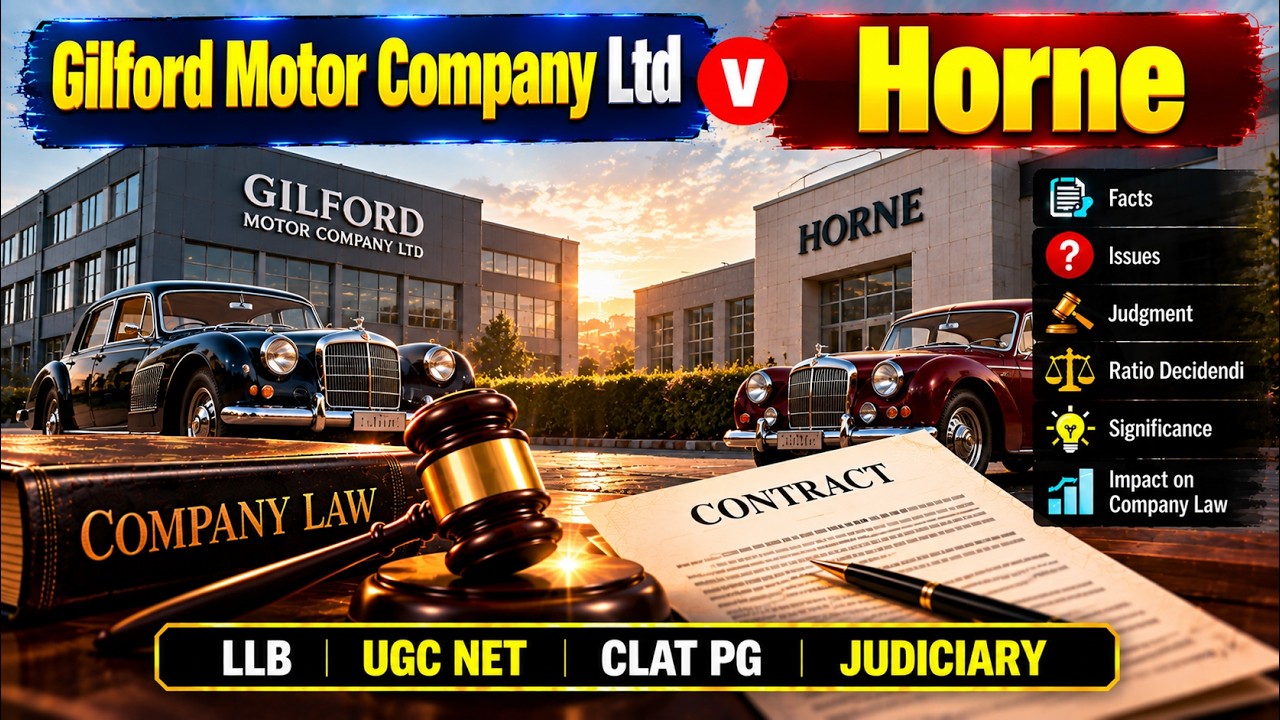
Understand the landmark company law judgment in Gilford Motor Company Ltd v Horne (1933) on the doctrine of lifting the corporate veil. Learn how the Court of Appeal addressed the improper use of a corporate entity formed as a sham or facade to breach a contractual non-compete clause. In this video you will learn: • Understand the facts and procedural history of Gilford Motor Company Ltd v Horne • Learn the doctrine of lifting the corporate veil when a company is used as a sham or facade • Examine how courts treat artificial corporate structures created to evade legal obligations • Understand the limits of the separate legal personality rule laid down in Salomon v Salomon • Learn the specific criteria applied by the Court of Appeal to grant an injunction Topics covered: • Doctrine of lifting the corporate veil • Company as a facade, cloak, or sham • Evasion of contractual obligations • Restrictive covenants and non-compete clauses • Facts of Gilford Motor Co Ltd v Horne • High Court decision by Farwell J • Court of Appeal decision by Lord Hanworth MR • Limits to the Salomon v Salomon separate legal entity doctrine Important case laws: • Gilford Motor Company Ltd v Horne (1933) • Salomon v Salomon and Company Limited Useful for: LL.B. (3-year and 5-year integrated), UGC NET Law, CLAT PG and University semester exams. Chapters: 00:00 Introduction to Gilford Motor Co v Horne 02:28 Central Issue and Restrictive Covenant 03:34 Facts of the Case 07:04 High Court Ruling 08:11 Court of Appeal Decision 09:16 Reasoning on Piercing the Corporate Veil 12:06 Legal Principle and Practical Example 13:11 Summary and Significance Notes and study material: https://www.thelaweasy.com #CompanyLaw #CorporateLaw #LLB #UGCNETLaw #LawEasy

Case law

Judgments to read alongside

The written case notes: facts, issues, judgment and the principle to remember.

Case law library

Gilford

Court of Appeal

Horne, a former managing director bound by a promise not to solicit his old employer's customers, set up a new company and solicited those customers through it. The Court of Appeal held that the new company was a mere cloak or sham formed to escape his promise, and granted an injunction against both Horne and the company. The case is a leading example of lifting the corporate veil where a company is used to escape a legal obligation.

Company Law (Corporate Law)

Salomon v. Salomon

House of Lords

The House of Lords held that a validly registered company is a separate legal person from its members, even when one person holds almost all its shares. So Aron Salomon was not personally liable for the company's debts, and as a secured debenture holder he was paid before the unsecured creditors. The case is the foundation of modern company law and the leading authority on corporate personality.

Company Law (Corporate Law)

Turquand's case

Company Law (Corporate Law)

The company was held bound by a bond its directors gave to the Royal British Bank, even though the general resolution required by the company's deed of settlement had not been passed. The bank was taken to know the deed, but it was entitled to assume that internal formalities like passing the resolution had been completed. The case gave the doctrine of indoor management its other name, 'the rule in Turquand's case'.

Company Law (Corporate Law)

Notes

Notes on Company Law (Corporate Law)

All notes on this subject
Company Law (Corporate Law) Complete notes

Corporate Law: Complete Notes

Corporate Law (Company Law) studies the company from beginning to end: from what a company is and how it is born, to how it finally comes to an end. The course has six units; the first deals with the introduction to company law and the incorporation of a company.

136 min read

Company Law (Corporate Law) Complete notes

Corporate Law One Shot

The evolution of corporate law in India has been influenced significantly by British laws, evolving over time to regulate the rights, duties, and responsibilities of companies. Below is the development explained in a po…

113 min read

Company Law (Corporate Law) Case compilation

Corporate Law Case Law

Key Point: The case clarified that corporations are not "citizens" under the Indian Constitution.

18 min read

Practise 24 Company Law (Corporate Law) MCQs Check what you have learnt with practice questions on this subject.

Video lectures

More on Company Law (Corporate Law)

All lectures on this subject

Learn with video

Watch every lecture free on YouTube

Complete courses, landmark case explanations and quick Shorts from The Law Easy channel. Subscribe to get new lectures as soon as they are published.