Skip to content
The Law Easy

Case explanation · Banking Law

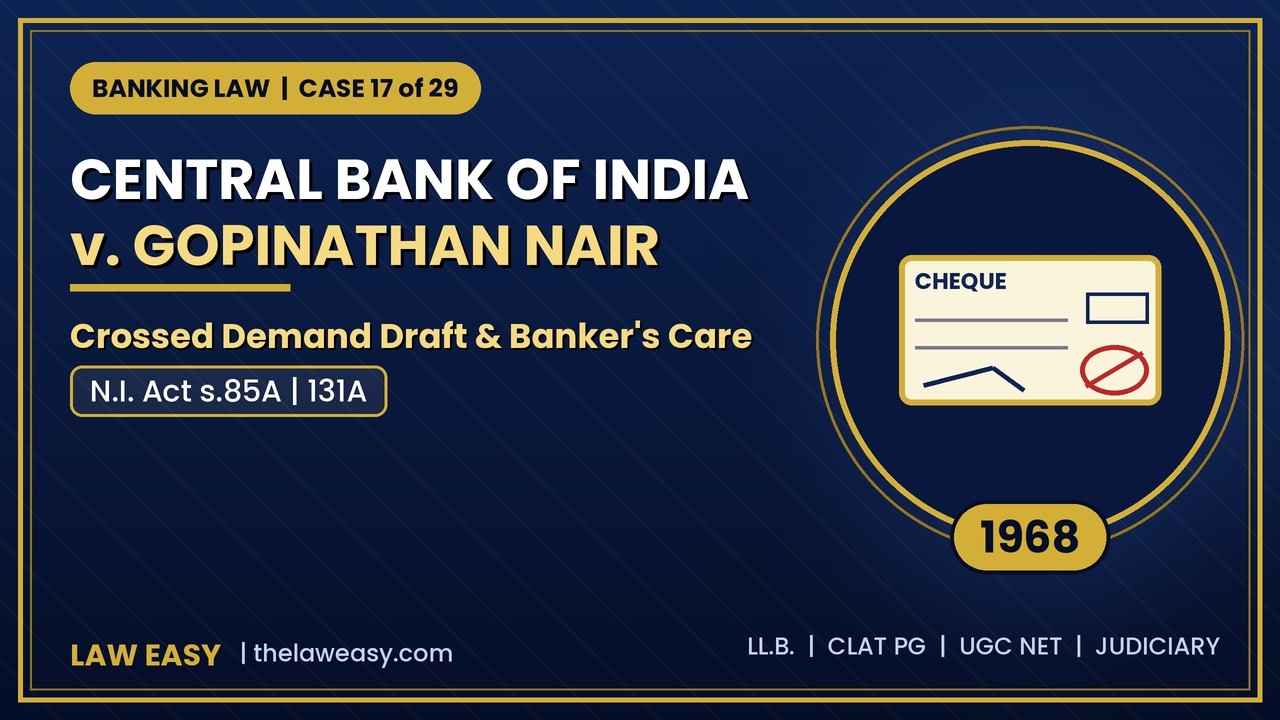
Central Bank of India v V Gopinathan Nair (1968) | Crossed Demand Draft & Banker's Protection

  • 4 min

The lecture loads from YouTube in privacy-enhanced mode only when you press play.

From the YouTube description

About this lecture

Banking Law Case 17 of 29 by Law Easy, for LL.B., CLAT PG, UGC NET Law and Judiciary exams. Case: Central Bank of India v V. Gopinathan Nair (1968), Kerala High Court (Justice K. K. Mathew). FACTS: The plaintiff bought a demand draft for Rs 4,000 at the bank's branch in Alappuzha. It was drawn on the bank's own branch in Kolkata and payable to a Kolkata firm that had kept an account with that branch for about 20 years. The draft was intercepted in transit. A fraudster forged the payee's endorsement and collected the money through an account he held in another bank. The plaintiff sued both banks. LEGAL ISSUE: Were the paying bank and the collecting bank protected, or did negligence take away the protection? JUDGMENT: The High Court held that neither bank was protected. The paying branch knew its old customer well, and the unusual endorsement should have put it on enquiry. The collecting bank had opened the fraudster's account in breach of its own rules, on a weak introduction, and asked no questions about how he came to hold a draft endorsed to him by a stranger. Both appeals were dismissed. PRINCIPLE TO REMEMBER: In India a banker is protected only if he pays in due course, that is in good faith and without negligence, and the burden of proving absence of negligence lies on the banker. Good faith and proper care must exist together. Conduct at account opening can matter when judging a later collection. PROVISIONS: Negotiable Instruments Act, 1881: Section 85A (paying banker, drafts drawn by one branch on another), Section 131A (collecting banker, drafts), Section 131 (collecting banker, crossed cheques). EXAM NOTE: Bank protection is conditional, not automatic. Suspicious transactions call for inquiry. Fraud alone does not settle the issue; negligence has to be examined. PLAYLIST (all 29 cases in order): https://www.youtube.com/playlist?list=PLbhYsrMKgACA COMPLETE LECTURE (all 29 cases with timestamps): https://youtu.be/ayAN7RLlfPM PREVIOUS CASE (16, Bharat Barrel v Amin Chand Payrelal): https://youtu.be/s7uuxlBZUj0 More law notes: https://www.thelaweasy.com If this helps your exam preparation, please subscribe to Law Easy. This video is for education and is not legal advice. #BankingLaw #NegotiableInstrumentsAct #CollectingBanker #CLATPG #Judiciary #LLB #LawEasy

Notes

Notes on Banking Law

All notes on this subject
Banking Law Case compilation

Banking Law: 29 Important Case Laws

Question: Can the Government take over large banks and still be required to respect individual rights?

87 min read

Banking Law Complete notes

Banking Law: Complete Notes

Banking Law (the law and practice of banking in India) runs from why banks exist and why the law watches them so closely, to newer questions such as card frauds, online banking and FinTech. Behind every deposit, cheque, loan and online transfer lies a legal relationship governed by statutes…

106 min read

Practise 120 Banking Law MCQs Check what you have learnt with practice questions on this subject.

Video lectures

More on Banking Law

All lectures on this subject

Learn with video

Watch every lecture free on YouTube

Complete courses, landmark case explanations and quick Shorts from The Law Easy channel. Subscribe to get new lectures as soon as they are published.