Skip to content
The Law Easy

Case explanation · Banking Law

Electronics Trade v Indian Technologists (1996) | Cheque Stop Payment & Section 138 Explained

  • 4 min

The lecture loads from YouTube in privacy-enhanced mode only when you press play.

From the YouTube description

About this lecture

Banking Law Case 18 of 29 by Law Easy, for LL.B., CLAT PG, UGC NET Law and Judiciary exams. Case: Electronics Trade and Technology Development Corporation Ltd v Indian Technologists and Engineers (Electronics) Pvt Ltd (1996), Supreme Court of India (two-judge bench), decided January 1996. FACTS: A cheque came back with remarks such as refer to drawer, instructions for stopping payment and exceeds arrangement. The High Court quashed the complaint under Section 138 of the Negotiable Instruments Act. LEGAL ISSUE: Can the drawer escape the Section 138 offence by stopping payment of the cheque? JUDGMENT: The Supreme Court set aside the High Court order and held that on these facts the offence was prima facie made out. But it added a remark in passing: if the drawer, after issuing a cheque and before it is presented, tells the payee not to present it, the payee presents it anyway, and the bank returns it on the drawer's stop-payment instruction, Section 138 would not be attracted. PRINCIPLE TO REMEMBER: That stop-payment remark was not the final state of the law. If it had become the law, every dishonest drawer could issue a cheque, warn the payee and stop payment. PROVISIONS: Section 138 of the Negotiable Instruments Act, 1881 (dishonour of a cheque for insufficiency of funds, etc.); the Explanation says debt or other liability means a legally enforceable debt or other liability. EXAM NOTE (current law): This reasoning was later expressly rejected by the three-judge decision in Modi Cements v Kuchil Kumar Nandi (1998), which controls the stop-payment point today (see Case 19). A drawer cannot avoid Section 138 merely by telling the bank not to pay. Still, the offence needs a cheque for a legally enforceable debt, proper presentation, the statutory demand notice and failure to pay in time. Treat this case as legal history, not as a present-day defence. PLAYLIST (all 29 cases in order): https://www.youtube.com/playlist?list=PLbhYsrMKgACA COMPLETE LECTURE (all 29 cases with timestamps): https://youtu.be/ayAN7RLlfPM PREVIOUS CASE (17, Central Bank of India v V Gopinathan Nair): https://youtu.be/7bNHTn6Czyk More law notes: https://www.thelaweasy.com If this helps your exam preparation, please subscribe to Law Easy. This video is for education and is not legal advice. #BankingLaw #ChequeBounce #Section138 #CLATPG #Judiciary #LLB #LawEasy

Notes

Notes on Banking Law

All notes on this subject
Banking Law Case compilation

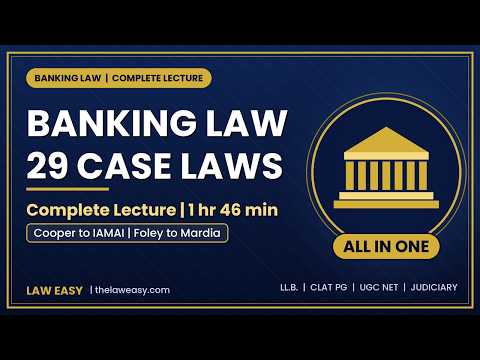
Banking Law: 29 Important Case Laws

Question: Can the Government take over large banks and still be required to respect individual rights?

87 min read

Banking Law Complete notes

Banking Law: Complete Notes

Banking Law (the law and practice of banking in India) runs from why banks exist and why the law watches them so closely, to newer questions such as card frauds, online banking and FinTech. Behind every deposit, cheque, loan and online transfer lies a legal relationship governed by statutes…

106 min read

Practise 120 Banking Law MCQs Check what you have learnt with practice questions on this subject.

Video lectures

More on Banking Law

All lectures on this subject

Learn with video

Watch every lecture free on YouTube

Complete courses, landmark case explanations and quick Shorts from The Law Easy channel. Subscribe to get new lectures as soon as they are published.