Skip to content
The Law Easy

Case explanation · Banking Law

HP Krishna Reddy v Canara Bank (1985) | Agricultural Loan Interest & Section 21A Explained

  • 4 min

The lecture loads from YouTube in privacy-enhanced mode only when you press play.

From the YouTube description

About this lecture

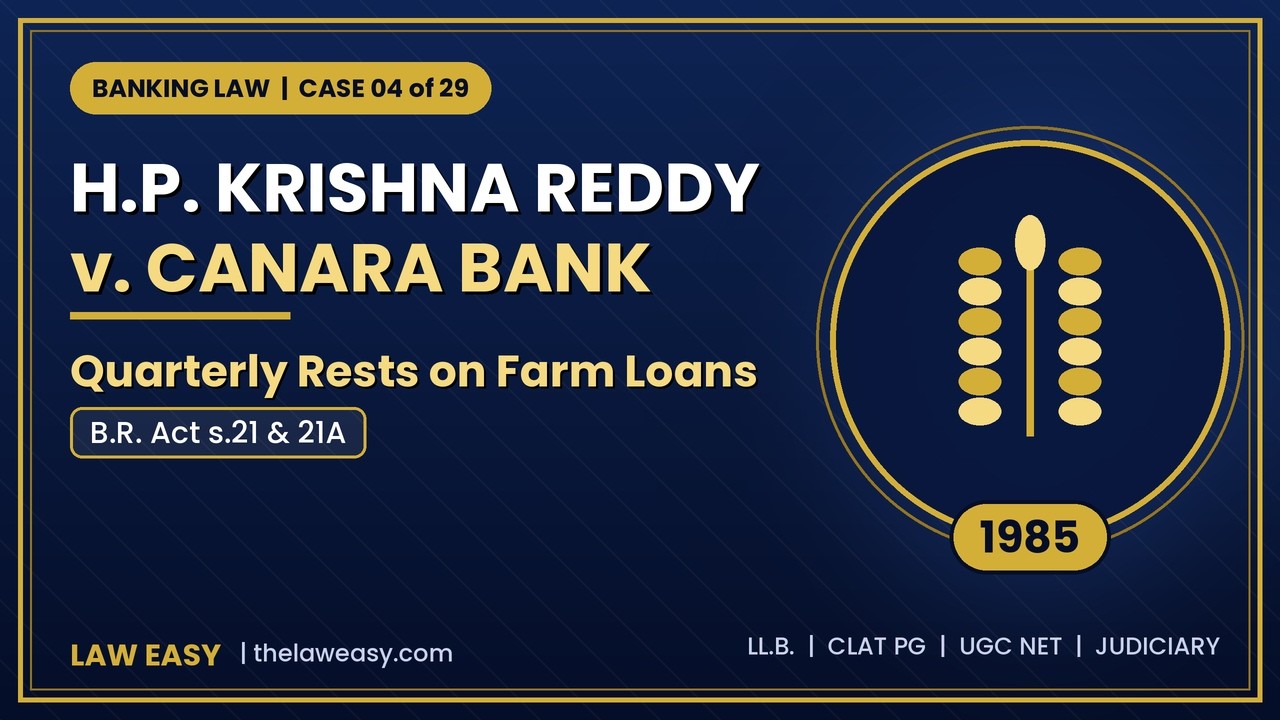
HP Krishna Reddy v Canara Bank (1985): can a bank add interest to an agricultural loan every 3 months when RBI directions do not allow it? Banking Law Case 04 of 29 by Law Easy, for LL.B., CLAT PG, UGC NET Law and Judiciary exams. Court and year: Karnataka High Court, February 1985 (judgment by Justice K. Jagannatha Shetty). Facts: A borrower had taken loans for agricultural purposes, and the bank charged compound interest with quarterly rests. A rest is the point at which interest is added to the principal, so that further interest is charged on it; quarterly rests mean this happens every 3 months. The bank argued that the new Section 21A of the Banking Regulation Act barred the court from interfering. Legal issue: Does Section 21A protect a bank that charges interest in a way the Reserve Bank's directions do not permit? Judgment: The Karnataka High Court disagreed with the bank. Section 21A only stops a court from reopening a bank loan on the ground that the interest is excessive, for example under the Usurious Loans Act. It does not protect a bank that charges interest beyond what the Reserve Bank permits. The Reserve Bank's directions on interest bind banks, and interest charged in breach of them is illegal and void. Since the RBI circulars did not allow quarterly rests on agricultural advances, the bank had to recompute the interest. Principle to remember: Distinguish the rate of interest from the method of adding interest to principal. Even an agreed rate can produce a very different debt if interest is compounded every 3 months. Provisions: Section 21 (RBI power to control advances) and Section 21A of the Banking Regulation Act, 1949. Limit: This is a rule about the legality of the interest calculation, not a blanket exemption from paying loan interest. Current and overdue amounts may be treated differently, so a court must identify the circular applicable to the loan and the period in question. Banking Law playlist (all 29 cases in order): https://www.youtube.com/playlist?list=PLbhYsrMKgACA Complete Banking Law lecture (all 29 cases with chapters): https://youtu.be/ayAN7RLlfPM Previous case (03 Peerless General Finance v RBI): https://youtu.be/OkeZlqbT4G0 Notes and study material: https://www.thelaweasy.com Subscribe to Law Easy for more LL.B., CLAT PG, UGC NET Law and Judiciary case-law lectures. This video is for education and is not legal advice. #BankingLaw #RBI #CLATPG #UGCNETLaw #Judiciary #LLB #LawEasy

Notes

Notes on Banking Law

All notes on this subject
Banking Law Case compilation

Banking Law: 29 Important Case Laws

Question: Can the Government take over large banks and still be required to respect individual rights?

87 min read

Banking Law Complete notes

Banking Law: Complete Notes

Banking Law (the law and practice of banking in India) runs from why banks exist and why the law watches them so closely, to newer questions such as card frauds, online banking and FinTech. Behind every deposit, cheque, loan and online transfer lies a legal relationship governed by statutes…

106 min read

Practise 120 Banking Law MCQs Check what you have learnt with practice questions on this subject.

Video lectures

More on Banking Law

All lectures on this subject

Learn with video

Watch every lecture free on YouTube

Complete courses, landmark case explanations and quick Shorts from The Law Easy channel. Subscribe to get new lectures as soon as they are published.