Skip to content
The Law Easy

Topic lecture · Banking Law

In Re Expeditious Trial of Section 138 Cases (2021) | Cheque Bounce Trial Procedure Explained

  • 4 min

The lecture loads from YouTube in privacy-enhanced mode only when you press play.

From the YouTube description

About this lecture

Banking Law Case 23 of 29 by Law Easy, for LL.B., CLAT PG, UGC NET Law and Judiciary exams. Case: In Re: Expeditious Trial of Cases under Section 138 of the Negotiable Instruments Act, 1881 (2021), Supreme Court of India (five-judge Constitution Bench), April 2021. BACKGROUND: The Court took up the matter on its own because over 35 lakh cheque cases were pending. LEGAL ISSUE: How can courts reduce the huge number of cheque cases without ignoring the criminal procedure fixed by law? Can a magistrate stop a Section 138 complaint using Section 258 of the old Code of Criminal Procedure? JUDGMENT: The Bench held that Section 258, which allows a magistrate to stop certain proceedings, does not apply to complaints under Section 138. The contrary findings in the Kanchan Mehta case (Case 22) do not lay down the correct law, so a court cannot close a cheque case merely because the accused offers payment if the complainant does not agree. The Bench also held that when the accused lives outside the court's territorial jurisdiction, the magistrate must hold an inquiry before issuing summons, and witnesses may give evidence on affidavit for that inquiry. A trial court has no inherent power to review or recall a summons once issued. The Court asked High Courts to treat service of summons in one complaint as service in all complaints before the same court from the same transaction, and recommended that Parliament allow a single trial for several cheque offences committed within 12 months. PRINCIPLE TO REMEMBER: Speed must come from procedure the law actually permits. Section 143 of the Negotiable Instruments Act provides for summary trial, and routine conversion into a full summons trial should not happen without reasons. PROVISIONS: Sections 138, 143 and 145 to 147 of the Negotiable Instruments Act, 1881; Section 258 of the old Code of Criminal Procedure (read with the present B.N.S.S., 2023 framework). EXAM NOTE: Kanchan Mehta (Case 22) remains useful for its emphasis on compensation and early settlement, but not for closing a case without the complainant's consent. PLAYLIST (all 29 cases in order): https://www.youtube.com/playlist?list=PLbhYsrMKgACA COMPLETE LECTURE (all 29 cases with timestamps): https://youtu.be/ayAN7RLlfPM PREVIOUS CASE (22, Meters and Instruments v Kanchan Mehta): https://youtu.be/oXnfqbXx3Jc More law notes: https://www.thelaweasy.com If this helps your exam preparation, please subscribe to Law Easy. This video is for education and is not legal advice. #BankingLaw #ChequeBounce #Section138 #CLATPG #Judiciary #LLB #LawEasy

Notes

Notes on Banking Law

All notes on this subject
Banking Law Case compilation

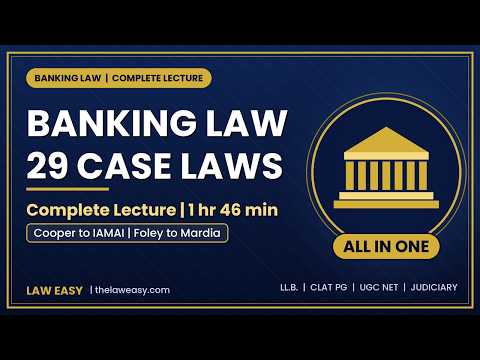
Banking Law: 29 Important Case Laws

Question: Can the Government take over large banks and still be required to respect individual rights?

87 min read

Banking Law Complete notes

Banking Law: Complete Notes

Banking Law (the law and practice of banking in India) runs from why banks exist and why the law watches them so closely, to newer questions such as card frauds, online banking and FinTech. Behind every deposit, cheque, loan and online transfer lies a legal relationship governed by statutes…

106 min read

Practise 120 Banking Law MCQs Check what you have learnt with practice questions on this subject.

Video lectures

More on Banking Law

All lectures on this subject

Learn with video

Watch every lecture free on YouTube

Complete courses, landmark case explanations and quick Shorts from The Law Easy channel. Subscribe to get new lectures as soon as they are published.