Skip to content
The Law Easy

Case explanation · Banking Law

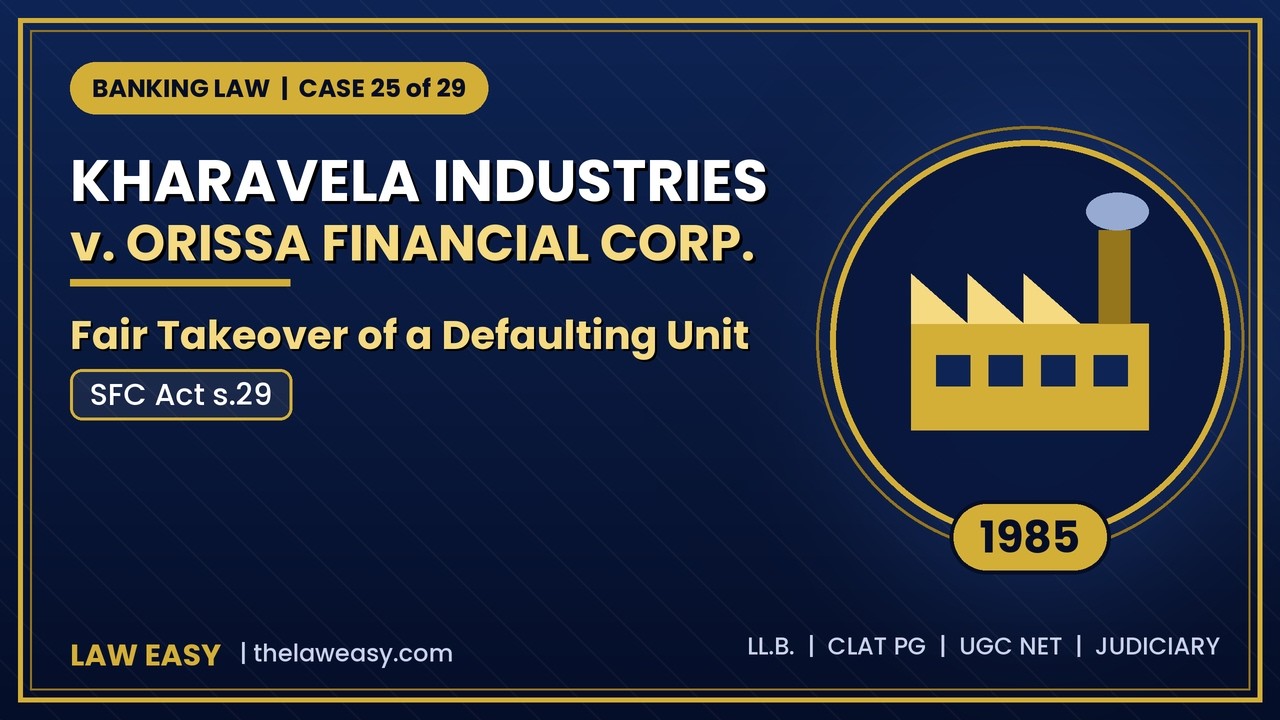
Kharavela Industries v Orissa State Financial Corporation (1985) | Section 29 SFC Act Explained

  • 4 min

The lecture loads from YouTube in privacy-enhanced mode only when you press play.

From the YouTube description

About this lecture

Banking Law Case 25 of 29 by Law Easy, for LL.B., CLAT PG, UGC NET Law and Judiciary exams. Case: Kharavela Industries Pvt Ltd v Orissa State Financial Corporation (1985), Orissa High Court (Division Bench), decided February 1985 (Justice G. B. Patnaik). FACTS: When the company defaulted on its loan, the corporation passed a takeover order but did not act on it. The company then paid some money. Ignoring this, the corporation suddenly took possession of the unit, issued a sale notice the next day and sold it within days. LEGAL ISSUE: Must a State Financial Corporation exercising its power under Section 29 consider payments already made and give the borrower a fair chance to respond? JUDGMENT: The High Court quashed the takeover and the sale. Section 29 of the State Financial Corporations Act, 1951 is an extraordinary power that lets a corporation take over the management or possession of a defaulting industrial concern and sell it without going to court. It must be used in good faith, after considering all relevant facts, including payments made by the borrower. Because a takeover has grave civil consequences and there is no appeal, the borrower must get notice and a minimum opportunity to be heard, and a sale made in such haste, without adequate publicity and time, breaks the duty to obtain the best price. PRINCIPLE TO REMEMBER: The power to recover a factory does not remove the duty to act fairly. Effective recovery law still demands fairness, relevant facts, notice and a proper sale. PROVISIONS: Section 29 of the State Financial Corporations Act, 1951. EXAM NOTE: The decision concerns a state financial corporation under its specific Act. Do not present it as the exact procedural rule for every modern bank under a different recovery statute such as SARFAESI (see Cases 26 and 27). The judgment does not say borrowers may ignore their instalments. PLAYLIST (all 29 cases in order): https://www.youtube.com/playlist?list=PLbhYsrMKgACA COMPLETE LECTURE (all 29 cases with timestamps): https://youtu.be/ayAN7RLlfPM PREVIOUS CASE (24, Dayawati v Yogesh Kumar Gosain): https://youtu.be/GO3t3XMg41E More law notes: https://www.thelaweasy.com If this helps your exam preparation, please subscribe to Law Easy. This video is for education and is not legal advice. #BankingLaw #SFCAct #LoanRecovery #CLATPG #Judiciary #LLB #LawEasy

Notes

Notes on Banking Law

All notes on this subject
Banking Law Case compilation

Banking Law: 29 Important Case Laws

Question: Can the Government take over large banks and still be required to respect individual rights?

87 min read

Banking Law Complete notes

Banking Law: Complete Notes

Banking Law (the law and practice of banking in India) runs from why banks exist and why the law watches them so closely, to newer questions such as card frauds, online banking and FinTech. Behind every deposit, cheque, loan and online transfer lies a legal relationship governed by statutes…

106 min read

Practise 120 Banking Law MCQs Check what you have learnt with practice questions on this subject.

Video lectures

More on Banking Law

All lectures on this subject

Learn with video

Watch every lecture free on YouTube

Complete courses, landmark case explanations and quick Shorts from The Law Easy channel. Subscribe to get new lectures as soon as they are published.