Skip to content
The Law Easy

Case explanation · Banking Law

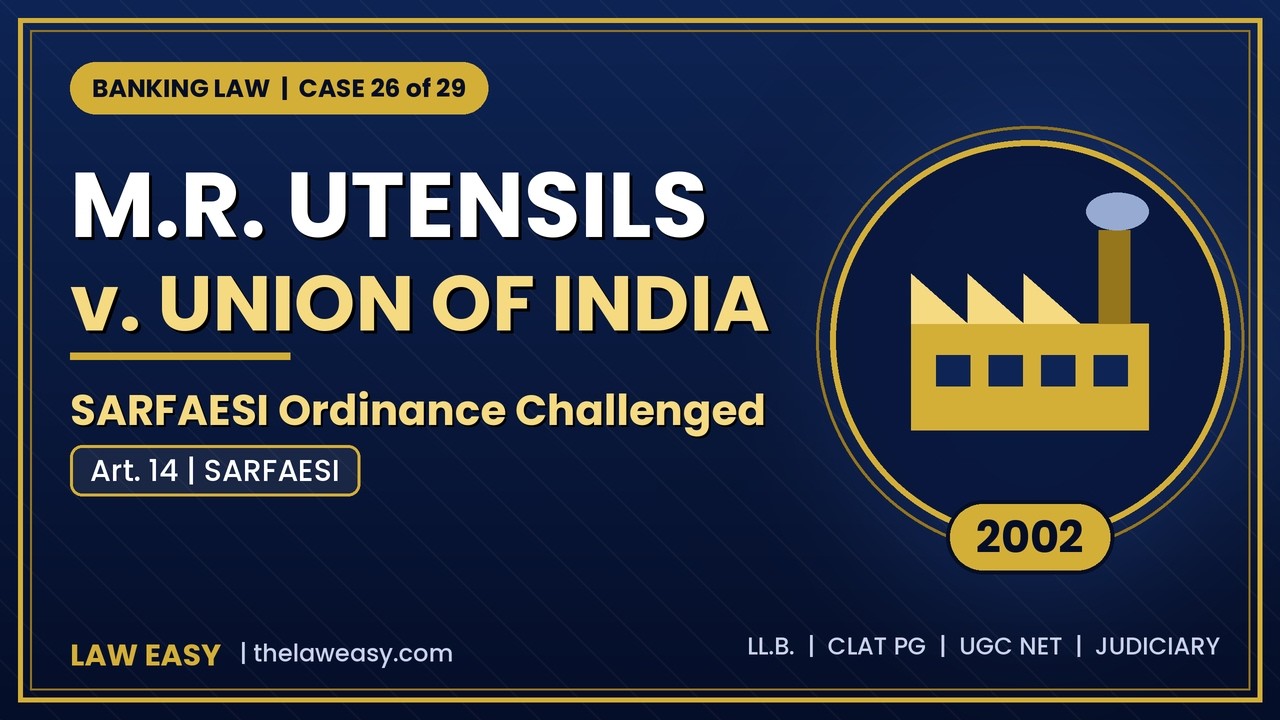
MR Utensils v Union of India (2002) | SARFAESI Ordinance Challenge Explained

  • 4 min

The lecture loads from YouTube in privacy-enhanced mode only when you press play.

From the YouTube description

About this lecture

Banking Law Case 26 of 29 by Law Easy, for LL.B., CLAT PG, UGC NET Law and Judiciary exams. Case: MR Utensils v Union of India (2002), Gujarat High Court (Division Bench, Chief Justice D. S. Sinha), decided 8 October 2002. FACTS: Borrowers challenged the second SARFAESI ordinance, before Parliament enacted the final recovery statute, under Article 14 of the Constitution. They argued that it left a borrower with no remedy against the creditor's action. LEGAL ISSUE: Is a law unconstitutional merely because it lets a secured lender act without first obtaining a civil court decree? JUDGMENT: The High Court rejected the challenge. It held that the notice to the borrower, the remedy before the Debt Recovery Tribunal and then before the Appellate Tribunal, and the provision for restoring possession with compensation gave borrowers adequate protection, so the law was not arbitrary. It also noted that none of the petitioners had yet received a notice from any secured creditor, so their challenge was academic. PRINCIPLE TO REMEMBER: A court assesses the whole system of safeguards rather than one power in isolation. SARFAESI lets banks enforce security without the intervention of courts, following the recommendations of expert committees. PROVISIONS: Article 14 of the Constitution; the Securitisation and Reconstruction of Financial Assets and Enforcement of Security Interest Act, 2002 (SARFAESI Act), and the ordinances that preceded it. EXAM NOTE (current law): This was an early High Court decision, mainly of historical interest. The ordinance also contained a heavy deposit condition (75 per cent of the claimed amount), which the Supreme Court later held unconstitutional in Mardia Chemicals v Union of India (2004). See Case 27. An answer that cites only the Gujarat ruling is incomplete: state the historic decision and then identify how the later Supreme Court ruling changed the law. PLAYLIST (all 29 cases in order): https://www.youtube.com/playlist?list=PLbhYsrMKgACA COMPLETE LECTURE (all 29 cases with timestamps): https://youtu.be/ayAN7RLlfPM PREVIOUS CASE (25, Kharavela Industries v Orissa State Financial Corporation): https://youtu.be/3FTKLWQ64Lc More law notes: https://www.thelaweasy.com If this helps your exam preparation, please subscribe to Law Easy. This video is for education and is not legal advice. #BankingLaw #SARFAESI #LoanRecovery #CLATPG #Judiciary #LLB #LawEasy

Notes

Notes on Banking Law

All notes on this subject
Banking Law Case compilation

Banking Law: 29 Important Case Laws

Question: Can the Government take over large banks and still be required to respect individual rights?

87 min read

Banking Law Complete notes

Banking Law: Complete Notes

Banking Law (the law and practice of banking in India) runs from why banks exist and why the law watches them so closely, to newer questions such as card frauds, online banking and FinTech. Behind every deposit, cheque, loan and online transfer lies a legal relationship governed by statutes…

106 min read

Practise 120 Banking Law MCQs Check what you have learnt with practice questions on this subject.

Video lectures

More on Banking Law

All lectures on this subject

Learn with video

Watch every lecture free on YouTube

Complete courses, landmark case explanations and quick Shorts from The Law Easy channel. Subscribe to get new lectures as soon as they are published.