Can the government control every part of your private life just because the Constitution does not use the word 'privacy'?
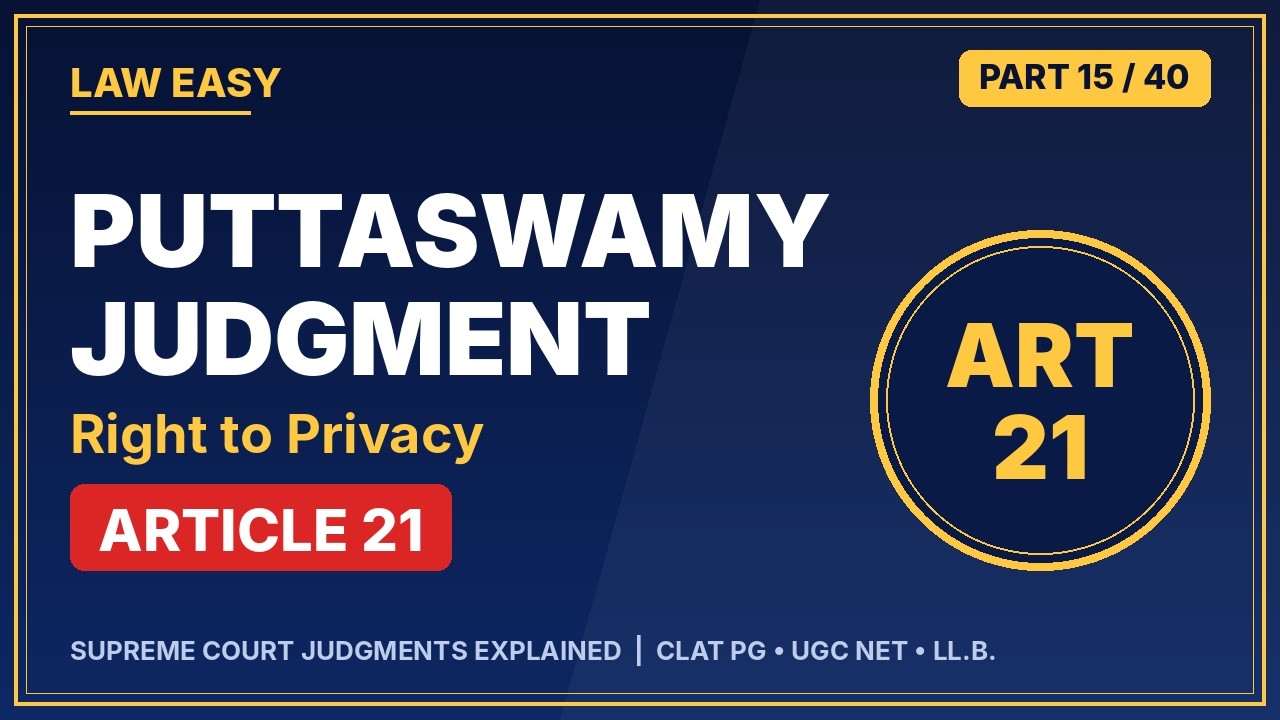
Justice K. S. Puttaswamy (Retd.) v. Union of India (2017) explained in simple English - Article 21 and Part III. Part 15 of 40 in Law Easy's Constitutional Case Laws series for LL.B., CLAT PG, UGC NET Law and judiciary preparation.
THE FACTS
The case arose during constitutional challenges connected with the Aadhaar system. A retired judge, Justice K. S. Puttaswamy, questioned government collection and use of personal information. The Supreme Court first had to settle whether privacy itself is protected by the Constitution.
THE LEGAL QUESTION
Is the right to privacy a fundamental right under the Constitution?
WHAT THE SUPREME COURT HELD
Nine judges considered the question and all nine recognised privacy as a fundamental right protected by Part III, especially Article 21. Privacy includes control over personal information, decisions about your body and important choices in private life. The right is not absolute - a restriction must satisfy legality, a legitimate State objective and proportionality. The Court rejected older statements suggesting the Constitution did not protect privacy. Whether particular parts of Aadhaar were valid was decided later in another judgment.
KEY POINTS TO REMEMBER
- Privacy is linked with dignity and autonomy
- Proportionality: a restriction must be appropriately connected to its purpose and go no further than justified
- Privacy does not put a person beyond every law
FOR YOUR EXAM
Remember: nine-judge bench, 24 August 2017, unanimous, privacy as part of Article 21 and Part III, and the three-part test of legality, legitimate aim and proportionality.
CONTINUE THE SERIES
Next, Part 16: Navtej Singh Johar v Union of India (2018) | Section 377 Decriminalised
https://youtu.be/SJniKv1hf30
Related, Part 17: Joseph Shine v Union of India (2018) | Adultery Law Section 497 Struck Down
https://youtu.be/Z0O8Pyoetxk
All 40 Constitutional Case Laws (playlist):
https://www.youtube.com/playlist?list=PLT4r9ZZ3tKLM
Complete lecture, all 40 cases in one video:
https://youtu.be/oUrSfn3wp8s?t=1928 (this case starts at 32:08)
Notes and study material:
https://www.thelaweasy.com
Subscribe to Law Easy for more Constitutional Law, LL.B., CLAT PG, UGC NET Law and judiciary lectures:
https://www.youtube.com/@LawEasyin?sub_confirmation=1
Educational content only, not legal advice. Always read the original judgment and check the latest law before relying on a case in an answer or in practice.
#ConstitutionalLaw #CLATPG #UGCNETLaw #LawEasy #Article21