Skip to content
The Law Easy

Case explanation · Banking Law

RC Cooper v Union of India (1970) | Bank Nationalisation Case Explained | Article 14, 19 & 31

  • 4 min

The lecture loads from YouTube in privacy-enhanced mode only when you press play.

From the YouTube description

About this lecture

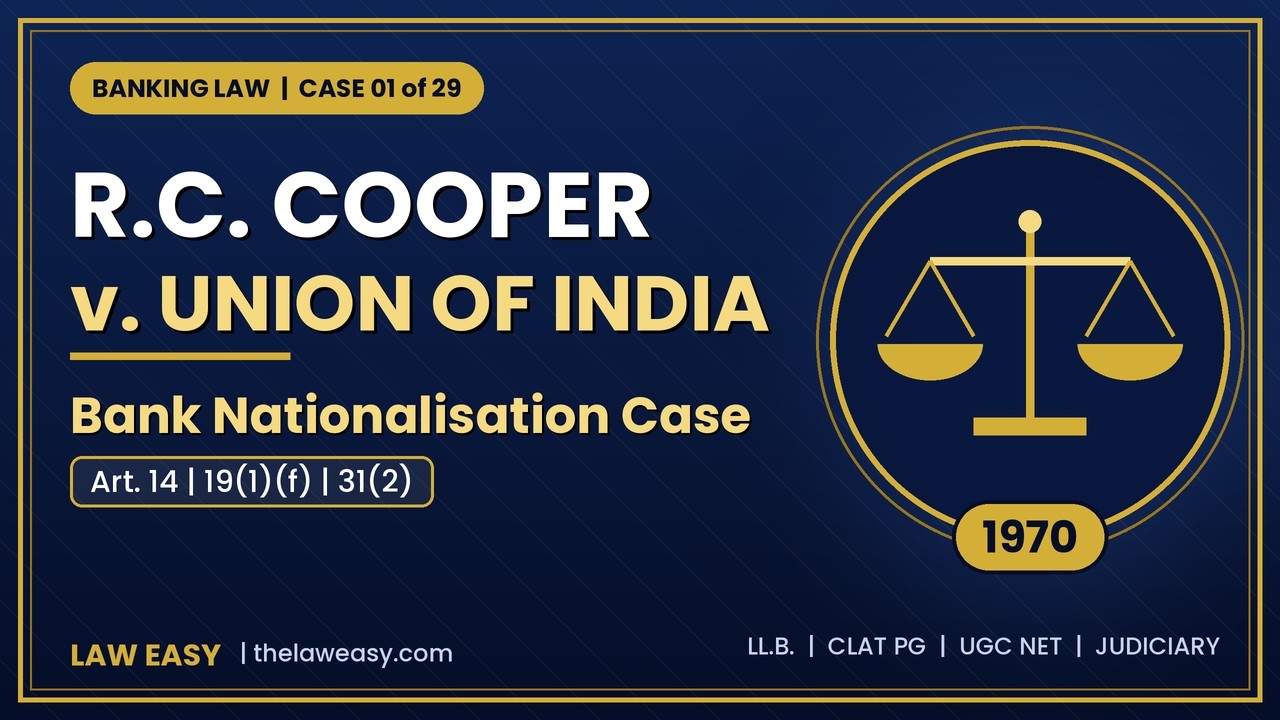
RC Cooper v Union of India (1970): the Bank Nationalisation Case explained for LL.B., CLAT PG, UGC NET Law and Judiciary exams. Banking Law Case 01 of 29 by Law Easy. Court and year: Supreme Court of India, 1970. Facts: 14 banks were nationalised in 1969. Rustom Cavasjee Cooper owned shares in several of them, was a director of one and also held deposits, and challenged the nationalisation Act because of its effect on his rights. Legal issue: Can the State nationalise banks by law and still respect fundamental rights? Did the Act breach Article 14 (equality), Article 19(1)(f) (right to property, as it then stood) and Article 31(2) (compensation)? Judgment: The majority held that Parliament had power to make the law (banking is in the Union List and acquisition of property is in the Concurrent List) and that a shareholder can sue when state action impairs his own fundamental rights. But the Act was struck down. It was hostile discrimination under Article 14 to take over these banks and bar only them from banking in future, while other Indian and foreign banks could continue. It also violated Article 31(2) because it did not lay down relevant principles for compensation: it ignored items such as goodwill and the value of long leases. Principle to remember: A law must be judged by its direct effect on fundamental rights, not merely by its object or form. This effect test is the lasting legacy of the case. Article 19(1)(f) and Article 31 were not mutually exclusive. Provisions: Articles 14, 19(1)(f) and 31(2) as they stood in 1969. Exam note: Do not teach the old right to property as a present fundamental right. After the 44th Amendment, property is protected by Article 300A as a constitutional right. Banking Law playlist (all 29 cases in order): https://www.youtube.com/playlist?list=PLbhYsrMKgACA Complete Banking Law lecture (all 29 cases with chapters): https://youtu.be/ayAN7RLlfPM Notes and study material: https://www.thelaweasy.com Subscribe to Law Easy for more LL.B., CLAT PG, UGC NET Law and Judiciary case-law lectures. This video is for education and is not legal advice. #BankingLaw #RCCooper #CLATPG #UGCNETLaw #Judiciary #LLB #LawEasy

Notes

Notes on Banking Law

All notes on this subject
Banking Law Case compilation

Banking Law: 29 Important Case Laws

Question: Can the Government take over large banks and still be required to respect individual rights?

87 min read

Banking Law Complete notes

Banking Law: Complete Notes

Banking Law (the law and practice of banking in India) runs from why banks exist and why the law watches them so closely, to newer questions such as card frauds, online banking and FinTech. Behind every deposit, cheque, loan and online transfer lies a legal relationship governed by statutes…

106 min read

Practise 120 Banking Law MCQs Check what you have learnt with practice questions on this subject.

Video lectures

More on Banking Law

All lectures on this subject

Learn with video

Watch every lecture free on YouTube

Complete courses, landmark case explanations and quick Shorts from The Law Easy channel. Subscribe to get new lectures as soon as they are published.