Skip to content
The Law Easy

Case explanation · Constitutional Law I

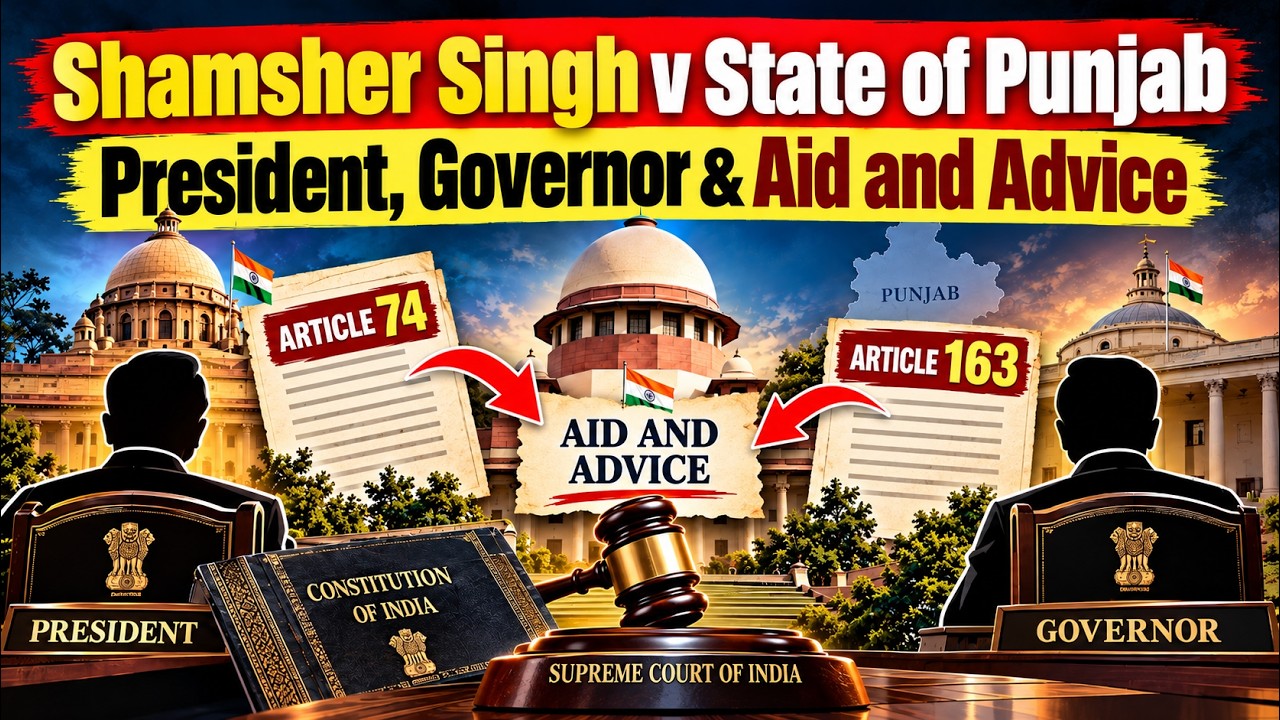
Shamsher Singh v. State of Punjab

  • 13 min
  • 6 chapters

The lecture loads from YouTube in privacy-enhanced mode only when you press play.

From the YouTube description

About this lecture

In this lecture, we analyse the landmark Supreme Court decision in Shamsher Singh v State of Punjab. We explore the constitutional position of the President and Governor as constitutional heads acting on ministerial aid and advice, the overruling of Sardari Lal's case, and the safeguards governing judicial officers under Articles 235 and 311. In this video you will learn: • Understand the constitutional status of the President and Governor under parliamentary democracy. • Examine the doctrine of responsible government and requirement of ministerial aid and advice. • Learn why the Supreme Court overruled Sardari Lal v Union of India. • Understand the scope of Article 311 protections regarding probationers and punitive terminations. • Analyse the High Court's exclusive control over subordinate judiciary under Article 235. Topics covered: • Facts of Shamsher Singh and Ishwar Chand Agarwal • Issues regarding executive power of Governor and President • Doctrine of responsible government and cabinet advice • Overruling of Sardari Lal v Union of India • Status and termination of probationers under Article 311 • High Court control over subordinate judiciary under Article 235 • Delegation of disciplinary inquiries to vigilance department Important case laws: • Shamsher Singh v State of Punjab • Sardari Lal v Union of India Statutory provisions discussed: • Article 311, Constitution of India • Article 235, Constitution of India • Article 234, Constitution of India • Article 163, Constitution of India • Article 154, Constitution of India • Rules 7 and 9, Punjab Civil Services (Judicial Branch) Rules, 1951 Useful for: LL.B. (3-year and 5-year integrated), UGC NET Law, CLAT PG, University semester exams and Judiciary aspirants. Chapters: 00:00 Introduction to Shamsher Singh Case 02:07 Core Legal Issues 03:11 Arguments by Appellants and State 05:39 Key Constitutional Provisions 06:44 Supreme Court Ruling and Analysis 10:18 Final Relief and Orders Notes and study material: https://www.thelaweasy.com #ConstitutionalLaw #ShamsherSinghCase #Article311 #JudiciaryExams #LawEasy

Case law

Judgments to read alongside

The written case notes: facts, issues, judgment and the principle to remember.

Case law library

Rameshwar Prasad vs Union of India

Supreme Court of India (Constitution Bench) · 2006

First, let us understand the basic meaning. Normally, a Legislative Assembly is elected, meets, and functions for up to five years unless dissolved earlier. Rameshwar Prasad & Ors. vs. Union of India (2006) asks a startling question: can an assembly be dissolved before it has even held its first me…

Constitutional Law I

Public Interest Foundation vs Union of India

Supreme Court of India (5-Judge Constitution Bench) · 2018

First, let us understand the basic meaning. India's Constitution already lists specific reasons a person cannot become a Member of Parliament under Article 102 . But what happens when a serious social problem — people facing serious criminal charges contesting and winning elections, then going on t…

Constitutional Law I

GVK Industries Ltd. vs Income Tax Officer

Supreme Court of India (Constitution Bench) · 2011

First, let us understand the basic meaning. Article 245 of the Constitution deals with how far laws made by Parliament and State legislatures can extend. GVK Industries Ltd. vs. Income Tax Officer (2011) answers a precise question: can Parliament make laws about things that happen outside the terri…

Constitutional Law I

Notes

Notes on Constitutional Law I

All notes on this subject
Constitutional Law I Complete notes

Constitution I One Shot

Definition: Constitutionalism is a system that gives legitimacy to a democratic government.

69 min read

Constitutional Law I

Inclusion of an Ex-CJI into Parliament

On March 19,2020, former Chief Justice of India, Ranjan Gogoi, took oath as a member of the Rajya Sabha, the upper house of India's Parliament. His nomination was made by the President of India under Article 80 of the C…

10 min read

Practise 40 Constitutional Law I MCQs Check what you have learnt with practice questions on this subject.

Video lectures

More on Constitutional Law I

All lectures on this subject

Learn with video

Watch every lecture free on YouTube

Complete courses, landmark case explanations and quick Shorts from The Law Easy channel. Subscribe to get new lectures as soon as they are published.