Skip to content
The Law Easy

Case explanation · Company Law (Corporate Law)

Foss v. Harbottle

  • 13 min
  • 7 chapters

The lecture loads from YouTube in privacy-enhanced mode only when you press play.

From the YouTube description

About this lecture

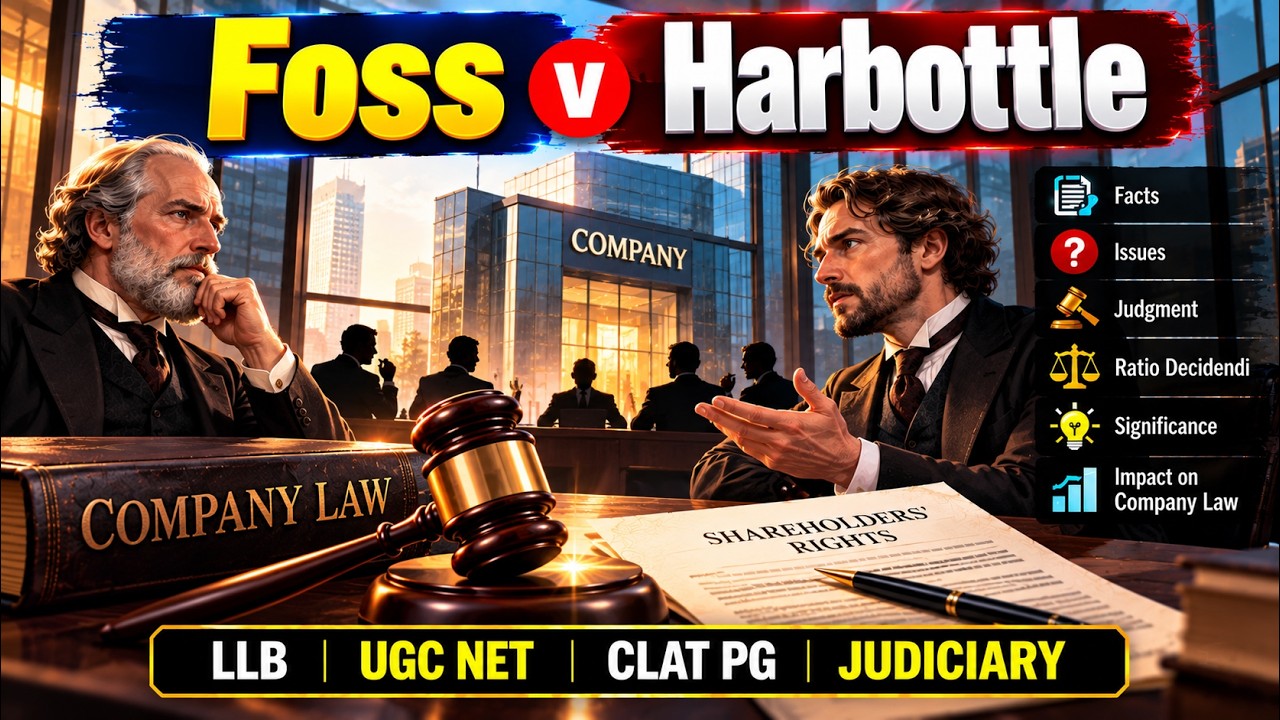
Understand the landmark company law judgment in Foss v Harbottle and its foundational legal principles. This lecture explains the proper plaintiff rule, the doctrine of majority rule, and the essential exceptions created to safeguard minority shareholder interests. In this video you will learn: • Understand the core legal dispute and facts of Foss v Harbottle • Learn the Proper Plaintiff Rule and separate corporate personality • Examine the Majority Principle Rule and internal corporate management • Identify exceptions including ultra vires acts and fraud on the minority • Understand how derivative actions protect minority shareholders Topics covered: • Significance of Foss v Harbottle in Company Law • Concept of Corporate Personality and Proper Plaintiff • Facts of Foss v Harbottle (Victoria Park Company) • Issues Raised Before the Court • Arguments of the Plaintiffs and Defendants • Judgment of Wigram V.C. • The Proper Plaintiff Rule • The Majority Principle Rule • Exceptions to the Rule in Foss v Harbottle • Derivative Actions and Minority Shareholder Protection Important case laws: • Foss v Harbottle Useful for: LL.B. (3-year and 5-year integrated), UGC NET Law, CLAT PG and University semester exams. Chapters: 00:00 Introduction to Foss v Harbottle 02:46 Facts of the Case 04:32 Issues and Contentions 06:41 Judgment of the Court 08:30 Two Rules in Foss v Harbottle 09:58 Exceptions to the Majority Rule 11:45 Summary and Key Takeaways Notes and study material: https://www.thelaweasy.com #CompanyLaw #FossVHarbottle #CorporateLaw #LLB #LawEasy

Case law

Judgments to read alongside

The written case notes: facts, issues, judgment and the principle to remember.

Case law library

Foss v. Harbottle

Company Law (Corporate Law)

Two shareholders sued the directors of their company for selling their own land to the company at an excessive price and misapplying its property. The court dismissed the suit because a wrong done to the company must be remedied by the company itself, and the majority could decide whether to sue or could approve what had been done. The case is the foundation of the majority rule in company law and gave rise to the proper plaintiff rule and the rule of internal management.

Company Law (Corporate Law)

Turquand's case

Company Law (Corporate Law)

The company was held bound by a bond its directors gave to the Royal British Bank, even though the general resolution required by the company's deed of settlement had not been passed. The bank was taken to know the deed, but it was entitled to assume that internal formalities like passing the resolution had been completed. The case gave the doctrine of indoor management its other name, 'the rule in Turquand's case'.

Company Law (Corporate Law)

Gilford

Court of Appeal

Horne, a former managing director bound by a promise not to solicit his old employer's customers, set up a new company and solicited those customers through it. The Court of Appeal held that the new company was a mere cloak or sham formed to escape his promise, and granted an injunction against both Horne and the company. The case is a leading example of lifting the corporate veil where a company is used to escape a legal obligation.

Company Law (Corporate Law)

Notes

Notes on Company Law (Corporate Law)

All notes on this subject
Company Law (Corporate Law) Complete notes

Corporate Law: Complete Notes

Corporate Law (Company Law) studies the company from beginning to end: from what a company is and how it is born, to how it finally comes to an end. The course has six units; the first deals with the introduction to company law and the incorporation of a company.

136 min read

Company Law (Corporate Law) Complete notes

Corporate Law One Shot

The evolution of corporate law in India has been influenced significantly by British laws, evolving over time to regulate the rights, duties, and responsibilities of companies. Below is the development explained in a po…

113 min read

Company Law (Corporate Law) Case compilation

Corporate Law Case Law

Key Point: The case clarified that corporations are not "citizens" under the Indian Constitution.

18 min read

Practise 24 Company Law (Corporate Law) MCQs Check what you have learnt with practice questions on this subject.

Video lectures

More on Company Law (Corporate Law)

All lectures on this subject

Learn with video

Watch every lecture free on YouTube

Complete courses, landmark case explanations and quick Shorts from The Law Easy channel. Subscribe to get new lectures as soon as they are published.