Skip to content
The Law Easy

Topic lecture · Public International Law

Monism and Dualism

  • 12 min
  • 13 chapters

The lecture loads from YouTube in privacy-enhanced mode only when you press play.

From the YouTube description

About this lecture

Understand monism and dualism in public international law and how international rules interact with Indian municipal law. This lesson explains treaty implementation, customary international law and harmonisation through Indian court decisions, with examples for LL.B., UGC NET Law, CLAT PG and law university revision. 📚 For Complete Law Notes, Visit: https://www.thelaweasy.com TOPICS COVERED • Municipal law and public international law: one legal system or two? • Dualism, transformation and specific adoption theories. • Monism, self-executing treaties and delegation theory. • India's approach to treaties and Parliament's power under Article 253; Article 51(c). • Customary international law, statutory conflict and harmonious interpretation. • ICCPR Article 11, Section 51 of the Code of Civil Procedure and Article 21. • CEDAW and the role of international conventions in Vishaka. CASES DISCUSSED Maganbhai Ishwarbhai Patel v. Union of India (1969) Gramophone Company of India Ltd. v. Birendra Bahadur Pandey (1984) Jolly George Varghese v. Bank of Cochin (1980) Vishaka v. State of Rajasthan (1997) CHAPTERS 00:00 The treaty versus domestic law puzzle 00:33 Municipal law and international law 01:17 Dualism 02:06 Transformation and specific adoption 03:06 Monism and self-executing treaties 04:18 Delegation theory 04:50 India's treaty approach: Maganbhai Patel 06:02 Articles 253 and 51(c) 06:52 Customary international law: Gramophone case 08:41 Harmonisation theory 09:27 Jolly George Varghese and the ICCPR 10:49 Vishaka and CEDAW 11:34 Quick revision CONTINUE LEARNING Public International Law complete course: https://www.youtube.com/watch?v=franMa2Ztjs Subscribe to Law Easy for clear legal concepts, case law explanations and exam revision. Use the chapters to revisit a theory, then test your understanding with the opening courtroom problem. #LawEasy #InternationalLaw #LLB #UGCNETLaw #CLATPG

Case law

Judgments to read alongside

The written case notes: facts, issues, judgment and the principle to remember.

Case law library

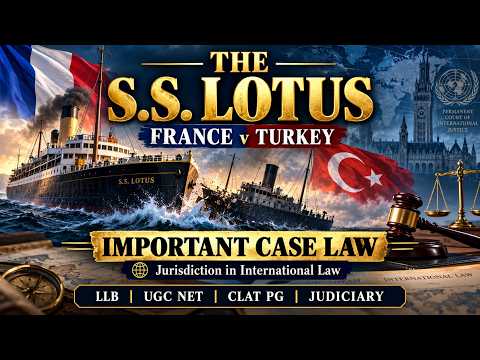
Lotus Case

1927

After a French ship collided with a Turkish ship on the high seas, the P.C.I.J. held in 1927 that Turkey could try the French officer, because international law did not forbid it. The case gave the 'Lotus principle': a State is free to act unless a rule of international law prohibits it. Its specific rule on collisions at sea was later reversed by treaty, now Article 97 of UNCLOS, 1982.

Public International Law

Notes

Notes on Public International Law

All notes on this subject
Public International Law

Relationship between International Law and Municipal Law

About this topic ▶ Watch this part of the lecture (0:00) This topic explains how international law and the law inside a country (municipal law) relate to each other: whether they form one legal system or two, which of them prevails when they clash, and how Indian courts actually treat treaties and…

16 min read

Public International Law Complete notes

Public International Law: Complete Notes

About this subject ▶ Watch this part of the lecture (00:00) Public International Law is studied in seven units: from how a law between nations was born to how a new State or government is accepted by other States. Rules made between States work quietly in daily life, when a parcel is sent abroad, a…

123 min read

Public International Law Complete notes

International Law One Shot

Oppenheim defines international law as the set of customary and conventional rules that are legally binding for "civilized" states in their relations with each other. This definition mainly considers states as the prima…

89 min read

Practise 136 Public International Law MCQs Check what you have learnt with practice questions on this subject.

Video lectures

More on Public International Law

All lectures on this subject

Learn with video

Watch every lecture free on YouTube

Complete courses, landmark case explanations and quick Shorts from The Law Easy channel. Subscribe to get new lectures as soon as they are published.