Skip to content
The Law Easy

Case explanation · Public International Law

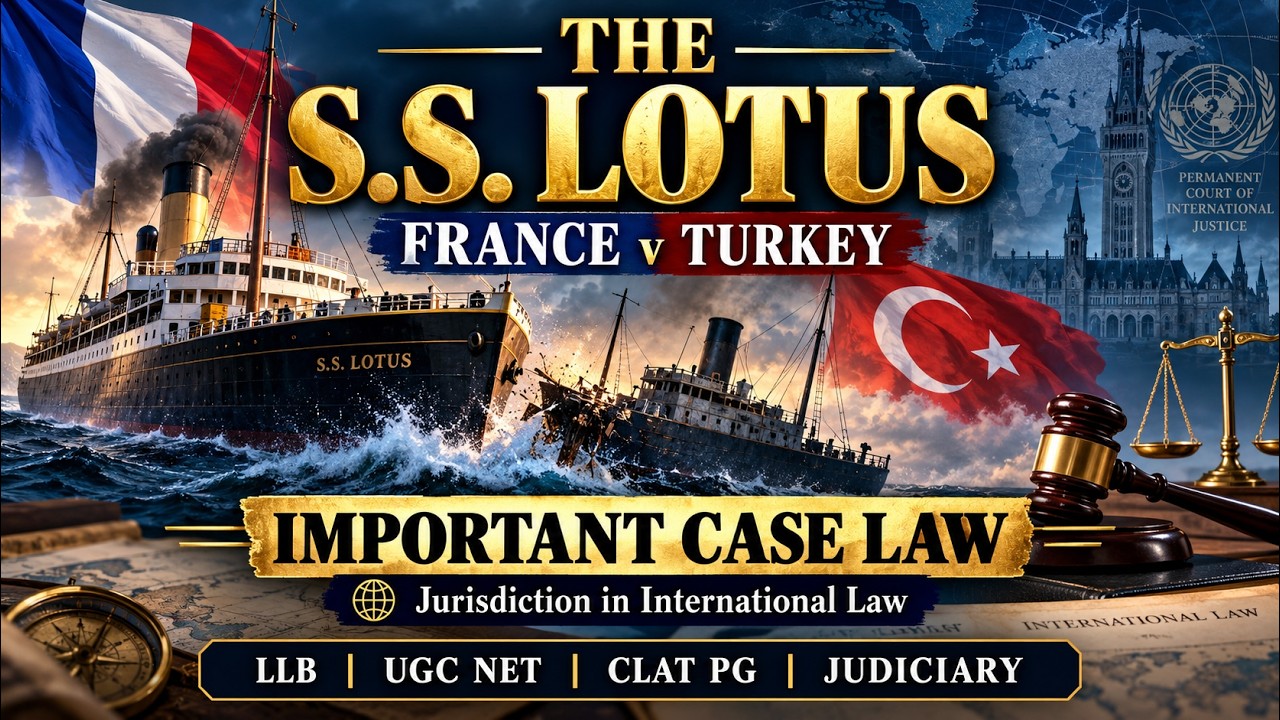
S.S. Lotus Case

  • 14 min
  • 7 chapters

The lecture loads from YouTube in privacy-enhanced mode only when you press play.

From the YouTube description

About this lecture

This lecture explains the landmark public international law decision in the SS Lotus Case (France v Turkey, 1927) decided by the Permanent Court of International Justice. Learn the factual background of the high-seas collision, the issues of criminal jurisdiction, and the reasoning behind the famous Lotus principle. The video also covers the concepts of concurrent jurisdiction and how the ruling was subsequently modified by UNCLOS. In this video you will learn: • Understand the factual matrix of the collision between SS Lotus and SS Boz-Kourt • Learn Turkey's and France's arguments concerning jurisdiction on the high seas • Examine the Permanent Court of International Justice ruling delivered in 1927 • Master the Lotus principle: states are free to act unless explicitly prohibited • Distinguish between exclusive flag state jurisdiction and concurrent jurisdiction • Analyze how the 1958 Geneva Convention and UNCLOS curtailed the Lotus ruling Topics covered: • Introduction to the SS Lotus case • High seas collision between SS Lotus and SS Boz-Kourt • Turkish detention and manslaughter trial of Lieutenant Demons • French diplomatic protest and argument of flag state jurisdiction • Questions referred to the Permanent Court of International Justice • PCIJ ruling on territorial effects and jurisdiction • The Lotus principle: freedom of states absent prohibitive rules • Positive, negative, and concurrent jurisdiction principles • Clash between flag state and territorial jurisdiction • Subsequent curtailment of the Lotus principle by the 1958 Geneva Convention and UNCLOS Important case laws: • France v Turkey (1927) Useful for: LL.B. (3-year and 5-year integrated), UGC NET Law, CLAT PG and University semester exams. Chapters: 00:00 Introduction to the SS Lotus Case 02:09 Facts of the Collision and Detention 05:01 Legal Issues Before the PCIJ 06:08 PCIJ Decision and Effects Doctrine 07:13 The Lotus Principle Explained 08:41 Positive, Negative and Concurrent Jurisdiction 11:19 Curtailment by 1958 Convention and UNCLOS Notes and study material: https://www.thelaweasy.com #PublicInternationalLaw #SSLotusCase #LawOfTheSea #UGCNETLaw #LawEasy

Case law

Judgments to read alongside

The written case notes: facts, issues, judgment and the principle to remember.

Case law library

Lotus Case

1927

After a French ship collided with a Turkish ship on the high seas, the P.C.I.J. held in 1927 that Turkey could try the French officer, because international law did not forbid it. The case gave the 'Lotus principle': a State is free to act unless a rule of international law prohibits it. Its specific rule on collisions at sea was later reversed by treaty, now Article 97 of UNCLOS, 1982.

Public International Law

Notes

Notes on Public International Law

All notes on this subject
Public International Law Complete notes

Public International Law: Complete Notes

About this subject ▶ Watch this part of the lecture (00:00) Public International Law is studied in seven units: from how a law between nations was born to how a new State or government is accepted by other States. Rules made between States work quietly in daily life, when a parcel is sent abroad, a…

123 min read

Public International Law Complete notes

International Law One Shot

Oppenheim defines international law as the set of customary and conventional rules that are legally binding for "civilized" states in their relations with each other. This definition mainly considers states as the prima…

89 min read

Public International Law

State Jurisdiction

State jurisdiction asks a basic question of Public International Law: when may a state make, enforce and apply its law to a person, a thing or an event? The topic covers the three kinds of jurisdiction, the five recognised bases (the "keys") on which a state may claim jurisdiction, the two limits (…

16 min read

Practise 136 Public International Law MCQs Check what you have learnt with practice questions on this subject.

Video lectures

More on Public International Law

All lectures on this subject

Learn with video

Watch every lecture free on YouTube

Complete courses, landmark case explanations and quick Shorts from The Law Easy channel. Subscribe to get new lectures as soon as they are published.