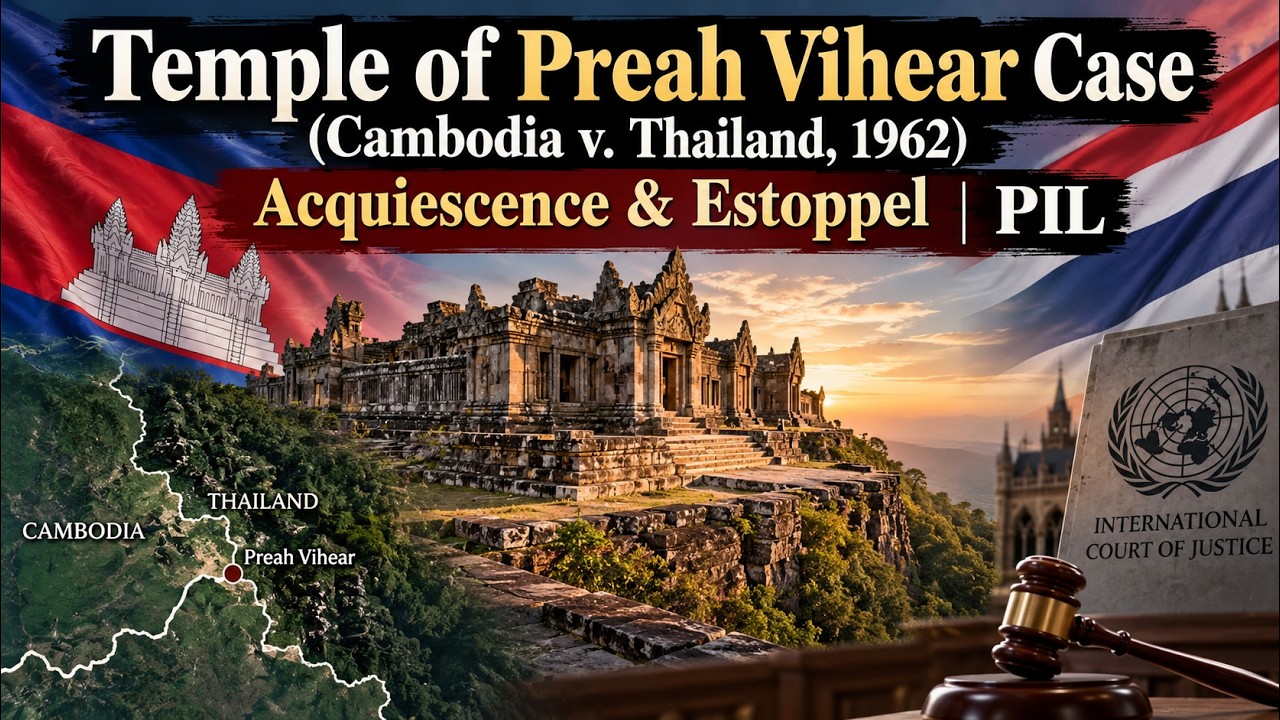
Can fifty years of acceptance stop a country from rejecting an old boundary map? In this video we explain the Case Concerning the Temple of Preah Vihear (Cambodia v. Thailand, ICJ 1962), the leading case on acquiescence and estoppel in international law: a State that stays silent when it should protest, and accepts benefits, cannot later change its position.
Timestamps:
0:00 Can fifty years of acceptance stop a country rejecting an old map?
0:08 Silence, acquiescence and estoppel explained
0:36 The Temple of Preah Vihear Case: Cambodia v. Thailand
0:43 Facts: the temple on the cliff and the 1904 watershed boundary agreement
0:59 The French map placing the temple on the Cambodian side
1:04 Siam uses the map for about 50 years; the 1930 royal visit
1:15 Cambodia becomes independent; Thailand occupies the temple
1:24 ICJ 1962 (9 votes to 3): the temple is in Cambodia, Thailand must withdraw
1:34 Even if the map departed from the watershed, Thailand accepted it by conduct
1:39 The maxim: qui tacet consentire videtur si loqui debuisset ac potuisset
1:50 Why Thailand could not plead error
2:05 Return of objects taken from the temple (7 votes to 5)
2:11 The 2013 interpretation: sovereignty over the whole promontory
2:19 The principle: silence plus accepted benefits means estoppel or preclusion
2:29 Example: Sameer, Arman and the wall on a shared map
2:41 Thailand's watershed argument vs. Cambodia's map and conduct
2:53 What the Court considered: long absence of protest
3:01 Acquiescence and estoppel defined
3:14 Not every silence is consent: knowledge, reason to speak, conduct over time
3:25 How the 2013 judgment clarified the original decision
3:28 A fictional example (not a fact about the case)
3:42 International disputes: official documents and the full conduct of States
Key takeaways:
- Acquiescence is acceptance shown by conduct, including silence when an objection should reasonably have been made.
- Estoppel prevents a party from denying a position on which it earlier acted or from which it benefited.
- Not every silence is consent: knowledge, a reason to speak and conduct over time matter.
- A State cannot plead error if it contributed to the error, could have avoided it, or was put on notice.
Subject: Public International Law (LL.B.)
Notes: thelaweasy.com
Disclaimer: This video is for educational purposes only and is not legal advice.
#PreahVihear #PublicInternationalLaw #Acquiescence #Estoppel #LawEasy