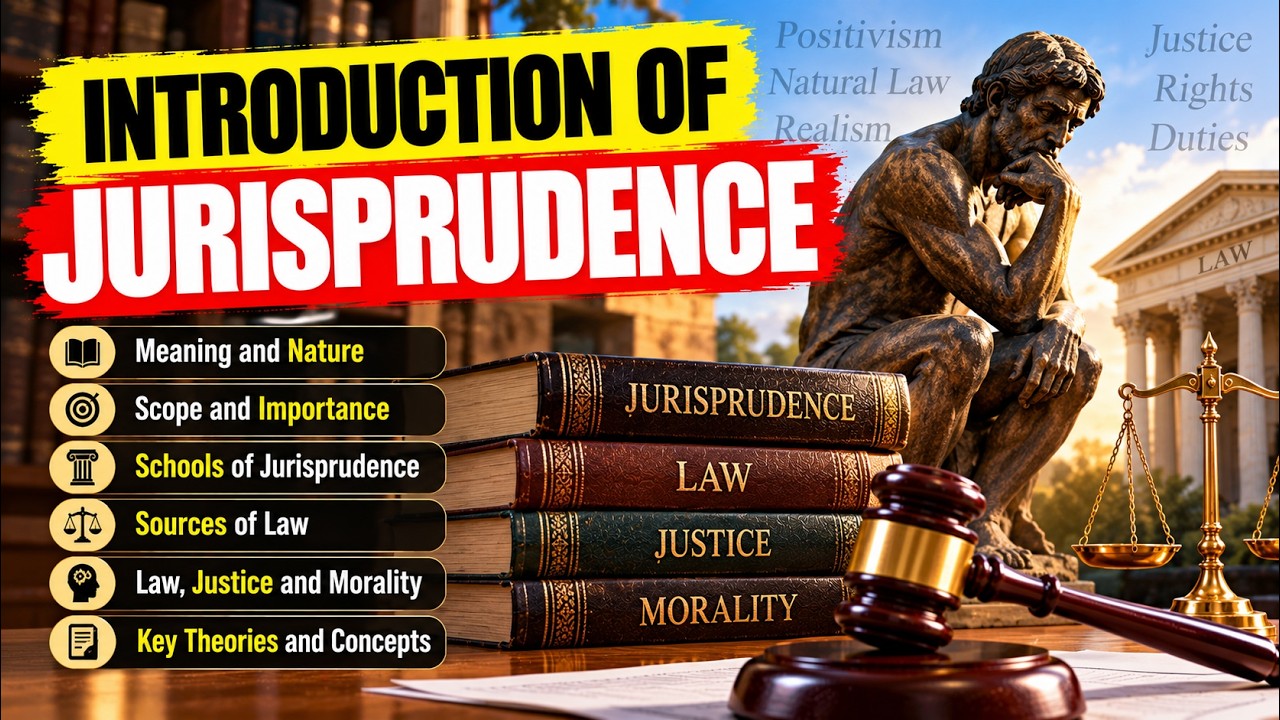
This lecture provides a clear and foundational introduction to Jurisprudence, explaining why the subject is studied and how it directly shapes constitutional interpretation. Using the landmark Emergency decision in ADM Jabalpur alongside modern rulings like Puttaswamy, it breaks down the core conflict between Legal Positivism and Natural Law. It also demystifies essential jurisprudential terminology and provides a repeatable four-question framework to master every legal school of thought.
In this video you will learn:
• Understand the meaning of jurisprudence and why thinking about legal rules differs from learning them.
• Compare Legal Positivism (John Austin, H.L.A. Hart) with Natural Law theory (Aquinas, Augustine).
• Examine how the ADM Jabalpur ruling reflected positivism while Justice H.R. Khanna applied natural law.
• See how Savigny's Historical School influences the recognition of custom in the Hindu Marriage Act, 1955.
• Master essential jurisprudential terms including ontology, epistemology, normative, and teleology.
• Apply a practical four-question framework to dissect and retain any jurist's legal theory.
Topics covered:
• Nature and definition of jurisprudence
• ADM Jabalpur v Shivkant Shukla and conflicting philosophies of law
• Legal Positivism: John Austin and H.L.A. Hart
• Natural Law Theory: St. Augustine and Thomas Aquinas
• Austin's sovereign theory versus Kesavananda Bharati
• Friedrich Carl von Savigny and the Historical School
• Custom under the Hindu Marriage Act, 1955
• American Legal Realism and Roscoe Pound's Social Engineering
• Key vocabulary: Ontology, Epistemology, Normative, and Teleology
• Four-step method to analyse any legal theory
• Overruling of ADM Jabalpur in K.S. Puttaswamy v Union of India
Important case laws:
• ADM Jabalpur v Shivkant Shukla (1976)
• Kesavananda Bharati v State of Kerala (1973)
• K.S. Puttaswamy v Union of India (2017)
Statutory provisions discussed:
• Article 359, Constitution of India
• Article 21, Constitution of India
• Section 3(a), Hindu Marriage Act, 1955
• Section 7(1), Hindu Marriage Act, 1955
• Article 20, Constitution of India
Useful for: LL.B. (3-year and 5-year integrated), UGC NET Law, CLAT PG, University semester exams and Judiciary aspirants.
Chapters:
00:00 Introduction: ADM Jabalpur and Jurisprudence
01:45 Why Jurisprudence Feels Difficult
03:11 Legal Positivism vs Natural Law
05:42 Austin, Basic Structure and Historical Context
08:55 Key Philosophical Vocabulary Explained
09:58 Four-Question Method to Study Thinkers
Notes and study material:
https://www.thelaweasy.com
#Jurisprudence #LegalTheory #UGCNETLaw #CLATPG #LawEasy