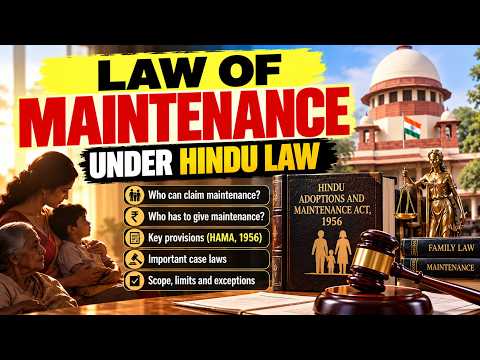
This lecture provides an in-depth analysis of maintenance under Muslim Law (Nafaqah), explaining the interplay between Muslim personal law, Section 144 BNSS (formerly Section 125 CrPC), and the Muslim Women (Protection of Rights on Divorce) Act, 1986. It covers the evolution of maintenance rights across marriage, iddat, and post-divorce through landmark Supreme Court rulings such as Shah Bano, Danial Latifi, and Mohd. Abdul Samad. Students will also learn about the maintenance rights of children, parents, and antenuptial allowances like Kharcha-i-Pandan.
In this video you will learn:
• Understand the formula of one duty, two tracks, and three stages of Muslim maintenance law.
• Contrast maintenance under Muslim personal law with Section 144 BNSS and Section 125 CrPC.
• Learn the nature and enforceability of Kharcha-i-Pandan and antenuptial agreements.
• Examine the ratio and constitutional impact of the landmark Shah Bano case (1985).
• Analyze Sections 3, 4, and 5 of the Muslim Women (Protection of Rights on Divorce) Act, 1986.
• Understand Danial Latifi v. Union of India and the interpretation of fair and reasonable provision.
• Review Mohd. Abdul Samad (2024) regarding concurrent remedies under secular criminal procedure.
• Master the rules governing maintenance of legitimate and illegitimate children, parents, and grandparents.
Topics covered:
• Concept of Nafaqah and Maintenance in Muslim Law
• Personal Law Track vs Secular Track (Section 144 BNSS / Section 125 CrPC)
• Maintenance of Wife During Marriage and Justified Non-Cohabitation
• Kharcha-i-Pandan and Antenuptial Agreements
• Grounds of Divorce under Dissolution of Muslim Marriages Act 1939
• Maintenance During and After Iddat
• Shah Bano Case and the Nature of Mahr
• Muslim Women (Protection of Rights on Divorce) Act, 1986
• Danial Latifi Constitutional Interpretation of 'Fair and Reasonable Provision'
• Mohd Abdul Samad Judgment and Concurrent Remedies
• Maintenance of Legitimate and Illegitimate Children
• Maintenance of Parents and Grandparents
Important case laws:
• Ali Akbar v Fatima (1929)
• Mohd. Ahmed Khan v. Shah Bano Begum (1985)
• Danial Latifi v. Union of India (2001)
• Mohd. Abdul Samad v. State of Telangana (2024)
Statutory provisions discussed:
• Section 2, Muslim Personal Law (Shariat) Application Act, 1937
• Section 2(ii), Dissolution of Muslim Marriages Act, 1939
• Section 144, Bharatiya Nagarik Suraksha Sanhita, 2023
• Section 125, Code of Criminal Procedure, 1973
• Section 2(b), Muslim Women (Protection of Rights on Divorce) Act, 1986
• Section 3, Muslim Women (Protection of Rights on Divorce) Act, 1986
• Section 4, Muslim Women (Protection of Rights on Divorce) Act, 1986
• Section 5, Muslim Women (Protection of Rights on Divorce) Act, 1986
• Section 146(3)(b), Bharatiya Nagarik Suraksha Sanhita, 2023
• Article 44, Constitution of India
Useful for: LL.B. (3-year and 5-year integrated), UGC NET Law, CLAT PG, University semester exams and Judiciary aspirants.
Chapters:
00:00 Introduction and Opening Problems
02:07 Maintenance During Marriage under Personal Law
04:15 Kharcha-i-Pandan and Pre-Nuptial Agreements
05:18 Secular Track: Section 144 BNSS Analysis
09:52 Maintenance During Iddat and Divorce Rules
12:01 Shah Bano Case and CrPC Section 125
15:35 Muslim Women Act 1986: Sections 3 to 5
18:46 Danial Latifi v Union of India Judgment
21:20 Mohd Abdul Samad v State of Telangana (2024)
23:50 Application of Formula and Final Solutions
Notes and study material:
https://www.thelaweasy.com
#MuslimLaw #FamilyLaw #ShahBano #DanialLatifi #LawEasy