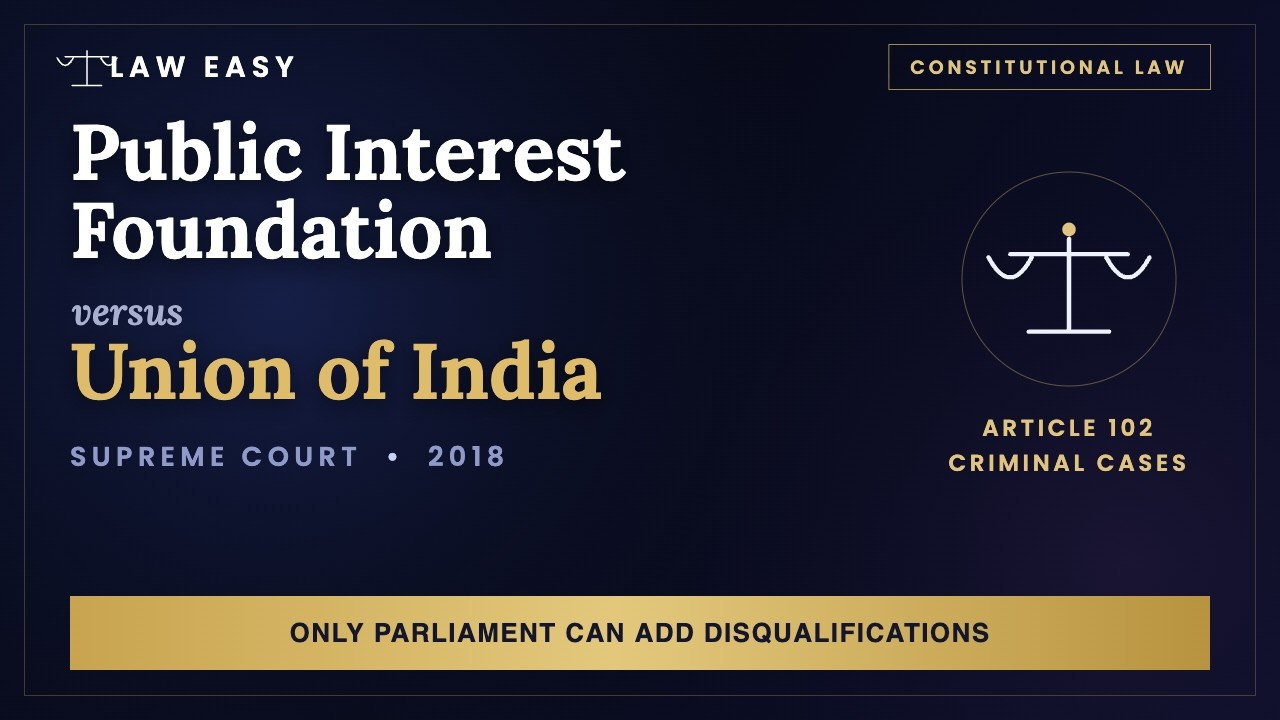
Public Interest Foundation & Ors. vs. Union of India & Ors. (2018) - the Supreme Court held that only PARLIAMENT can add new grounds of disqualification for candidates, and gave directions to put criminal records before voters.
Read the Complete Notes:
https://thelaweasy.com/public-interest-foundation-vs-union-of-india-2018-case-summary
Decided by a five-judge Constitution Bench on 25 September 2018. This video explains what Article 102 covers, why the Court refused to bar candidates facing criminal charges, and what it directed instead.
THE CASE
Public Interest Foundation & Ors. vs. Union of India & Ors.
Supreme Court of India | 5-judge Constitution Bench | 25 September 2018
Constitutional Law - Articles 102, 191 and 145(3), Tenth Schedule, Section 29A(5) RPA
THE BACKGROUND
The case is about the criminalisation of politics - people facing serious criminal charges contesting elections and going on to make laws. A three-judge bench felt the question too important to decide alone and referred it under Article 145(3), which requires at least five judges for a substantial question of constitutional interpretation. It therefore came before a five-judge Constitution Bench.
THE ISSUES
1. Can courts create grounds of disqualification beyond Article 102 and the laws made under it?
2. Can a candidate facing criminal charges be barred from the party's reserved symbol?
THE PROVISIONS EXPLAINED
- Article 102: the grounds on which a person is disqualified from being an MP - office of profit, unsound mind, undischarged insolvent, not a citizen of India, and disqualification under any law made by Parliament.
- The Tenth Schedule: disqualification on the ground of defection - leaving your own party after the election.
- Article 191: the same scheme for members of State legislatures.
- Section 29A(5), Representation of the People Act; Article 14: equality before the law.
THE ARGUMENTS
Petitioners: those facing serious criminal charges should not become lawmakers; allowing it goes against democracy and Article 14. The Election Commission should be given guidelines stopping such candidates from contesting on a party symbol.
Respondents: separation of powers must be respected - creating new disqualifications is Parliament's job, and the Court can at most recommend. Section 29A(5) is complete in itself, and acting against a party on mere charges would breach it.
THE COURT'S ANALYSIS
- Only Parliament can legislate on disqualification; the Court cannot take that role.
- On the symbol: barring a candidate from it would create a new disqualification through the back door, and the Court cannot do indirectly what it cannot do directly.
- The Court urged Parliament to legislate so that parties themselves stop nominating candidates facing serious criminal charges.
THE DIRECTIONS
Unable to add disqualifications, the Court turned to transparency:
1. Every candidate must fill the nomination form completely, with full details of pending criminal cases.
2. Those cases must be stated in bold letters.
3. The candidate must inform their political party about them.
4. Parties must publish this about their candidates on their official websites.
5. Candidate and party must publicise it at least three times after nomination, in widely circulated newspapers and on electronic media.
THE PRINCIPLE OF LAW
The judiciary can interpret the law but cannot create new disqualifications - that power belongs to Parliament alone. A voter has the right to an informed choice, and a vote cast without full information is not truly free.
WHAT YOU WILL LEARN
- What Article 102 actually lists as disqualifications
- Why Article 145(3) sends a case to a Constitution Bench
- The separation-of-powers limit on judicial law-making
- Exam-ready points for LLB, Judiciary, UPSC, PCS (J) and CLAT PG
CHAPTERS
0:00 Should people facing criminal charges make our laws?
0:46 Why it matters: criminalisation of politics
1:23 How the case reached a five-judge bench (Article 145(3))
2:13 The two issues before the Court
2:45 Article 102: the existing disqualifications
3:31 The Tenth Schedule and Article 191
3:56 The petitioners' arguments
4:32 The respondents: separation of powers
5:09 Section 29A(5) of the RP Act
5:32 The Court's analysis: only Parliament can disqualify
5:59 Issue 2: the party's reserved symbol
6:31 No disqualification through the back door
6:51 The Court asks Parliament to legislate
7:03 The directions: disclosure on the nomination form
7:38 Criminal cases in bold, and told to the party
7:56 Publication on websites, in newspapers and on TV
8:17 Why the voter's right to information matters
8:30 Courts interpret, Parliament legislates
DISCLAIMER: This video is for educational purposes only. It is a simplified explanation of a reported judgment and is not legal advice. Please consult a qualified advocate on any specific matter.
#PublicInterestFoundation #Article102 #CriminalisationOfPolitics #ConstitutionalLaw #IndianConstitution #SupremeCourtOfIndia #LawEasy