Skip to content
The Law Easy

Case explanation · Public International Law

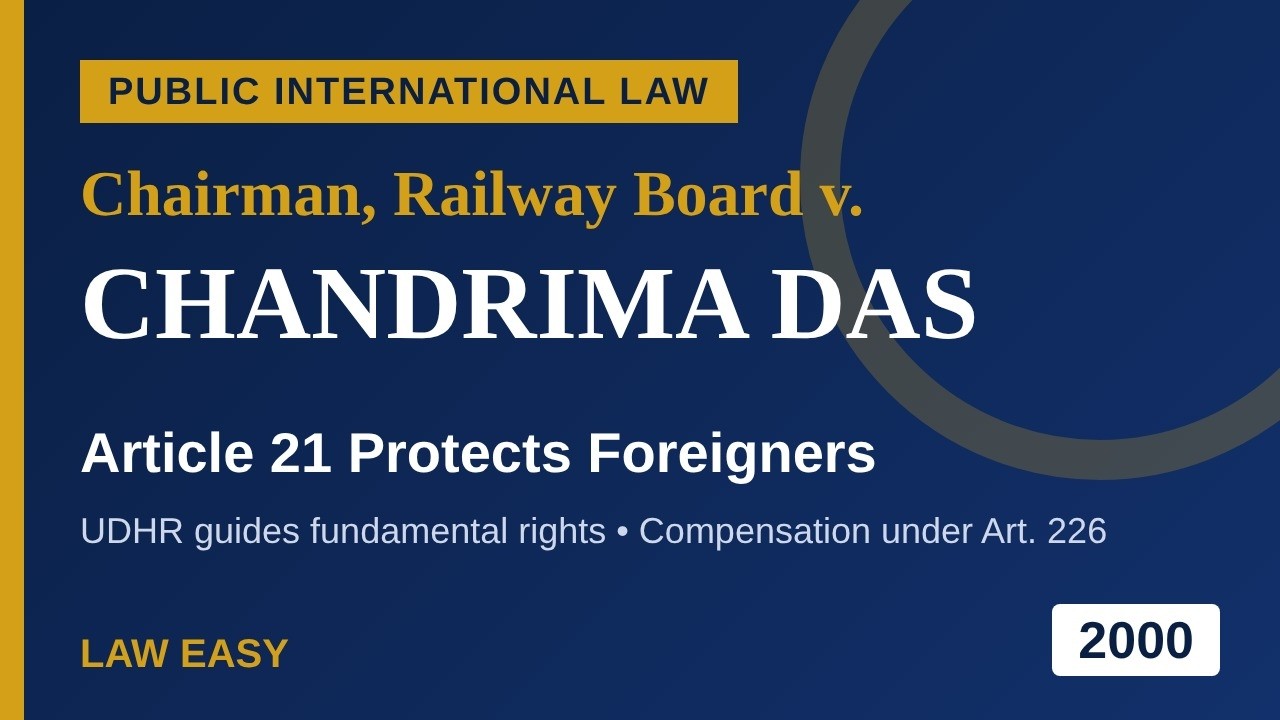
Chairman, Railway Board v. Chandrima Das (2000) | Article 21 for Foreigners | PIL Case Law

  • 4 min
  • 12 chapters

The lecture loads from YouTube in privacy-enhanced mode only when you press play.

From the YouTube description

About this lecture

Chairman, Railway Board v. Chandrima Das (2000) explained in simple language: how the Supreme Court held that the right to life under Article 21 belongs to every person, including a foreign visitor, and upheld compensation under Article 226. Useful for LL.B., CLAT PG, UGC NET Law and judiciary exams. In this video (case law note for Public International Law): 00:00 Does the right to life disappear when the victim is a foreign visitor? 00:09 Article 21 ("person") and Article 14 00:31 Article 226 and public law relief 00:41 Role of international human rights declarations 01:20 Facts of the case: Hanufa Khatun, Yatri Niwas at Howrah Station, and the petition by advocate Chandrima Das 01:41 Arguments of the Railway Board 01:52 Decision of the Court: Justice Saghir Ahmad, 2000 02:03 Universal Declaration of Human Rights and the UN declaration on violence against women 02:22 Vicarious liability of the Union and compensation under Article 226 02:34 Principle of law: human rights standards guide fundamental rights 03:28 Let us see the example: Renu, a tourist from Bangladesh 03:51 Conclusion: why Chandrima Das still matters Key points to remember: - Article 21 protects "persons", not only citizens, so foreign nationals are covered. - The Calcutta High Court awarded 10 lakh rupees compensation; the Supreme Court dismissed the Railway Board's appeal. - Public law compensation can be available for violation of fundamental rights. - International declarations guide the reading of fundamental rights but do not replace the Constitution. - Not every crime in a public place becomes state liability; there must be a legally sufficient connection with the public authority. Part of the Public International Law (PIL) series on Law Easy. Watch the full playlist for the complete course, case laws and revision. Study notes: https://thelaweasy.com Subscribe to Law Easy for daily law MCQs, case laws and exam-ready notes. Disclaimer: This video is for educational purposes only and is not legal advice. #ChandrimaDas #PublicInternationalLaw #LawEasy

Case law

Judgments to read alongside

The written case notes: facts, issues, judgment and the principle to remember.

Case law library

Lotus Case

1927

After a French ship collided with a Turkish ship on the high seas, the P.C.I.J. held in 1927 that Turkey could try the French officer, because international law did not forbid it. The case gave the 'Lotus principle': a State is free to act unless a rule of international law prohibits it. Its specific rule on collisions at sea was later reversed by treaty, now Article 97 of UNCLOS, 1982.

Public International Law

Notes

Notes on Public International Law

All notes on this subject
Law of Torts Case compilation

Law Of Tort Important Case Law

1 Ashby v. White 1703. [Injuria Sine Damno] The plaintiff was a qualified voter at a parliamentary election, but the defendant, a returning officer, wrongfully refused to take the plaintiff’s vote. No loss was suffered…

35 min read

Public International Law Complete notes

Public International Law: Complete Notes

Public International Law is studied in seven units: from how a law between nations was born to how a new State or government is accepted by other States. Rules made between States work quietly in daily life, when a parcel is sent abroad, a flight goes to Singapore, or fish is caught in the Indian…

123 min read

Public International Law Complete notes

International Law One Shot

Oppenheim defines international law as the set of customary and conventional rules that are legally binding for "civilized" states in their relations with each other. This definition mainly considers states as the prima…

91 min read

Practise 136 Public International Law MCQs Check what you have learnt with practice questions on this subject.

Video lectures

More on Public International Law

All lectures on this subject

Learn with video

Watch every lecture free on YouTube

Complete courses, landmark case explanations and quick Shorts from The Law Easy channel. Subscribe to get new lectures as soon as they are published.