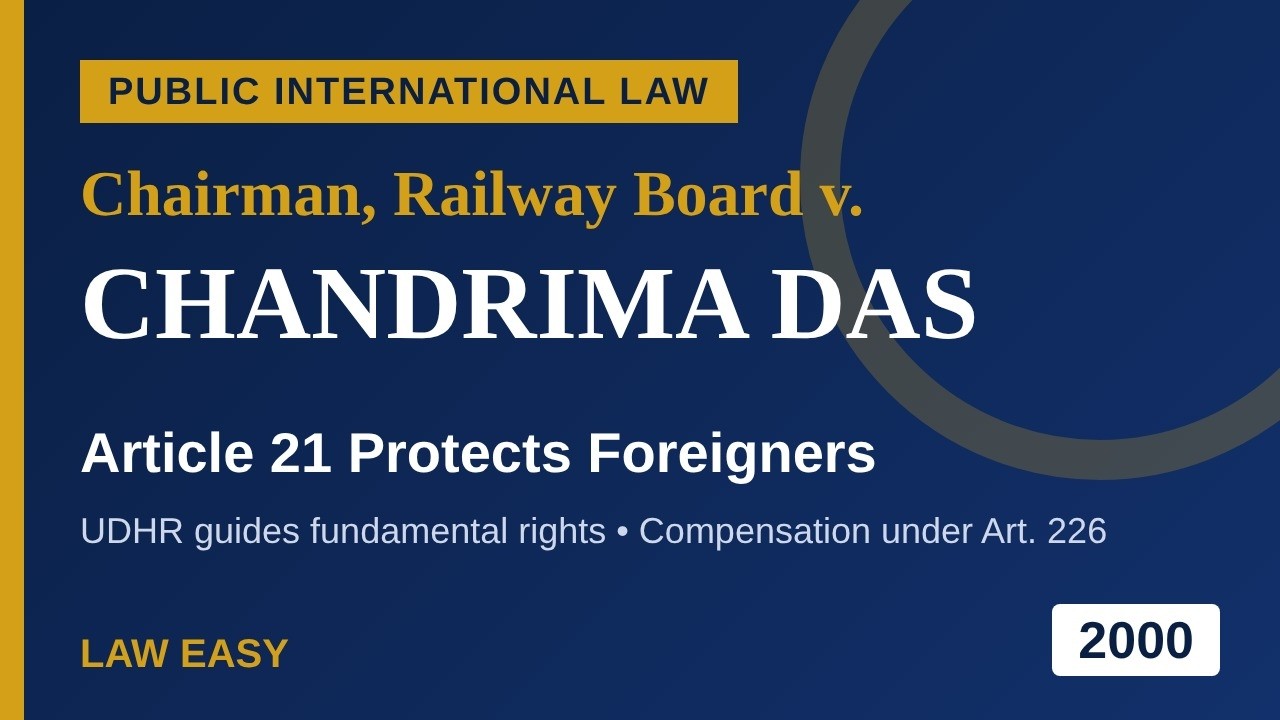
Chairman, Railway Board v. Chandrima Das (2000) explained in simple language: how the Supreme Court held that the right to life under Article 21 belongs to every person, including a foreign visitor, and upheld compensation under Article 226. Useful for LL.B., CLAT PG, UGC NET Law and judiciary exams.
In this video (case law note for Public International Law):
00:00 Does the right to life disappear when the victim is a foreign visitor?
00:09 Article 21 ("person") and Article 14
00:31 Article 226 and public law relief
00:41 Role of international human rights declarations
01:20 Facts of the case: Hanufa Khatun, Yatri Niwas at Howrah Station, and the petition by advocate Chandrima Das
01:41 Arguments of the Railway Board
01:52 Decision of the Court: Justice Saghir Ahmad, 2000
02:03 Universal Declaration of Human Rights and the UN declaration on violence against women
02:22 Vicarious liability of the Union and compensation under Article 226
02:34 Principle of law: human rights standards guide fundamental rights
03:28 Let us see the example: Renu, a tourist from Bangladesh
03:51 Conclusion: why Chandrima Das still matters
Key points to remember:
- Article 21 protects "persons", not only citizens, so foreign nationals are covered.
- The Calcutta High Court awarded 10 lakh rupees compensation; the Supreme Court dismissed the Railway Board's appeal.
- Public law compensation can be available for violation of fundamental rights.
- International declarations guide the reading of fundamental rights but do not replace the Constitution.
- Not every crime in a public place becomes state liability; there must be a legally sufficient connection with the public authority.
Part of the Public International Law (PIL) series on Law Easy. Watch the full playlist for the complete course, case laws and revision.
Study notes:
https://thelaweasy.com
Subscribe to Law Easy for daily law MCQs, case laws and exam-ready notes.
Disclaimer: This video is for educational purposes only and is not legal advice.
#ChandrimaDas #PublicInternationalLaw #LawEasy