Skip to content
The Law Easy

Case explanation · Constitutional Law II

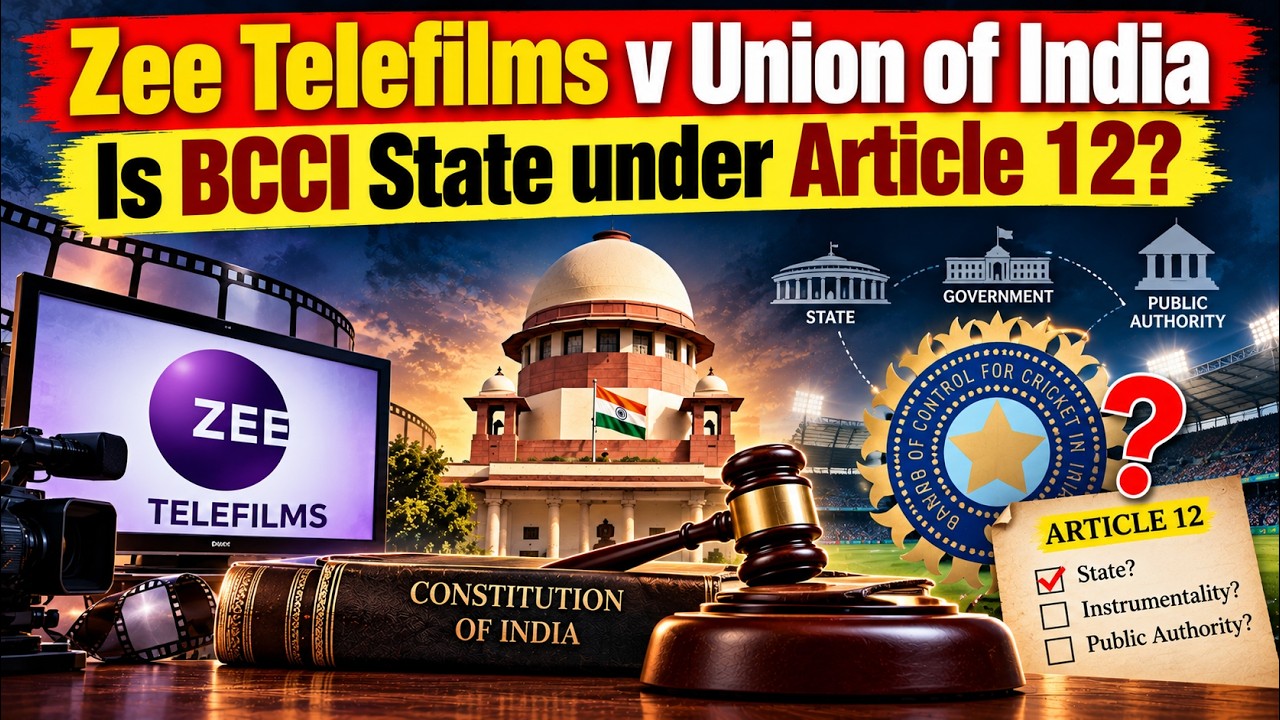
Zee Telefilms v. Union of India

  • 13 min
  • 7 chapters

The lecture loads from YouTube in privacy-enhanced mode only when you press play.

From the YouTube description

About this lecture

In this lecture, we explore the landmark constitutional law case of Zee Telefilms Ltd. v. Union of India. We examine whether the BCCI is an instrumentality of the State under Article 12 and whether writ petitions can be maintained against it under Articles 32 and 226. Understand the factual background, rival contentions, and the critical legal principles laid down by the Supreme Court. In this video you will learn: • Understand the definition and scope of 'State' under Article 12 of the Constitution of India. • Examine whether private bodies like the BCCI qualify as an instrumentality or agency of the State. • Learn the application of the Pradeep Kumar Biswas 6-test criteria for Article 12 determination. • Differentiate writ maintainability against private bodies under Article 32 versus Article 226. • Analyze the arguments surrounding public functions, monopoly status, and Article 19(1)(g). Topics covered: • Introduction to Zee Telefilms Ltd. v. Union of India • Facts of the tender dispute between Zee and BCCI • Definition of 'State' under Article 12 • Maintainability of writ petitions under Article 32 vs Article 226 • Arguments on monopoly and instrumentality of the State • Precedents relied upon (Ajay Hasia, Pradeep Kumar Biswas, etc.) • The 6-test criteria for instrumentality under Article 12 • Public functions performed by private bodies • Alleged violation of Article 14 and Article 19(1)(g) • Key legal takeaways and exam principles Important case laws: • Zee Telefilms Ltd. v. Union of India • Sukhdev Singh v. Bhagatram Sardar Singh Raghuvanshi (1975) • Sabhajit Tewary v. Union of India (1975) • Pradeep Kumar Biswas v. Indian Institute of Chemical Biology (2002) Statutory provisions discussed: • Article 12, Constitution of India, 1950 • Article 32, Constitution of India, 1950 • Article 226, Constitution of India, 1950 • Article 14, Constitution of India, 1950 • Article 19(1)(g), Constitution of India, 1950 Useful for: LL.B. (3-year and 5-year integrated), UGC NET Law, CLAT PG, University semester exams and Judiciary aspirants. Chapters: 00:00 Introduction and Core Legal Question 01:47 Facts of the Tender Dispute 03:36 Issues Before the Supreme Court 05:39 Arguments by the Respondents 07:04 Court's Decision on Article 12 08:51 Monopoly and Article 19(1)(g) 11:19 Summary of Key Legal Principles Notes and study material: https://www.thelaweasy.com #ConstitutionalLaw #Article12 #ZeeTelefilms #LawEasy #JudiciaryExams

Case law

Judgments to read alongside

The written case notes: facts, issues, judgment and the principle to remember.

Case law library

Zee Telefilms

Supreme Court of India · 2005

In Zee Telefilms v. Union of India (2005), a five-judge Constitution Bench of the Supreme Court held, by a 3:2 majority, that the Board of Control for Cricket in India (B.C.C.I.) is not a 'State' under Article 12. So a writ petition under Article 32 is not maintainable against it. However, because B.C.C.I. performs public functions, High Courts can issue writs against it under Article 226. The case is a key part of the Article 12 line of cases that follows Pradeep Kumar Biswas.

Constitutional Law II

Zee Telefilms

Supreme Court of India · 2005

A five-judge Constitution Bench of the Supreme Court held, by a 3:2 majority, that the Board of Control for Cricket in India (B.C.C.I.) is not a 'State' under Article 12, so a writ petition under Article 32 is not maintainable against it. The Court also accepted that B.C.C.I. performs public functions, so High Courts can still issue writs against it under Article 226. The case is a key part of the Article 12 line of cases after Pradeep Kumar Biswas.

Constitutional Law II

Romesh Thappar vs State of Madras

Supreme Court of India · 1950

First, let us understand the basic meaning. Article 19(1)(a) of the Constitution gives every citizen the right to freedom of speech and expression . But does that right stop at merely holding or voicing an opinion, or does it also protect your ability to share and circulate that opinion with others…

Constitutional Law II

Notes

Notes on Constitutional Law II

All notes on this subject
Constitutional Law II Complete notes

Constitutional Law II: Complete Notes

Constitutional Law II deals with civil liberties. It is studied in eight units, from the question of who is a citizen of India to how the Constitution enforces the rights it gives. These rights are at work in ordinary life: when a person speaks his mind online, prays in his own way, or is stopped b…

130 min read

Constitutional Law II Complete notes

Constitution II One Shot

A child born in India before July 1, 1987, automatically acquired Indian citizenship regardless of their parents' nationality.

57 min read

Practise 24 Constitutional Law II MCQs Check what you have learnt with practice questions on this subject.

Video lectures

More on Constitutional Law II

All lectures on this subject

Learn with video

Watch every lecture free on YouTube

Complete courses, landmark case explanations and quick Shorts from The Law Easy channel. Subscribe to get new lectures as soon as they are published.