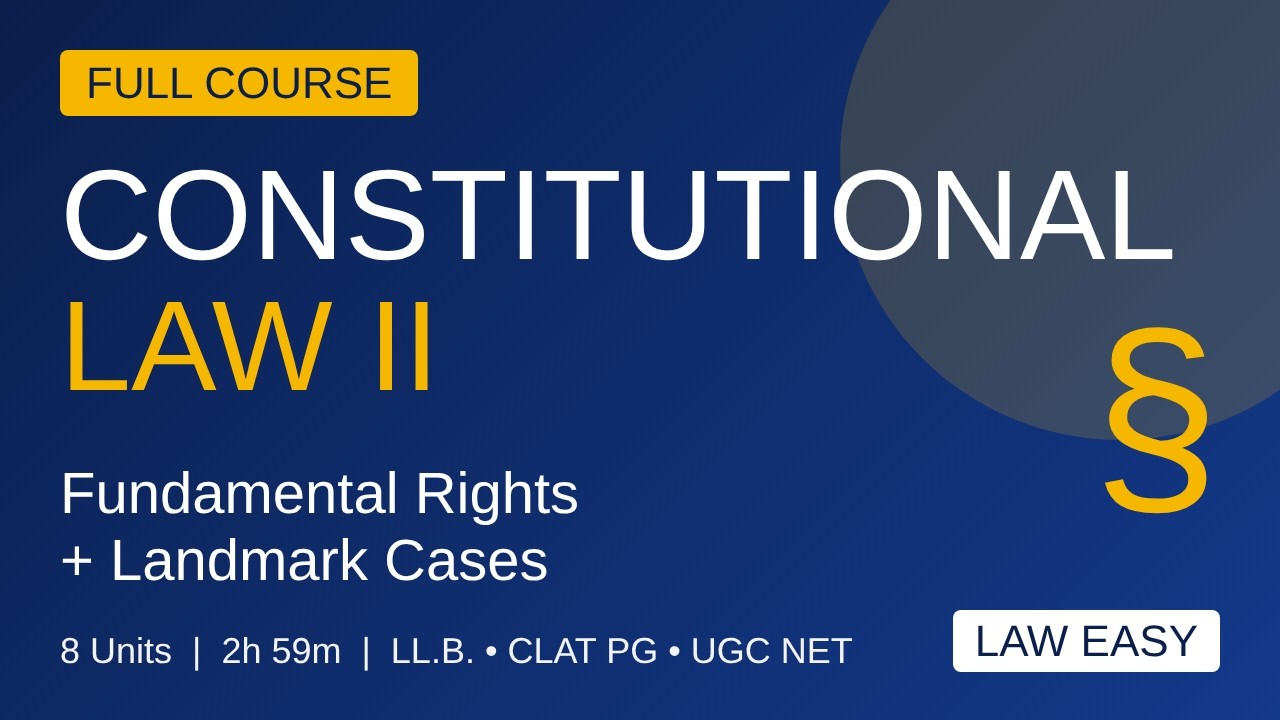
Constitutional Law II in simple English: citizenship, Article 12 (State), Article 13, equality (Articles 14-17), the freedoms in Article 19, life and liberty (Articles 20-24, with Article 21 at the centre), religion, minority rights and constitutional remedies, with the Supreme Court cases you need for exams. Use the chapters below to jump to any topic.
Made for LL.B. students, CLAT PG, UGC NET Law and judiciary aspirants. The course covers Part II (citizenship), Part III (fundamental rights), Part IV (directive principles) and Part IVA (duties). Syllabi differ by university, so check yours. Some matters (CAA 2019, the Hijab case, the Sabarimala reference) were pending when this lecture was prepared; check the latest position before quoting them in an answer.
WHAT YOU WILL LEARN
Unit 1 Citizenship: Articles 5-11, Citizenship Act 1955, Section 6A, OCI, CAA 2019
Unit 2 State and rights: Articles 12-13, eclipse, severability, basic structure, Article 300A, Articles 31A-31C
Unit 3 Equality: Articles 14-17, reasonable classification, arbitrariness, reservation
Unit 4 Freedoms: Article 19, speech, sedition, protest, trade and profession
Unit 5 Life and liberty: Articles 20-24, Article 21A, privacy, preventive detention
Unit 6 Religion: Articles 25-28, essential religious practices, secularism
Unit 7 Minorities: Articles 29-30
Unit 8 Remedies: Articles 32 and 226, writs, PIL, Articles 37, 44, 48, 51A
LANDMARK CASES: Kesavananda Bharati, Maneka Gandhi, Indra Sawhney, Puttaswamy, Shayara Bano, Sabarimala, Shreya Singhal, Navtej Johar, Zee Telefilms, Ajay Hasia, Kedar Nath Singh, Selvi, TMA Pai, Minerva Mills, Bijoe Emmanuel, Hussainara Khatoon and more (see chapters).
Constitutional Law II notes:
https://www.thelaweasy.com/constitutional-law-ii-complete-notes
For Constitutional Law notes and other law study materials, visit:
https://www.thelaweasy.com
Related course: 57 Landmark Constitutional Law Cases
https://youtu.be/VSU0caKdO04
Subscribe to Law Easy for more law lectures, case law explanations, MCQs and study materials.
#ConstitutionalLaw #FundamentalRights #LawEasy
CHAPTERS
00:00 Introduction to Constitutional Law II
00:46 Unit 1: Citizenship and Domicile
03:35 Articles 5-11 and Citizenship Act 1955
08:36 Assam Accord, Section 6A, Sonowal
12:18 OCI and Dual Citizenship
14:18 Citizenship Amendment Act (CAA) 2019
17:48 Unit 2: State and Article 12
19:13 Mohan Lal and Sukhdev Singh Cases
22:03 Ajay Hasia and Biswas Tests
24:22 Is BCCI a State? Zee Telefilms
26:47 Private Actors and Social Media
29:34 Article 13 and Meaning of Law
31:31 Eclipse, Severability and Waiver
35:41 Personal Laws and Article 13
38:01 Golaknath, Kesavananda, Basic Structure
42:39 Right to Property: Article 300A
46:16 Articles 31A-31C and Exceptions
48:45 Unit 3: Equality and Rule of Law
49:43 Article 14: Reasonable Classification
53:11 Arbitrariness: Royappa to Shayara Bano
55:04 Formal vs Substantive Equality
56:27 Articles 15 and 16 Explained
59:42 Backward Classes: Balaji to Mandal
1:01:33 Indra Sawhney Case
1:03:29 Promotions: Nagaraj, Jarnail Singh
1:05:41 50% Ceiling, EWS, Creamy Layer
1:09:43 Reservation and Merit
1:12:05 Article 17: Untouchability
1:15:51 Unit 4: Article 19 Freedoms
1:17:25 Freedom of Speech and Expression
1:19:17 Right to Remain Silent: Bijoe Emmanuel
1:20:47 Article 19(2): Speech Restrictions
1:22:00 Online Speech, IT Rules, Fake News
1:24:24 Shreya Singhal: Section 66A
1:26:03 Obscenity and Religious Feelings
1:29:01 Sedition: Kedar Nath, B.N.S. 152
1:31:51 Right to Protest: Shaheen Bagh
1:33:59 Association, Movement, Trade, Profession
1:39:19 Unit 5: Life and Personal Liberty
1:39:54 Article 20: Ex Post Facto, Double Jeopardy
1:43:01 Self-Incrimination and Selvi Case
1:45:57 Article 22: Arrest, Preventive Detention
1:49:52 Article 21: Gopalan to Maneka Gandhi
1:52:18 ADM Jabalpur, Dignity, Right to Die
1:54:48 Right to Privacy: Puttaswamy
1:57:06 Sexual Autonomy: Navtej, Joseph Shine
2:01:56 Live-in, Marriage, Bodily Autonomy
2:04:41 Data Protection and Surveillance
2:08:39 Animal Rights and Jallikattu
2:09:46 Articles 23-24: Exploitation
2:13:59 Right to Education: Article 21A
2:15:33 Unit 6: Religion, Articles 25-28
2:18:04 Essential Religious Practices Test
2:20:05 Shayara Bano: Triple Talaq
2:21:58 Hijab Case: Aishat Shifa
2:23:14 Article 26 and Sabarimala Case
2:26:10 Waqf Amendment Act 2025
2:27:16 Conversion Laws and Secularism
2:32:55 Unit 7: Minority Rights, Articles 29-30
2:34:38 Who Is a Minority? Kerala Education Bill
2:37:21 TMA Pai and Inamdar Cases
2:40:38 Aligarh Muslim University Case
2:43:10 Unit 8: Remedies, Article 32
2:44:24 Article 32 vs Article 226
2:46:29 Five Writs Explained
2:49:17 Public Interest Litigation (PIL)
2:51:33 Directive Principles of State Policy
2:53:48 Uniform Civil Code and Article 48
2:56:34 Fundamental Duties: Article 51A
2:57:57 Exam Problem and Conclusion